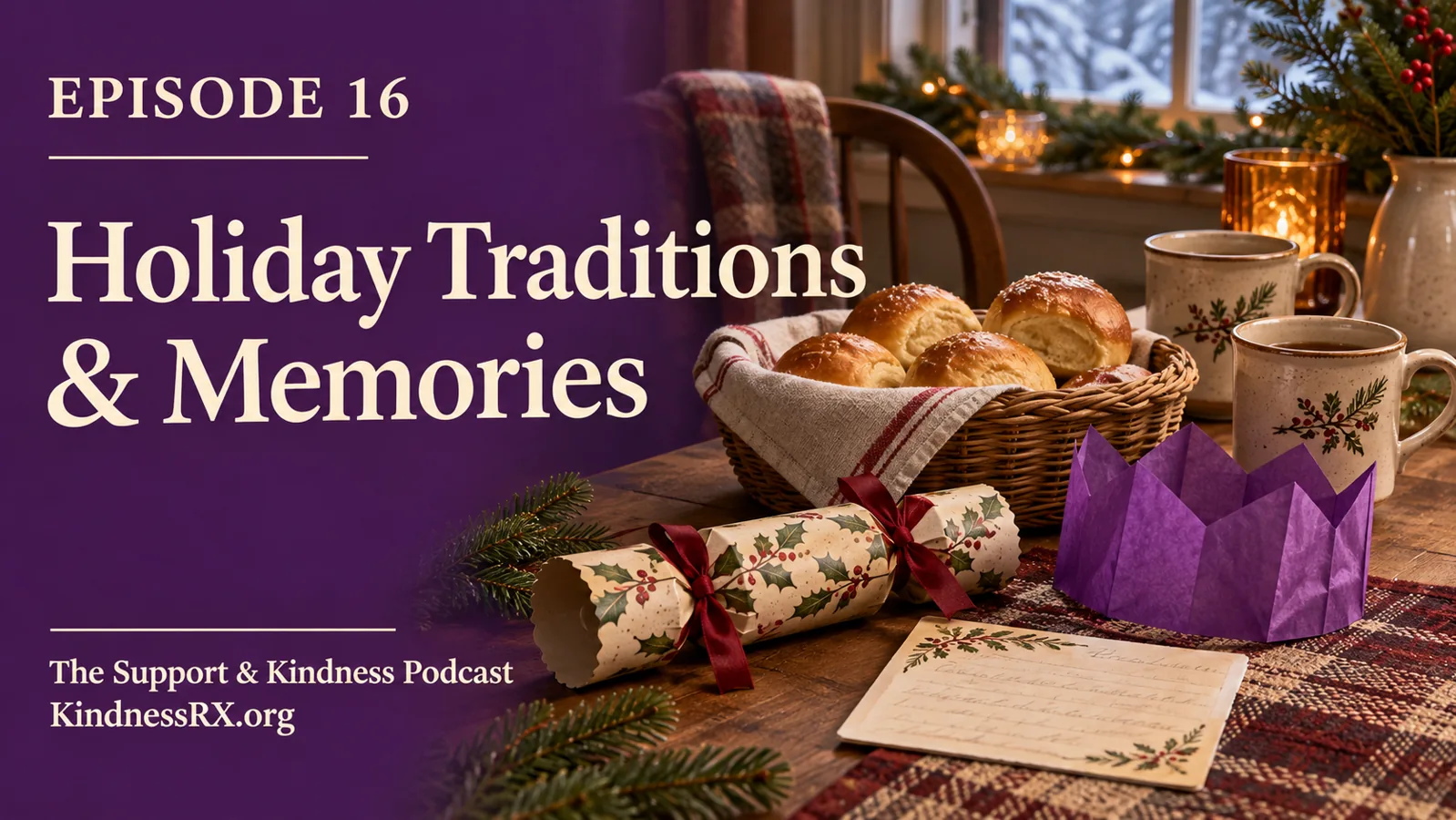
Episode 16: Holiday Traditions and Memories
Some holiday memories live in the smallest things.
A dinner roll. A paper hat. A song that comes on while you are doing something else. For a moment, you are back in a room with people you miss.
That can feel lovely. It can hurt, too.
In Episode 16 of The Support and Kindness Podcast, Greg, Rich, Jay and Derek talk about holiday traditions and memories. We share the food, music and family moments that stayed with us. We also talk about what happens when those moments cannot happen in the same way again.
This companion goes further into the research and offers some small ways to make the season fit your life now.
The main idea: A tradition is something you repeat because it matters to you. It can change as your health, family, money or needs change. Keeping the meaning does not mean keeping every task.
Content note: This episode and article include grief, family changes and seasonal mental health. They share lived experience and general information, not medical advice.
Listen to Episode 16
For another seasonal conversation, listen to Episode 13: Holiday Stress.
Find more conversations on our podcast listening page.
What our holiday memories have in common
Our stories are different. Yet there is a thread running through them: we remember how it felt to be there.
Rich describes years of holiday gatherings with his wife’s family. What matters most is the ease of it. People come together without a fight over who made which dish or when the food will be ready. There is room to enjoy one another.
That is a useful thing to notice. A meal can be simple and still leave a strong memory. An expensive celebration can leave people worn out. The feeling around the table matters.
Jay remembers being at his grandparents’ house with a small group of family. The food matters, but so does the sense of being together before loss and other changes reshaped those days.
Derek recalls music, food and relaxed time on Christmas Eve. He also remembers the strain of travelling because it was expected. Both things belong in the story. A holiday can contain warmth and duty at the same time.
Greg remembers Christmas crackers, the little paper hats inside them and everyone pulling a cracker with someone else. It was a small shared act. You did not need to be good at it. You just joined in.
You might recognise your own version of that. It could be a greeting, a joke or the same film every year. A ritual does not have to impress anyone to count.
Why holiday traditions and memories can feel so strong
Nostalgia is that pull towards a meaningful part of the past. It often involves people, places and moments that help us feel connected to our own story.
A research paper reporting six experiments explored nostalgia and a sense of continuity between past and present. The findings suggest that nostalgia can support that connection, with social connectedness playing a role. These experiments do not show that every memory helps every person, or that nostalgia treats grief or depression.
In daily life, the question is simpler: does this memory help you feel held, or does it leave you feeling worse right now?
You do not have to force yourself to look at old photographs. You can enjoy one song and skip the rest of the playlist. You can put a keepsake away and come back to it another day.
Memories can be mixed. Missing a person does not mean every part of the relationship was easy. Enjoying a new holiday does not erase the old one. You can make space for more than one feeling.
Food can hold a whole family story

Rich’s grandmother made dinner rolls known as Ruth’s Rolls. They were a special-occasion food, and sometimes a birthday treat. He remembers them with real warmth. He also wonders whether someone in the family still has the recipe.
Jay’s memories include corn pudding and shrimp dip. Some of those dishes are still made, even though the family gatherings have changed.
Derek’s food memories include dips, cookies and crepes. The conversation is full of ordinary food carrying a great deal of meaning.
If a food memory matters to you, there are ways to keep it without taking on a full holiday meal:
- Ask someone for one recipe, with no pressure to find it straight away.
- Record a short voice note about who used to make it.
- Make a small batch, or ask someone to cook alongside you.
- Write down the story even if the recipe is lost.
- Choose a simpler version that suits your budget and energy.
Food needs can change. Chewing or swallowing difficulties, allergies, pain and other health needs may make an old dish harder to manage. A soft version, a different ingredient or simply sharing the memory may fit better. Follow any food or swallowing guidance your own care team has given you.
You do not owe anyone a meal that leaves you unwell. The care behind a dish can survive a change in the recipe.
And if the first try tastes different, that is all right. You are making something in your life now. It does not have to pass a test against the past.
The holidays can be joyful and stressful
An American Psychological Association poll released in 2023 surveyed 2,061 U.S. adults. Forty-one percent said their stress increased during the holiday season. Fifty-eight percent named money as a source of holiday stress, and 72% agreed that the season can feel bittersweet. These are survey findings from that year, not a diagnosis or a prediction about your holiday.
There is room for those mixed feelings in this episode. We can love a tradition and feel tired by it. We can want company and need quiet. We can miss an old gathering while knowing we cannot recreate it.
Try asking what is creating the pressure. Is it the cost? The journey? A crowded room? The fear of upsetting someone?
Once you name the strain, you can make a more useful change. For ideas about taking one thing at a time, read our article on what to do when you feel overwhelmed.
Keep it, change it or pause it
Before adding a new tradition, take a look at the ones already on your list. You can use three simple choices.
Keep
Choose something that still brings meaning and is manageable. Perhaps it is putting up one decoration or calling a friend on the same evening each year.
Ask: What part of this would I miss?
Change
Keep the part you value and adjust the work around it. A large meal might become soup with a friend. A long journey might become a short video call. A late-night gathering might move to lunchtime.
Ask: What would make this fit my life now?
Pause
Some things need a rest. You can skip decorating this year. You can decline a gathering. You can leave a box of memories closed.
Ask: What would I feel relieved to leave off the list?
A pause does not need to be a decision for the rest of your life. You can review it next year, or next week.
If money is shaping your choices, our Cost of Survival episode companion offers another conversation about financial pressure. A caring holiday should leave room for the bills you still have to pay afterwards.
When someone is missing
Grief can make familiar dates feel different. There may be someone you want to call and cannot. There may be a chair you notice before you notice anything else.
In the episode, Derek speaks about valuing time with his father. Jay talks about changes in his family and his gratitude for the time they still have. These are personal reflections from the recording, not updates about their lives today.
The Dougy Center’s holiday grief guidance encourages making room for different needs and choices. People in the same family may want different things. One person may want familiar customs, while another needs a change. There is no single plan that works for everyone.
You might keep one gentle way to remember someone. Say their name. Tell a short story. Put on a favourite song. Use a battery candle. Or have a quiet moment that nobody else needs to see.
You can also decide that remembrance feels too much today. That does not measure your love.
If you are supporting someone who is grieving, offer something clear and easy to answer. You might ask whether they would like a short call, a meal left at the door or some quiet company. Leave space for no.
Avoid making them explain their grief to earn your care. A steady, kind check-in can matter even when there is no reply.
Chosen family and being on your own
Jay makes space in the conversation for family beyond blood ties. The care between friends can become a real part of holiday life.
That matters because being surrounded by relatives is not the only way to feel connected. It is also possible to feel lonely in a full room.
A KFF report published in 2024, using a 2023 survey of 6,292 U.S. adults, found that 15% felt lonely always or often in the past year. This was reported by 31% of adults aged 18–29 and 23% of adults with household income below $40,000. These figures describe loneliness generally. They are not holiday-specific rates.
If you are spending the day alone, you can still choose a shape for it. Plan one meal, one point of contact and one thing that feels gentle. That might be a film, a game, a radio programme or a few minutes at the window.
You do not have to make the day feel special. You can aim for manageable.
If you would like peer connection, see our free online support groups. The current page has details and sign-up information. Peer support can offer company and understanding, but it does not replace professional or crisis care.
Make room for pain, fatigue and sensory needs
Some holiday plans assume that everyone can travel, stand, cook, hear over a busy room or stay late. Many of us cannot.
You can make the needs part of the plan from the start. Ask about steps, seating, toilets and transport before the day. Agree on a finish time. Keep a quiet place available. Let people join by phone or leave early without a speech about it.
If loud crackers or flashing lights are uncomfortable, choose a quiet version. If scents cause problems, skip scented candles. If a whole film is too much, watch one favourite scene. If a walk is not possible, sit near an open window when weather and health allow.
For gatherings, give people useful details in advance. Knowing who will be there, what food is available and how long things may last can make planning easier.
Our Understanding Fibromyalgia companion is another place to explore life with symptoms that other people may not see.
Rest does not have to be the reward at the end of a celebration. It can be built into the celebration.
A few traditions from the episode’s world tour
Greg opens with customs from several places and faiths. They have their own histories and meanings. They do not all fall in winter everywhere, and some festivals mentioned in the episode happen in other seasons. Shared themes of light or gathering do not make the traditions interchangeable.
Here are four places to learn more:
- Lucia in Sweden: Visit Sweden explains the December 13 celebration, songs, processions and saffron buns.
- Mari Lwyd in Wales: Museum Wales explores the decorated horse figure and singing custom. Practice varies by place and group.
- Krampus: The Library of Congress traces the history and development of this winter folklore figure.
- Christmas KFC in Japan: KFC’s own history describes the 1974 campaign. It is a reminder that a familiar custom can have a fairly recent start. This is a brand account of its own campaign.
You can enjoy learning about a custom without assuming that everyone from that place follows it. Ask people about their own experience. Let their answer be more interesting than a list of facts.
Music, stories and further watching
Greg names “Fairytale of New York” by The Pogues featuring Kirsty MacColl, and “Do They Know It’s Christmas?” by Band Aid. Jay talks about holiday films and a playlist of older Christmas songs.
Read more about Fairytale of New York on Kirsty MacColl’s official site and Band Aid’s recording at Official Charts.
You could make a short playlist with a friend. Pick three songs each. Add a sentence about why you chose them. There is no need to agree on the music.
For further reflection, these official TED talks connect with themes in the episode:
- Nora McInerny: We don’t “move on” from grief. We move forward with it.
- Robert Waldinger: What makes a good life? Lessons from the longest study on happiness
These are optional further viewing. You do not have to turn a difficult day into a lesson.
This week’s small kindness challenge
Choose one action that fits the energy and money you actually have.
- Pick something you want to keep, change or pause.
- Make it small enough to do without a long recovery afterwards.
- If it involves another person, ask rather than assume.
- Afterwards, notice how it felt. Keep it, adjust it or leave it there.
You might send a message about a good memory. Ask for a recipe. Share a song. Make one simple dish. Or give yourself permission to rest.
If another person comes to mind, try a specific invitation: would they like a ten-minute call sometime this week? A small invitation with room to decline can feel easier than a large open-ended plan.
Common questions
Is it wrong to stop a family tradition?
No. You can care about your family and still change what you do. Explain the part you can manage, if you want to. You do not need to argue that your needs are serious enough.
Can I start a tradition on my own?
Yes. A tradition can be personal. A yearly letter to yourself, a favourite meal or a quiet moment can have meaning without an audience.
What if a memory makes me sad?
You can step away from it. Sadness does not mean the memory is bad, but you do not have to stay with it for longer than feels useful. Reach out for support if you need it.
Are holiday sadness and seasonal depression the same?
No. Seasonal affective disorder is a form of depression with a recurring seasonal pattern. It is different from feeling sad about a holiday. The National Institute of Mental Health explains symptoms and care. If mood changes persist or affect daily life, talk with a health professional.
Support and resources
You deserve support even if other people seem to be enjoying the season.
- KindnessRX: Peer support groups and more podcast episodes.
- Grief: Dougy Center offers grief information and resources.
- Mental health information and referrals: NAMI HelpLine. Check its page for current service hours. It is not a crisis line.
- Treatment referrals: SAMHSA National Helpline, 1-800-662-HELP.
- Local practical help in the U.S.: 211 can help you find food, housing and other community services.
- U.S. crisis support: Call or text 988, or visit the 988 Suicide & Crisis Lifeline. If there is immediate danger, call emergency services.
- Outside the U.S.: Find A Helpline lists support by country.
You are allowed to simplify. You are allowed to miss people. You are allowed to enjoy a small good thing while life is still hard.
What is one holiday tradition you want to keep, change or pause? If you feel comfortable sharing, we would love to hear about it.
More cultural links from the episode
These resources expand on the recording’s world tour. Customs differ by family, region, faith, and calendar. Some are folklore or superstition. The Norway link gives general cultural context; widespread present-day broom hiding was not verified. The Caracas source documents community skating celebrations, rather than a universal practice of skating to Mass.
- Yule and winter celebrations: City of Oslo: Christmas in Norway
- Saturnalia: Getty Museum: The Wild Holiday That Turned Ancient Rome Upside Down
- Christmas trees and the royal family: Royal Collection Trust: A Royal Christmas
- Las Posadas: Government of Mexico: Las posadas mexicanas
- Hanukkah: National Library of Israel: Hanukkah
- Diwali: Smithsonian National Museum of Asian Art: Diwali
- Lunar New Year: Smithsonian National Museum of Asian Art: Lunar New Year
- Nian: Asian Art Museum: Nian the Beast
- Hogmanay and first-footing: Scotland.org: Hogmanay
- Spain's twelve grapes: Spain's official tourism site: New Year's Eve
- Czech shoe tossing: VisitCzechia: Czech Christmas Traditions
- Bonfire Night: UK Parliament: Gunpowder Plot FAQs
- Guatemala's Quema del Diablo: Government of Guatemala: Quema del Diablo
- Día de los Muertos: UNESCO: Indigenous festivity dedicated to the dead
- Obon: Japan National Tourism Organization: Japan in August
- Greek Christmas goblins: Visit Greece: Christmas Holidays in Greece
- Oaxaca's Night of the Radishes: Mexico's Secretariat of Culture: Noche de Rábanos
- Caracas Christmas skating: Venezuela's Culture Ministry: community Christmas celebrations
- Norway's hidden brooms: Visit Norway: Christmas in Norway
- Feast of the Seven Fishes: Denver Public Library: What's the Meaning of the Feast of Seven Fishes?
Research and further reading
- APA: Even a joyous holiday season can cause stress for most Americans, 2023 poll.
- KFF: Loneliness and social support networks, 2024 report using a 2023 survey.
- Nostalgia and self-continuity research, PubMed record.
- Dougy Center: Getting through the holidays.
- NIMH: Seasonal affective disorder.
Episode stories come from the uploaded Episode 16 transcript. Research and practical suggestions expand on the conversation and are not presented as statements made by the panel.