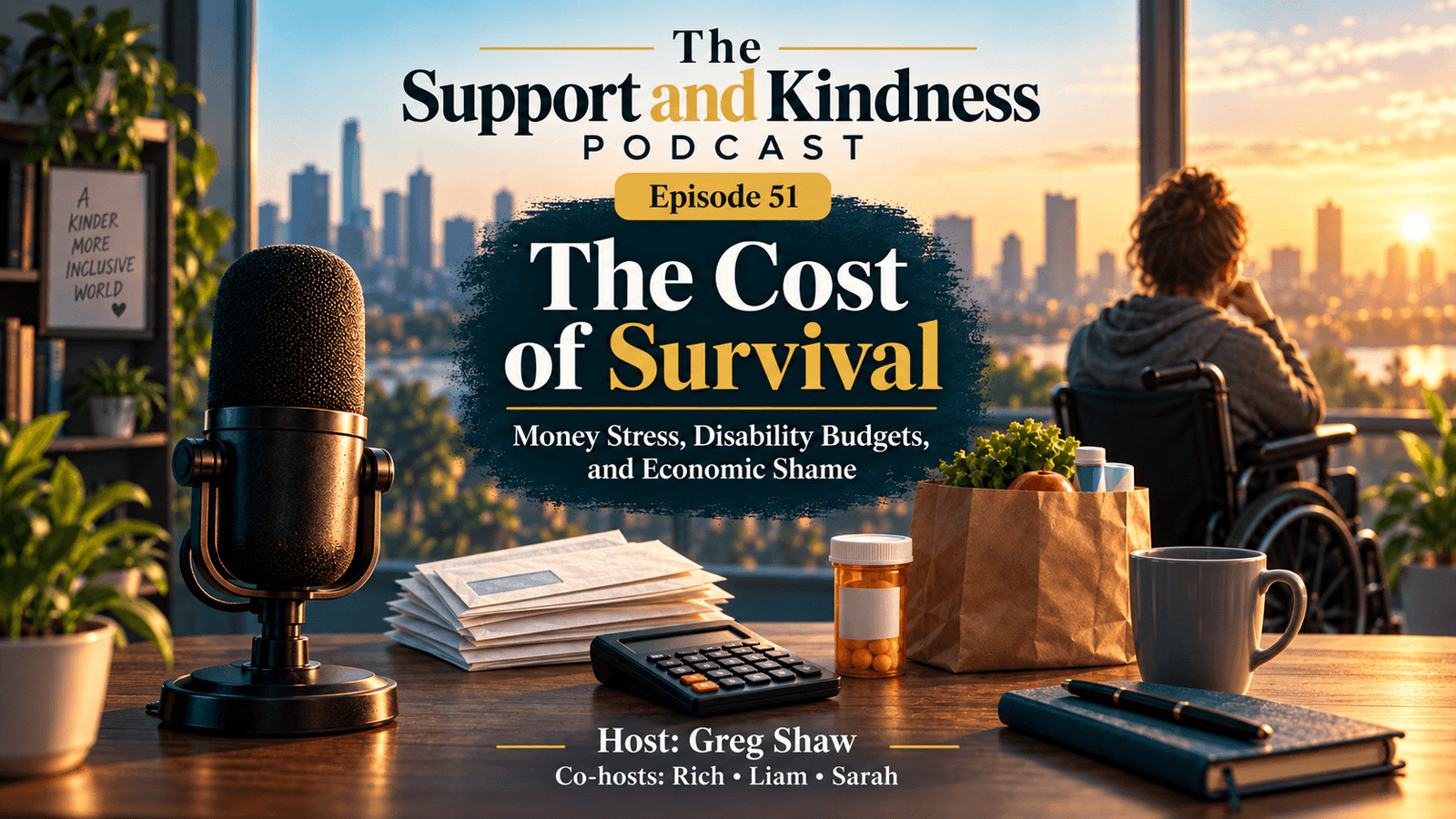
Episode 51: The Cost of Survival
When Disability Makes Survival More Expensive
A companion article to Episode 51 of The Support & Kindness Podcast: “The Cost of Survival.”
A budget can look reasonable on paper and still fail in real life.
Most financial advice assumes you can take public transportation, shop around for the best prices, carry bulk purchases home, cook meals from scratch, compare products, and complete paperwork whenever it is needed. For many disabled people, those assumptions are not realistic.
The lower-cost apartment may have stairs. The grocery store with the best prices may not offer delivery. Cooking may require energy, balance, concentration, mobility, or pain tolerance that is unavailable that day. A two-dollar bus ride can become a twenty-five-dollar rideshare when accessible transportation falls through.
That is not poor planning. It is part of the added cost of living with disability.
Episode 51 of The Support & Kindness Podcast, “The Cost of Survival,” brings those costs into the open. Greg, Rich, Liam, and Sarah discuss money stress without turning it into a lecture about personal responsibility or willpower. Their conversation is about finances, but it is also about access, energy, benefits, isolation, dignity, and the right to enjoy small parts of life.
Disability Can Raise Costs While Reducing Income
Disability can limit income, but the financial impact goes much further. It may raise the cost of transportation, food, housing, medical care, household tasks, and time.
A 2020 National Disability Institute analysis estimated that households with an adult whose disability limits their ability to work may need about 28% more income to reach the same standard of living as comparable households without a disabled adult.
Those costs do not always appear clearly in a monthly budget. They can include:
- Higher transportation costs when accessible transit is unavailable
- Grocery delivery fees that prevent a fall, symptom flare, or exhaustion
- Prepared foods needed on days when cooking is not possible
- Higher housing costs because accessible apartments are scarce
- Utility costs related to medical equipment, heating, cooling, or being home more often
- Household tools that make routine tasks safer or manageable
- Clothing, shoes, mobility items, and personal care needs that get delayed because essentials come first
A lower price is not always a lower cost if getting that item requires more physical or mental capacity than someone has.
The Cheapest Choice May Be Out of Reach
Buying in bulk can save money only if a person has cash available up front, space to store items, transportation home, and the strength to manage them.
Cooking from scratch can cost less only if someone can stand safely, prepare ingredients, stay focused, wash dishes, and recover afterward. Public transportation may be affordable only if the route is accessible, reliable, safe, and workable with a person’s symptoms and mobility needs.
What looks like a convenience expense to someone else may be an access expense for the person paying it.
The same is true with food. According to the USDA Economic Research Service, 33.9% of U.S. households with an adult out of the labor force due to disability were food insecure in 2023, compared with 10.5% of other households.
For people living on a fixed income, groceries often require constant tradeoffs:
- Specialty foods, including gluten-free options, can cost much more.
- Food benefits may not cover toiletries, cleaning supplies, paper towels, or toothpaste.
- Fresh food may be expensive, difficult to transport, and harder to prepare.
- A prepared meal may cost more but be the only realistic way to eat on a high-pain day.
- Rent, utilities, and medical expenses may take most of a monthly check before groceries are considered.
The issue is not whether people understand that healthy food matters. The issue is whether they can afford, access, carry, store, prepare, and eat it.
Energy Belongs in the Budget
Money is not the only limited resource. Pain, fatigue, memory, concentration, balance, mobility, and emotional stamina all shape what can happen in a day.
A refrigerator full of groceries does not guarantee someone has the energy to cook. A simple meal can take hours when standing is painful, brain fog is severe, or someone is recovering from a seizure, migraine, injury, treatment, or medical appointment.
That is why practical accommodations matter. The episode includes examples such as:
- Using a slow cooker so food can cook while a person rests
- Keeping a chair or rolling cart in the kitchen for people who cannot stand for long
- Placing supplies near where they are used to reduce unnecessary walking
- Breaking tasks into one manageable step per day
- Protecting energy for medical appointments, essential calls, and errands
These are not luxuries. They are everyday adjustments that make life possible when a body does not offer the same amount of energy every day.
A budget that leaves out energy is incomplete.
SSI, SSDI, and Why Saving Can Feel Risky
One of the most difficult parts of disability-related financial stress is that benefits can come with rules that make ordinary decisions feel dangerous.
SSI and SSDI have similar names, but they are different programs.
Social Security Disability Insurance (SSDI)
SSDI is based on a person’s work history and Social Security contributions. Eligibility depends on having enough qualifying work credits and meeting Social Security’s definition of disability.
Learn more through the Social Security Administration.
Supplemental Security Income (SSI)
SSI is a needs-based program for people with limited income and resources who meet disability, blindness, or age requirements.
In 2026, the maximum federal SSI payment is:
- $994 per month for an eligible individual
- $1,491 per month for an eligible couple
Actual payments may be lower based on income, living arrangements, and other circumstances.
SSI also has countable-resource limits of:
- $2,000 for an individual
- $3,000 for a couple
Those limits have not changed since 1989, despite decades of increases in rent, food, utilities, and basic living costs.
The term countable resources is important. Some property is excluded from the calculation, such as the home a person lives in, one vehicle per household in many situations, and most personal belongings. Review current details through SSA SSI Resources.
Before changing work hours, accepting a large gift, receiving a settlement, moving money into savings, opening a new account, or changing living arrangements, get information that fits your specific circumstances. A general answer online may not apply to your benefits case.
ABLE Accounts Can Help Eligible People Save
For eligible people, an ABLE account may make it possible to save and invest money for qualified disability-related expenses without immediately losing eligibility for certain means-tested benefits, including SSI and Medicaid.
Under SSI rules, up to $100,000 in an ABLE account may be excluded from SSI resource calculations. Rules about eligibility, deposits, distributions, and other benefits still apply.
ABLE funds may be used for qualified disability expenses, including:
- Housing
- Transportation
- Education
- Assistive technology
- Health care
- Personal support services
- Financial management
- Legal fees
- Other disability-related living expenses
Read the Social Security Administration’s ABLE Account Spotlight and consider speaking with a qualified benefits counselor before opening an account or transferring funds.
Get Benefits Counseling Before Making Work Changes
A raise, new job, extra work hours, side income, settlement, or change in living arrangements may help in the short term while creating questions about benefits, health coverage, reporting requirements, and potential overpayments.
The Social Security Administration’s Ticket to Work program includes Work Incentives Planning and Assistance (WIPA) services. WIPA provides free, individualized benefits counseling for eligible people who receive Social Security disability benefits and are considering work.
A benefits counselor can help explain how work may affect:
- SSI or SSDI payments
- Medicaid or Medicare
- Resource limits
- Reporting obligations
- Work incentives
- Long-term financial planning
Use the Ticket to Work “Find Help” tool before making a major work or benefits decision whenever possible.
Poverty and Employment Data Show the Larger Problem
Disabled people are not struggling because they are unwilling to work or incapable of managing money. The available data show large structural gaps.
According to the 2026 Annual Disability Statistics Compendium, 23.6% of working-age disabled adults were below the poverty line in 2024, compared with 9.6% of adults without disabilities.
Employment figures point to the same imbalance. The U.S. Bureau of Labor Statistics reported that in 2025:
- The employment rate for people with disabilities was 22.8%.
- The employment rate for people without disabilities was 65.2%.
- The unemployment rate for people with disabilities was 8.3%.
- The unemployment rate for people without disabilities was 4.1%.
For many disabled workers, jobs can be difficult to find, inaccessible, physically unsustainable, unstable, or incompatible with fluctuating symptoms. Benefits may feel more reliable than the labor market even when those benefits are not enough to cover basic needs.
That caution is not laziness. It is math.
Shame Makes a Hard Budget Harder
Financial strain often comes with a character judgment. Low income is treated as proof of laziness, bad choices, or a lack of discipline, rather than the result of limited income meeting rising costs and inaccessible systems.
People may be told to “budget better” without anyone asking:
- Is public transportation accessible and reliable?
- Can they physically carry groceries?
- Is their home safe and workable for cooking?
- Are symptoms unpredictable?
- Do they have dietary restrictions or medical needs?
- Are they managing paperwork, insurance calls, or benefit requirements?
- Are they avoiding social plans because they cannot afford to split the bill?
Money stress is difficult enough. Shame makes it heavier.
Work is also closely tied to identity in American culture. “What do you do?” may be casual conversation for one person but painful for someone whose illness, injury, or disability changed their career.
Income may drop at the same time that health-related costs rise. A person may also lose routine, social contact, confidence, and a familiar role in their family or community.
No lecture about coffee, haircuts, or streaming subscriptions solves those losses.
Small Comforts Are Not Evidence of Fraud
People receiving assistance are often expected to look unhappy enough to prove that they deserve support.
A haircut, a new pair of shoes, a streaming subscription, lunch with a friend, a birthday gift, or an afternoon at the pool can attract suspicion. The unspoken expectation is that anyone receiving help should give up every comfort in order to prove they are struggling.
That expectation causes real harm.
A streaming subscription may be one of the few ways someone who cannot go out often feels connected to the world. A haircut may support self-respect after illness changes someone’s appearance or routine. A modest outing may preserve a friendship that is already under strain from pain, fatigue, or isolation.
One enjoyable purchase does not explain a structural shortage. Outsiders rarely know the full picture, and they are not owed one.
As Rich says in the episode:
“I don’t know why we demonize the most vulnerable among us, when their impact is absolutely negligible.”
A person being judged for a haircut or a small pleasure is not responsible for the policies, prices, or systems that make survival expensive. But judgment still takes something real: dignity, connection, and the energy required to keep defending ordinary human needs.
Asking for Help Without Giving Up Privacy
Asking for help can feel like admitting defeat, especially for people who have been taught to measure adulthood by independence and income.
Specific offers are often the most respectful form of support.
Instead of saying, “Let me know if you need anything,” offer one concrete option:
- “I am going to the grocery store Thursday. Can I pick up a few things?”
- “Would a ride to your appointment help?”
- “Do you want company while you make that phone call?”
- “I made extra food. Would you like me to bring some over?”
- “I can help sort mail for thirty minutes this weekend.”
- “Would it help if I sat with you while you fill out that form?”
Specific offers reduce the pressure on the person who needs help. They do not have to disclose every detail, prove that they deserve assistance, or guess what support is available.
They can say yes, no, or suggest another option.
For local assistance with food, housing, transportation, utility bills, and other needs, visit 211.org.
Try a Five-Minute Check-In
If financial stress feels overwhelming, begin with facts rather than self-criticism.
Set a timer for five minutes and write down three things that are true about your current situation.
For example:
- “The electric bill is due Friday.”
- “I have enough medication through next week.”
- “I need help reading one letter.”
- “I have food for two more days.”
- “I need to call about transportation.”
Then finish this sentence:
One thing that might make this 5% easier is…
The answer can be small:
- Find one official phone number
- Put one document beside the form
- Text one trusted person
- Ask for one ride
- Move one task to tomorrow
- Rest before making the next decision
A small step does not solve a structural problem. It can make the next hour or next day more manageable.
Support and Resources
If disability, chronic pain, brain injury, mental health challenges, or money stress have left you feeling alone, KindnessRX offers free, confidential, online peer-led support groups each week:
- Brain Injury Support: Mondays, 1:00–2:00 p.m. Eastern
- Chronic Pain Support: Tuesdays, 12:00–1:00 p.m. Eastern
- Mental Health Support: Wednesdays, 7:30–8:30 p.m. Eastern
For current information and RSVP details, visit kindnessrx.org/groups.
These groups do not replace therapy, medical care, professional financial advice, or crisis services. They offer space to speak honestly, listen without judgment, and take the next step with people who understand.
If you are in emotional distress or thinking about suicide, call or text 988 in the United States, or visit the 988 Suicide & Crisis Lifeline.
The Point Is Not Perfection
Disabled people should not have to prove hardship by giving up every comfort, moment of connection, or source of joy.
Financial stress is not always a budgeting failure. It is often what happens when fixed income meets rising costs, inaccessible services, unpredictable health, and benefits rules that make saving feel unsafe.
The goal is not perfect self-sufficiency. The goal is enough safety, access, food, rest, dignity, and support to make the next step possible.
Listen to Episode 51, “The Cost of Survival,” on Spotify
Sources & further reading
• CDC: Disability Impacts All of Us
• National Disability Institute: The Extra Cost of Living with a Disability
• 2026 Annual Disability Statistics Compendium
• USDA ERS: Food Security in the U.S.
• Federal Reserve: Survey of Household Economics and Decisionmaking (SHED)
• Social Security Administration: 2026 SSI Federal Payment Amounts
• Social Security Administration: SSI Resources
• Social Security Administration: ABLE Account Spotlight
• Social Security Ticket to Work: Find Help (WIPA)
• U.S. Bureau of Labor Statistics: Persons with a Disability, 2025
• Crisis support: 988 Suicide & Crisis Lifeline