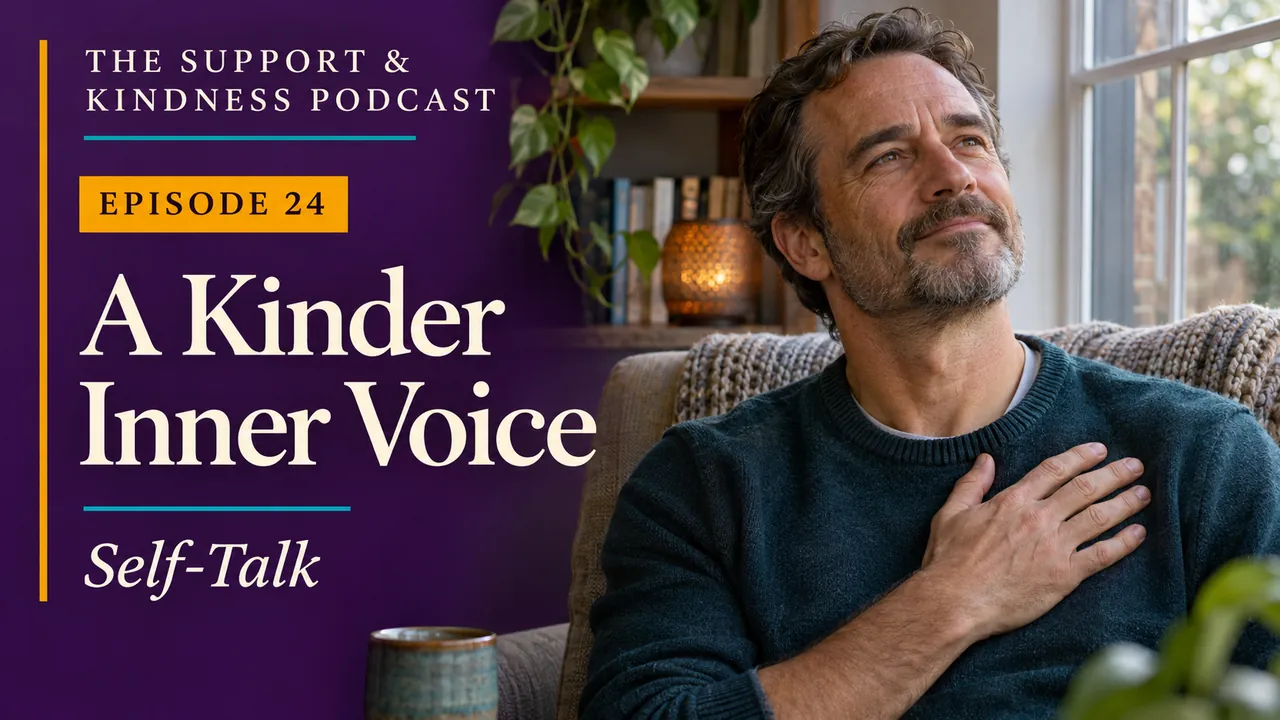
Episode 24: Self-Talk and a Kinder Inner Voice

You make one mistake. Before you can put it right, the voice in your head has already passed judgment.
“You always do this.”
“Everyone else can cope. Why can’t you?”
“You should be doing more.”
If that sounds familiar, this episode is for you. Self-talk is the way we speak to ourselves, silently or out loud. It can help us plan, learn, and get through a hard task. It can also turn one bad moment into a harsh story about who we are.
In Episode 24 of The Support and Kindness Podcast, Greg Shaw joins Rich, Jay, and Derek to talk about that inner voice. They share what self-criticism feels like, where it can come from, and what helps them respond with more care.
This companion adds research and practical ideas to their lived experience. You do not have to love every thought you have. You can start by answering one of them more fairly.
Listen to Episode 24
Prefer to browse first? Visit our podcast listening page.
A quick note: This article shares general information and peer experience. It is not medical advice or a substitute for care from a qualified professional.
What is self-talk?
Self-talk includes the words you use to guide yourself through life. It might be a quiet reminder to take your keys. It might be a pep talk before a phone call. It might be a sharp comment after you forget an appointment.
People experience thought in different ways. You do not need to hear a constant inner narrator to use these ideas. You can try a written sentence, a spoken reminder, or a simple prompt on your phone.
The useful question is less about how much you talk to yourself and more about what that talk does. Does it help you see the next step? Does it leave room for the full story? Or does it label you as a failure before you have had a chance to respond?
Consider the difference between these two thoughts:
“I forgot to call back. I need a reminder.”
“I forgot to call back. I’m a terrible friend.”
The first names a problem you can work on. The second turns the problem into your identity. A kinder inner voice can still be honest about what happened.
What Greg, Rich, Jay, and Derek bring to the conversation
At about 6:07, Greg describes an inner critic that repeats old messages from teachers and other children. He asks where those messages came from and whether the evidence supports them. His example shows how an old judgment can return during a new setback.
At 7:02, Rich talks about taking blame for things outside his control. His years as a coach gave him another way to think about feedback. You can help someone improve while treating them with respect. He wants to offer himself the same care he gives the children he coaches.
At 8:49, Jay shares how gratitude, music, games, a warm bath, and giving back can help him move away from harsh thought loops. These are his personal tools. Listeners can choose what fits their own health, energy, and circumstances.
At 10:07, Derek describes self-blame, deadline pressure, and using music to get started. He mentions Led Zeppelin’s “Stairway to Heaven,” Radiohead’s “Optimistic,” and a “Jukebox Hero” reference. The point is the role music plays in his own pep talk. You do not need to push past your limits to use a song as a cue for one manageable step.
During “What’s on Your Heart?” at 12:00, the conversation turns toward loved ones, gratitude, small pleasures, and everyday kindness. Those themes belong in our relationship with ourselves too.
Four common patterns in negative self-talk
The episode names four patterns that can make a hard day feel even harder. The NHS guide to reframing unhelpful thoughts describes similar patterns and ways to check them.
| Pattern | What it can sound like | A fairer reply to try |
|---|---|---|
| Taking all the blame | “They seem upset. It must be my fault.” | “I don’t know what caused this. I can ask instead of guessing.” |
| Expecting the worst | “This mistake will ruin everything.” | “What happened, and what can I do next?” |
| Filtering out the good | “Nothing went right today.” | “It was a rough day. Was there one thing I handled?” |
| All-or-nothing thinking | “If I can’t finish, there’s no point starting.” | “A small part can still be worth doing.” |
These labels are tools for noticing a pattern. They are not another set of faults to find in yourself.
Sometimes a worry points to a real problem. You may need help, rest, a boundary, an apology, or a change in the situation. A fair response leaves room for action as well as feelings.
What research says about self-talk
Using your own name may create helpful distance
In a 2014 paper by Ethan Kross and colleagues, seven studies involved 585 participants. Using a person’s own name or words other than “I” during reflection helped create psychological distance. In stressful social tasks, participants using this approach reported less distress and received better performance ratings.
Try a gentle version: “Greg, this is a hard call. What do you want to say first?”
That wording may make it easier to offer yourself the sort of advice you would give a friend. The studies do not show that using your name treats a mental health condition. Think of it as a small tool to test.
Daily life is more varied than a lab task
A 2025 daily-life study collected 12,966 surveys from 208 people over two weeks. Distanced self-talk was linked with better momentary feelings when people were preparing what to say or do. The same advantage did not appear across every kind of situation studied.
That matters. A tool can help in one setting and feel less useful in another. This was also an observational study, so it cannot prove that the wording caused the change in feelings.
Self-compassion programs show promise, with limits
A 2023 review of 56 randomized controlled trials found small to medium short-term effects of self-compassion programs on symptoms of depression, anxiety, and stress. Smaller benefits for depression and stress remained at follow-up.
The authors rated the overall risk of bias as high. These programs also involved more than a few kind sentences. They could include practice, teaching, reflection, and other exercises. The findings support further study without promising that self-talk alone will bring the same results.
Who was included in the research?
We should be careful with claims about age, gender, culture, or disability. For example, one social-stress experiment in the 2014 paper included 89 undergraduate students, with a mean age of about 19. The sample included 60 women and was 73% White.
That is useful context for the findings. It is not a picture of every listener. The research cited here does not give a single reliable percentage for how many people have negative self-talk. It also does not establish which demographic group has the “worst” inner critic.
A recent study looks at the words in our thoughts
A paper published on October 31, 2026 examined 1,496 mind-wandering reports from 152 people, alongside a separate set of dream reports. More negative emotional language in the mind-wandering reports was associated with negative feelings and symptoms of anxiety and depression.
This is a recent addition to the wider research on thought and language. It studied how people described their experiences, rather than testing a self-talk treatment. The results do not show that changing a few words treats depression. They suggest that the language in our reports can reflect how we are doing.
Two claims from the episode need some context
Greg mentions roughly 6,000 thoughts a day. A 2020 Queen’s University report described an estimate of about 6,200, based on indirect brain-imaging measures of transitions between thoughts.
This was not a count of every sentence a person says internally. It does not mean each person has the same number of thoughts. It also tells us nothing about what percentage of those thoughts are negative. The useful takeaway is that thoughts move and change. You do not have to count or control them all.
The episode also uses broad language about brain chemistry and “survival mode.” The evidence calls for more care. A 2017 study using EEG and fMRI found changes in measured emotional responses during third-person self-talk tasks. That does not show that a phrase predictably changes brain chemicals or switches off a stress response.
Words can be part of how we respond to stress. The science does not make them a guaranteed switch.
Why forced positive thinking can feel wrong
You may have tried a big positive statement and felt your mind argue back.
“I am amazing at everything.”
“No, you’re not,” says the inner critic, with a list ready to go.
A 2009 study by Wood, Perunovic, and Lee helps explain why this can happen. Across two experiments, people with low self-esteem could feel worse after repeating a sweeping positive self-statement. This does not mean every affirmation is harmful. It gives us a reason to choose words that feel believable.
You could try:
- “I don’t have to solve this whole problem today.”
- “One mistake does not tell the whole story.”
- “I can be upset and still deserve care.”
- “I may need help with this.”
If positive language feels out of reach, neutral language is a valid place to start. “This is the situation I’m in” may be easier to accept than “Everything happens for a reason.”
For more on making room for real feelings, read Episode 59: Toxic Positivity. You can also explore Episode 21: Self-Sabotage.
A short note can be enough. You do not need a long journal entry to begin.
A small self-talk practice for a hard moment
This is a companion exercise inspired by the episode. It is an invitation, not a test.
1. Notice the words
Pick one moment when your mood shifted. What did you say to yourself?
Write one sentence if that helps. You can also speak it into a private voice note or simply notice it. There is no need to track every thought through the day.
2. Separate the event from the judgment
“I missed an appointment” is an event.
 |
“I ruin everything” is a judgment.
You can take responsibility for the missed appointment without accepting the larger attack on your worth.
3. Add the missing context
Were you in pain? Was your calendar confusing? Did your transport fail? Did you forget to set a reminder?
Context helps you choose a useful response. It can also show you what to change next time. You might still need to make a call and apologize. You may also need a better reminder system.
4. Choose a reply you can believe
Try: “I missed it. I feel bad about that. I can call and ask what happens next.”
You do not need to feel calm before making the sentence fairer. You can feel upset while speaking to yourself with care.
5. Pair the words with one action
Make the call. Put the reminder where you will see it. Ask someone to sit with you while you do the task. Rest before trying again.
The action does not have to be large. It should fit the situation and the energy you have.
Self-talk when you live with pain, fatigue, or disability
This part of the conversation needs special care. People living with illness or disability can hear “think positively” as another demand to prove they are trying hard enough.
Your symptoms are not a failure of kindness. A supportive phrase cannot remove an access barrier, pay a bill, or make an unreliable lift work.
The following are practical examples for reflection, not claims that self-talk treats a condition:
| Situation | A harsh response | A more useful response |
|---|---|---|
| Pain changes your plans | “I let everyone down.” | “My symptoms changed. I can explain what I can manage.” |
| Fatigue leaves a task unfinished | “I’m lazy.” | “My energy is limited today. What can wait?” |
| Memory trouble causes a mistake | “I should be able to remember.” | “I can use reminders and ask for support.” |
| You need an accommodation | “I’m being difficult.” | “I can ask for what helps me take part.” |
A kind next step may be stopping. It may be asking for treatment, practical help, or a change in expectations. Rest does not need to become a reward you earn by suffering first.
Gratitude without comparing pain
Jay and Derek talk about gratitude as something that helps them. That experience deserves room. So does the listener who hears gratitude advice and feels unseen.
You can value a warm bed and still feel lonely. You can love people in your life and still need support. Someone else’s hardship does not cancel your own.
If a gratitude list helps, keep it specific and gentle. “My friend checked in today” may feel more grounded than telling yourself you should be happy because others have less.
If it makes you feel guilty, set the list aside. Another tool may fit better today. The aim is to offer care, including to yourself.
For another conversation on this theme, listen to Episode 17: Gratitude.
Music, kindness, and a change of focus
Derek uses music as part of his personal pep talk. Jay describes activities that give his mind something else to do. Greg suggests small acts of kindness, including a sincere compliment or a thoughtful note.
These are ways the hosts support themselves. You can adapt the idea without adding another demand to your day. A song might help you start one small task. A message to a friend might create a moment of connection. A quiet pause might be what you need most.
You do not need to volunteer, spend money, or help someone else before you deserve kindness. Giving back can be meaningful when you have the capacity. Receiving help belongs in the same community.
You may also find Episode 9: Asking for Help and Accepting It useful.
When checking a thought becomes another loop
Greg describes putting thoughts on trial. For him, checking the evidence is a useful way to question old messages.
You do not have to keep debating a thought until you win. If you find yourself asking the same question again and again, you can pause the exercise. Try a brief response such as: “I’ve looked at this for now. I can return to the next thing in front of me.”
The NHS guidance also makes room for thoughts you cannot change. Flexibility matters more than finding a perfect replacement sentence.
If thought-checking becomes distressing or hard to stop, discuss it with a qualified mental health professional. You deserve a way of working that fits your needs.
Support can include a conversation, practical help, and room to be heard.
This week’s challenge: choose one
Option one: One fair reply. Notice one harsh sentence this week. Write or say one reply that is more balanced. You can use your own name if that feels natural. There is no target for how many thoughts to change.
Option two: One kind next step. Skip the thought exercise and do one thing that supports you. Ask for help. Let a task wait. Send a message. Make room for rest. Then notice what that choice made possible, even if it was only a little relief.
These are new companion challenges built around the episode’s closing invitation to try one technique. There is no streak to keep and no catch-up work if you forget.
Questions listeners may have
Is talking to yourself always a problem?
Self-talk can serve everyday purposes such as planning and reflection. The important questions are how the experience feels and whether it is causing distress or disrupting your life. If you are concerned about what you are experiencing, describe it to a qualified professional rather than trying to diagnose it from an article.
What if I cannot believe a kind sentence?
Make it smaller. “I’m willing to pause before judging myself” may fit better than a sweeping claim about confidence. You can also focus on one practical act of care.
Can I hold myself accountable and still be kind?
Yes. Accountability can mean naming what happened, listening to the impact, and making a repair. An insult does not add a repair plan. “I need to apologize” gives you more to work with than “I’m a terrible person.”
Should this replace therapy or medication?
No. This is general information and peer discussion. A self-talk practice can sit alongside professional care. Make treatment decisions with your qualified provider.
TED talks, further reading, and practical resources
The recording does not verbally name the external research links listed in the script. These are further resources added for readers, rather than claims that the panel discussed each one.
- Ethan Kross: “Do you talk to yourself? Here’s how to harness your inner voice”. A TED talk about inner chatter and ways to gain perspective. Recorded at TED@BCG in September 2024.
- NHS: Reframing unhelpful thoughts. A practical guide to noticing and reviewing unhelpful thoughts.
- Kristin Neff’s self-compassion exercises. Explore the researcher’s own site for guided practices and further reading.
- Ethan Kross’s research lab. Find research on self-talk and psychological distance. His book Chatter is another route into the topic.
- Therapist Aid CBT worksheets. Browse thought records and related tools. Check access terms for the individual resource you choose.
- KindnessRX peer support groups. Find current group details and registration.
- More episodes of The Support and Kindness Podcast. Keep listening at your own pace.
If you need more support
If harsh self-talk is persistent, frightening, or affecting daily life, tell a mental health professional or primary care provider. You do not need to wait until things feel unbearable.
In the United States, call or text 988, or use 988 Lifeline chat, for suicide, mental health, or substance use crisis support. You do not have to be suicidal to reach out. Call 911 for immediate danger or a medical emergency.
The NAMI HelpLine is a separate information and support service, not the 988 crisis line. Call 800-950-6264 or text NAMI to 62640, Monday through Friday, 10 a.m. to 10 p.m. Eastern Time, excluding federal holidays. Outside the United States, use your local crisis or emergency service.
A kinder voice can start with one sentence
The closing message of Episode 24 is simple: notice how you speak to yourself, then try one act of kindness.
You may still feel hurt, tired, worried, or unsure. You may still need help with the problem in front of you. A fairer inner voice can leave room for all of that.
What would you say to a person you wanted to support today? Try offering yourself one part of that care.
Research references
- Kross et al. (2014). Self-talk as a regulatory mechanism: How you do it matters. Journal of Personality and Social Psychology.
- Moser et al. (2017). Third-person self-talk facilitates emotion regulation without engaging cognitive control. Scientific Reports.
- Wood, Perunovic, and Lee (2009). Positive self-statements: Power for some, peril for others. Psychological Science.
- Han and Kim (2023). Effects of self-compassion interventions on reducing depressive symptoms, anxiety, and stress: A meta-analysis. Mindfulness.
- The frequency, form, and function of self-talk in everyday life (2025). Scientific Reports.
- Strid et al. (2026). The words of our inner worlds: Emotional language use in mind-wandering and dream reports reflects mental ill-being. Neuroscience of Consciousness.
Research checked November 15, 2026. Research additions are distinct from the hosts’ personal experiences.