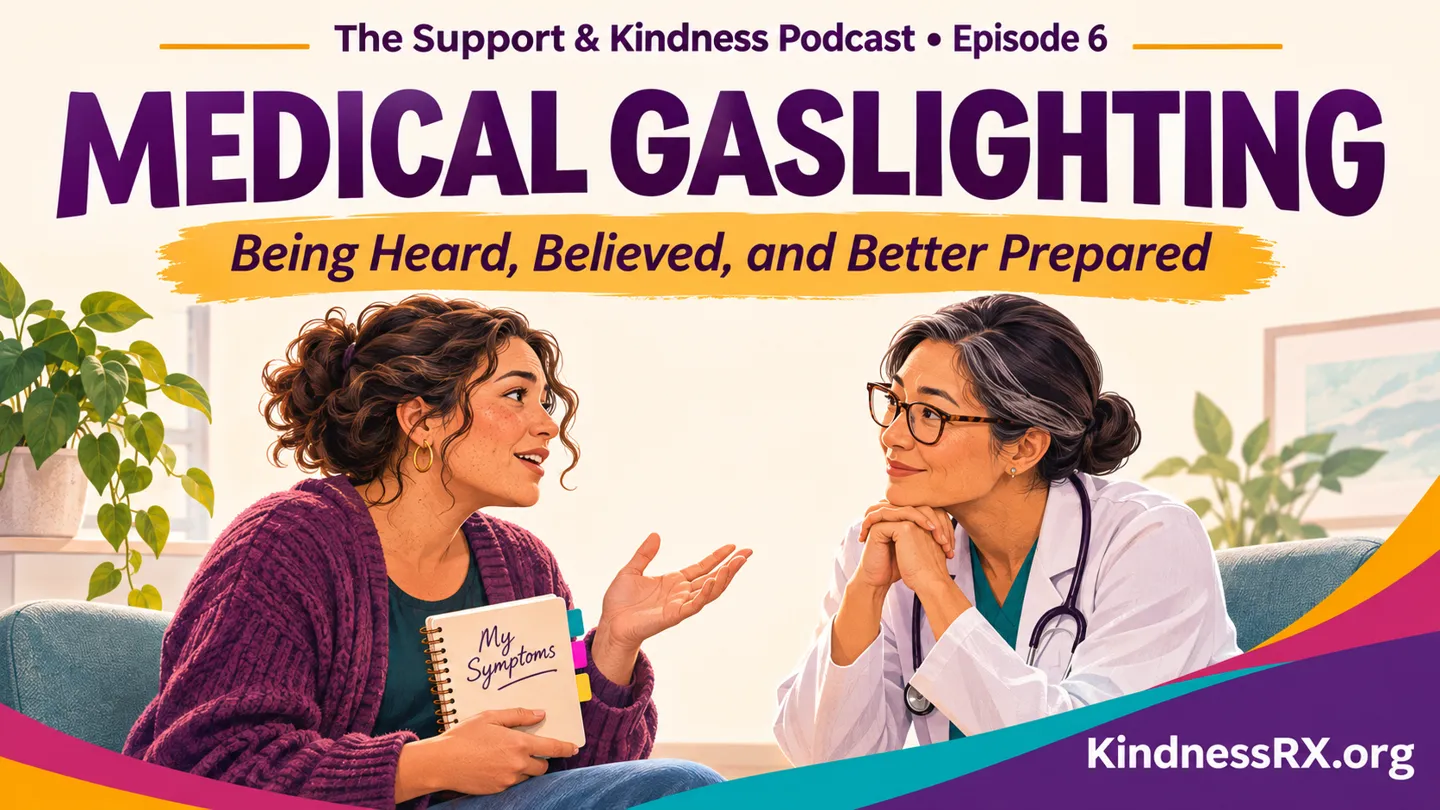
Medical Gaslighting: Being Heard, Believed, and Better Prepared | Episode 6
The Support & Kindness Podcast, Episode 6. With Greg Shaw, Rich, and guest Jay.
This companion expands on our 2025 conversation. Research and resources were reviewed on November 14, 2026. The personal stories belong to the speakers. The research below adds context and does not verify anyone’s medical records.
Medical gaslighting is a term people use when their health concerns are dismissed in ways that make them doubt themselves. You can ask for an explanation, a clear follow-up plan, and support at your appointment. You do not have to prove someone meant to hurt you before asking for better care.
Listen to Episode 6
Open the Episode 6 listening page.
This episode discusses medical dismissal, difficult care experiences, and racial gaps in maternal health. It offers peer support and general information, not personal medical or legal advice.
When you leave the appointment feeling unheard
You wait for an appointment. You think about what to say. Then the visit comes, and somehow the main thing never gets heard.
Maybe you were cut off. Maybe an old diagnosis seemed to explain every new symptom. Maybe you got your test results but still had no idea what would happen next.
You go home with questions. And sometimes you begin to question yourself.
Was I clear enough? Did I make too much of it? Should I just put up with this?
In Episode 6, Rich, Jay, and I talk about that feeling. Rich describes trying to explain symptoms during rushed visits. Jay shares his experience of repeated illness, delayed answers, and finding help from a pain specialist. I talk about fatigue that was taking over my days, and the frustration of having results without a clear next step.
These are different stories. But they share one need: to be heard and to leave with a plan.
What medical gaslighting means, and where the term gets tricky
People often use medical gaslighting to describe dismissal, disbelief, or blame in a healthcare setting. Researchers also use medical invalidation. That broader term can include being brushed aside even when there is no clear intent to manipulate someone.
A 2026 review of 158 studies found that definitions and ways of measuring these experiences vary a great deal. That matters. We do not have one reliable number showing how many people in the whole population experience medical gaslighting.
A doctor being unsure is not, by itself, gaslighting. Neither is a normal test result, a difference of opinion, or a decision that a particular scan would not help. Care can involve uncertainty and still be kind, careful, and thorough.
The question is how that uncertainty is handled. Can you finish explaining? Are your concerns explored? Does someone explain their reasoning and tell you what to do if things change?
You deserve that conversation even when there is no quick answer.
Three stories from the recording
Jay: an old diagnosis should not end a new conversation
At about 3:17, Jay describes living with cyclic vomiting syndrome. During one hospital stay, he felt that staff first assumed his symptoms came from that known condition. He says later imaging found hernias.
He also describes asking for a pain specialist. In his account, that person took time to understand his history and helped address his pain.
That does not mean everyone needs the same test or specialist. It shows why a fresh look can matter when something feels different.
Cyclic vomiting syndrome involves repeated episodes of severe nausea and vomiting. If you live with an ongoing condition, one useful question is: “What makes you think this is my usual condition, and what would make you reconsider?”
Rich: notes and another person can help
At about 10:40, Rich talks about his brain injury and the work it took to get useful ongoing care. He says a symptom journal helped. So did being clear and bringing someone with him.
Those tools can help when memory, fatigue, pain, or stress makes a visit hard to follow. They are supports, not a test you must pass to deserve care.
The CDC explains that moderate and severe traumatic brain injury can lead to lasting health changes. A person may need help over time, even when other people cannot see what is wrong.
Greg: results need a next step
At about 11:59, I describe fatigue that was affecting much of my day. Getting lab results was only part of what I needed. I wanted to know what happened next.
A result arriving in a portal does not always answer the question that brought you to the appointment.
Try asking: “Who will explain these results? When should I hear from them? What is the plan if the symptoms continue?”
That turns a vague wait into a clearer conversation.
Who can face extra barriers?
Dismissal can happen to anyone. It can also overlap with bias linked to sex, race, disability, weight, mental health, or a history of substance use. These experiences need careful study. We should avoid turning one study into a claim about every patient or clinician.
Pain care and recorded sex
A 2024 study in PNAS examined 21,851 emergency department discharge records across Israel and the United States. In its main Israeli dataset, 38% of female patients received an analgesic prescription, compared with 47% of male patients.
The difference remained after statistical adjustments. But these were discharge prescriptions, not every part of pain care. The records used binary sex categories. They do not tell us each clinician’s motives, and the figures are not a universal gaslighting rate.
They do give us a reason to take fairness in pain care seriously.
Maternal health: a clarification of the on-air figure
At about 15:54, I refer to Black women having higher rates of complications and death, and link that to malpractice. That wording went further than the evidence supports.
The CDC’s March 2026 report on 2024 maternal deaths gives rates of 44.8 deaths per 100,000 live births for non-Hispanic Black women and 14.2 for non-Hispanic White women. That is about 3.2 times as high.
This measure covers deaths during pregnancy or within 42 days after pregnancy ends. It differs from pregnancy-related death surveillance that can extend to one year. It is also not a measure of all childbirth complications, or of deaths caused by malpractice or gaslighting.
The gap is serious. Explaining it accurately helps us talk about it responsibly.
Being afraid to ask questions
In a CDC survey published in 2023, 20.4% of respondents reported at least one form of mistreatment during maternity care. The figures were 30.0% among Black respondents and 29.3% among Hispanic respondents. Overall, 44.7% reported holding back questions or concerns.
This was an opt-in survey of mothers recalling care connected with their youngest child. It does not show how common gaslighting is among all patients.
But it points to something worth asking: does the care setting make it feel safe to speak?
When an existing diagnosis overshadows a new symptom
Diagnostic overshadowing means wrongly attributing a symptom to an existing condition rather than assessing it properly. The Joint Commission discusses this patient-safety concern.
For example, someone with anxiety still needs new physical symptoms assessed. A person with a disability still needs attention to a change from their usual health.
You might say: “I know I have that diagnosis. This symptom is new for me. Can we look at it on its own too?”
A simple plan before your next appointment

Preparation can save energy. It should not become another full-time job.
Start with one page. A few notes on your phone are fine. If writing is hard, ask someone to help or use a voice note before the visit.
Write down what changed
Include when the symptom started, whether it comes and goes, and what makes it better or worse. Use an example from daily life.
Instead of only “I am tired,” you might write: “I now need to lie down after getting dressed. That was not happening last month.”
You are not trying to diagnose yourself. You are showing the change.
Choose your main question
A long list can feel hard to manage. Mark the one thing you most need help with today. Keep the rest so it does not get lost.
If there is too much for one visit, ask how the other concerns will be handled. Another appointment may help, but agree on when it should happen and whether anything needs faster attention.
Bring the useful details
Bring your medicines, supplements, allergies, relevant results, and a short health history. Include medicines you stopped and why, if that matters to the problem.
The Agency for Healthcare Research and Quality’s appointment guide offers a helpful starting list. You can use it without making your own system.
What to say when you feel brushed aside
These are suggested phrases for readers, not quotes from the episode. Choose the ones that sound like you.
| If this happens | You could say |
|---|---|
| You are interrupted | “There is one important change I have not explained yet.” |
| Stress is offered as the answer | “Could stress be part of it? What else have we considered?” |
| The test is normal but symptoms continue | “What does this result rule out, and what does it leave open?” |
| A test or referral is declined | “Could you explain why it would not help now, and when we would reconsider?” |
| You do not understand the plan | “Could we put the next steps in plain words?” |
| You are worried about waiting | “What changes mean I should contact you sooner?” |
You do not have to accuse someone of gaslighting to use these questions. Keep the focus on the symptom, the reasoning, and the next step.
If you freeze, hand over your notes. If you cry, you can still ask your question. Being upset does not make your symptoms less worthy of care.
Bringing someone with you
Jay talks at about 14:30 about taking his mum to some visits. He explains how easy it is to give the usual polite answer that you are doing well, then miss the chance to describe what is wrong.
A support person can take notes, remind you of a question, or help describe a change they have noticed. Before the visit, tell them what you want from them.
You might say: “Please let me speak first. If I forget the main point, remind me.”
If you cannot bring someone, ask the practice about support options. You can also ask about an interpreter, written instructions, or other help you need to take part in the visit. If you want to record the conversation, discuss permission and applicable rules first.
After the appointment: close the loop
Before you leave, try to answer five questions:
- What is the working explanation?
- What are we doing next?
- Who is arranging it?
- When should I hear back or return?
- What should I do if I get worse?
Read the visit summary when you have the energy. If an important fact is wrong or missing, contact the practice and ask how to correct or clarify it.
If the care still feels unsafe or unhelpful, a second opinion may be useful. Ask about coverage, referral rules, and how records will be shared. A hospital’s patient relations team or patient advocate may also help explain its complaint process.
A complaint can record what happened. It does not replace care you need now. If symptoms are new, severe, or rapidly worsening, seek timely medical help. For a medical emergency, call 911 in the United States or your local emergency number.
Could AI help people get answers?
At about 7:24, we ask whether AI might help with diagnosis or simply add more pressure to rushed care.
A 2024 NIH report describes an AI model that did well on diagnostic quiz questions but made mistakes when describing images and explaining its answers. That study tested a specific model and task. It does not establish that AI can safely diagnose you at home.
For a patient, a modest use may be turning your own notes into a short question list. Check that the summary keeps the facts right. Avoid sharing sensitive health details unless you understand how the service handles them.
An AI answer should not become a reason to dismiss a patient or to stop a proper assessment. The aim remains the same: careful attention to the person.
Further reading and TED talks
These are companion resources added after the recording. They are not all mentioned on air.
- Jennifer Brea: What happens when you have a disease doctors can’t diagnose. A personal account of illness, uncertainty, and being believed.
- Abraham Verghese: A doctor’s touch. A talk about human connection in medicine.
- Leana Wen: What your doctor won’t disclose. A TEDMED talk about trust and openness in care.
- AHRQ: Talk with your doctor. Questions and ideas for understanding a diagnosis and considering a second opinion.
- NIDDK: Cyclic vomiting syndrome. Background on the condition Jay discusses.
- CDC: Moderate and severe traumatic brain injury. Background on ongoing changes after TBI.
These talks are older reflections, not current treatment guidance. For practical help, try the AHRQ Question Builder. If insurance, access, or bills are getting in the way, check whether you qualify for Patient Advocate Foundation case management. Eligibility and capacity limits apply.
Keep the conversation going with KindnessRX
Being heard matters outside the doctor’s office too. Our free online support groups offer a place to connect with others. You can share or listen. Peer support does not replace medical care, but it can help you feel less alone while you work through it.
For more on these themes, read Episode 50: The Diagnosis That Never Comes, our companion on invisible illness, or Episode 47 on fibromyalgia with Linda Fraas. You can also browse the podcast.
Link mentioned on air: KindnessRX.org. The other research and resource links in this article were added for this companion.
This week’s small challenge
Choose one step. Write down the main question for your next appointment. Or offer to help someone else make their list.
If you have no appointment coming up, save this sentence somewhere easy to find:
“What is our next step, and when should it happen?”
You do not have to solve everything today. One clear question can be a place to start.
Common questions about medical gaslighting
Does a normal test mean my symptoms are not real?
No. It means that test did not find the thing it was checking for. Ask what the result tells you, what remains uncertain, and what follow-up is appropriate.
Is every disagreement with a doctor medical gaslighting?
No. A clinician may have a sound reason for recommending a different plan. You can ask them to explain that reason and discuss what would change the plan.
Can I take someone to an appointment as an adult?
You can ask to bring a person you trust. Discuss any practical limits with the care team. Tell your support person how you want them to help and what you wish to keep private.
What if I cannot explain myself clearly?
Bring notes, ask for more time, or request help with communication. You deserve care even when pain, fatigue, a brain injury, or distress makes it hard to find the words.
Where can I begin if I still feel unheard?
Ask for the reasoning and follow-up plan in writing. If concerns remain, ask about a second opinion or the practice’s patient relations process. Keep seeking appropriate care for symptoms that need attention.