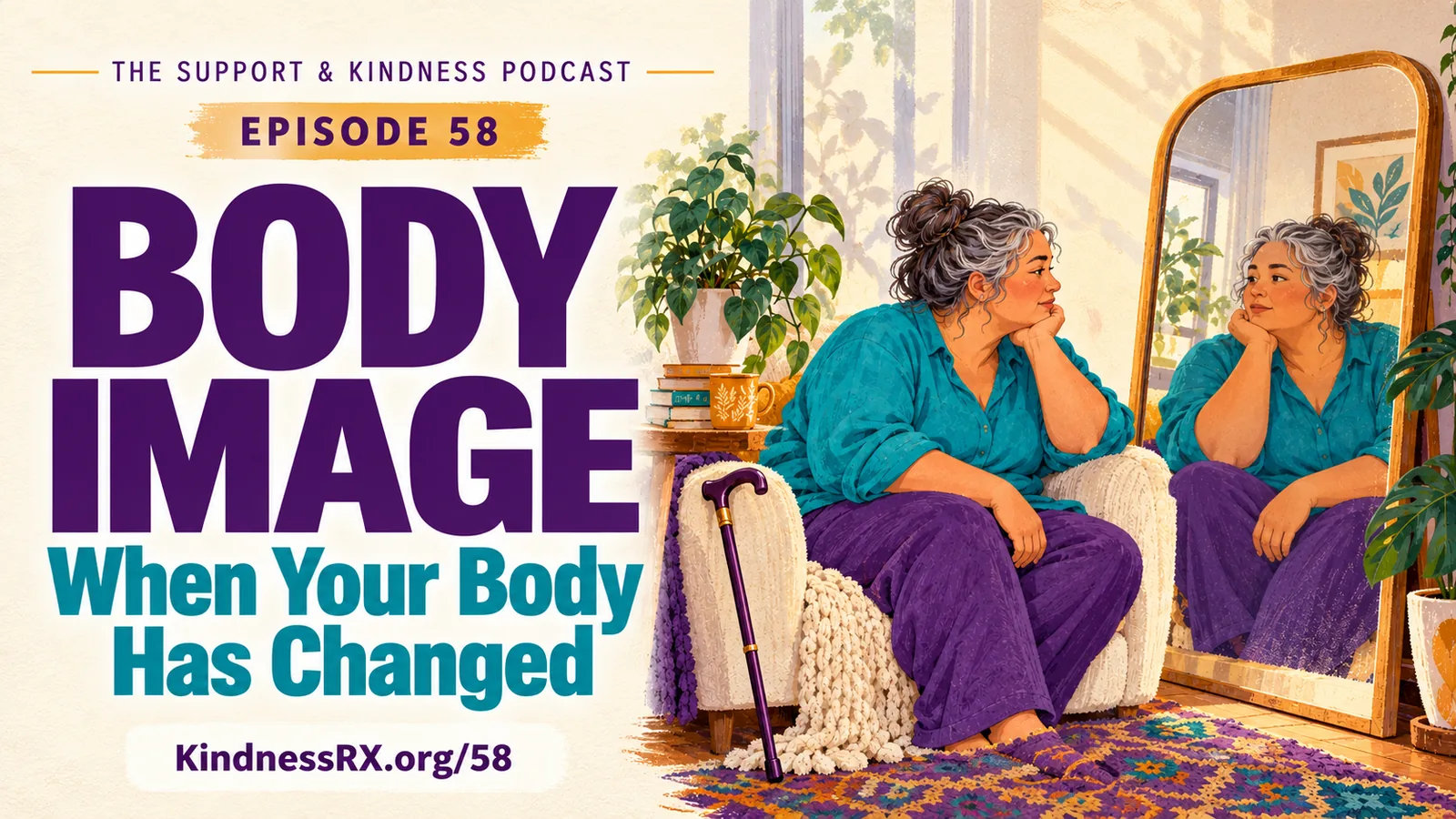
Body Image When Your Body Has Changed
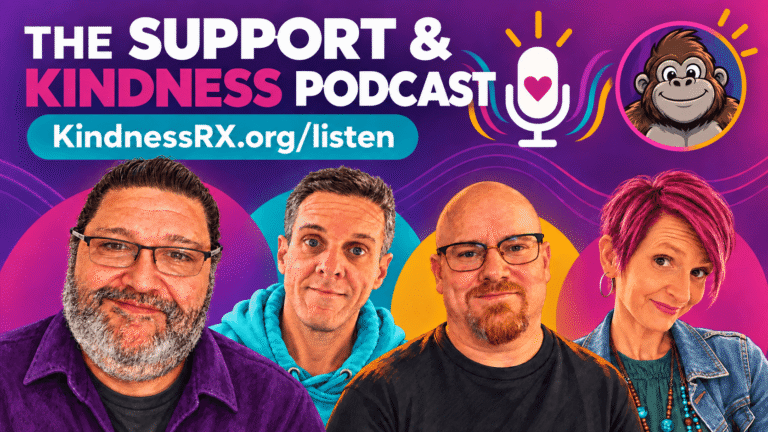
By Greg Shaw, host of The Support & Kindness Podcast | Episode 58 | October 30, 2026
Body image after illness, injury, disability, or aging can be hard to put into words. You might recognize the face in the mirror but miss the body you remember. You might look much the same while pain or fatigue changes almost everything about your day.
Then somebody says, “You just need to love yourself.”
I know they may mean well. But when your body has changed without your permission, that can feel like one more thing you're supposed to get right.
In Episode 58, Rich, Liam, Sarah, and I talk about what this feels like in real life. We talk about scars, weight changes, mobility aids, intimacy, and the gap between knowing you deserve kindness and actually giving yourself some.
You can care for your body while still having difficult feelings about it. You don't have to settle every feeling before you eat, rest, ask for help, or take part in your own life.
Listen to Episode 58 of The Support & Kindness Podcast.
Content note: This article discusses body dissatisfaction, weight change, disability, eating disorders, intimacy, and mental health. It offers peer support and general information, not medical advice or a diagnosis.
What does body image mean?
Body image includes what you think and feel about your body, how you experience being in it, and how those thoughts affect your behavior. The U.S. Office on Women's Health explains that it isn't determined by weight or size alone. 1
That might show up as avoiding photographs. It might mean changing clothes six times before leaving home. It might mean worrying about how a partner will react to a scar.
Liam talks about picking apart details in his own reflection that he would barely notice on somebody else. Sarah reminds us that what is happening medically can affect how we feel about ourselves, even when other people cannot see it.
For me, that is why this conversation needs to go beyond appearance. A body can look familiar and still feel unreliable. A day out can become a calculation about pain, bathrooms, seating, or how much energy the trip will cost.
Body grief after illness or injury
“Body grief” is a way to describe loss. It is not a diagnosis.
You may miss walking without an aid, getting dressed without help, or trusting that your energy will last until dinner. You may miss privacy. You may miss a future you thought was fairly certain.
In the episode, Sarah talks about still dreaming that she is walking without a device years after her spinal cord injury. The picture in your mind doesn't always change at the same pace as everyday life.
I talk about weight changes and how quickly I can turn old insults on myself. Knowing that I would never speak that way to a friend does not always stop me doing it to myself.
There isn't a deadline for making peace with this. Nor does every disabled person feel grief about disability. Some people feel pride, relief, frustration, or a mixture that changes from day to day. Let people describe their own experience.
A little context from the research
In the 2023 U.S. National Health Interview Survey, 24.3% of adults reported chronic pain. Another measure, high-impact chronic pain, affected 8.5%. That means pain frequently limited life or work activities. Chronic pain affected 36.0% of adults aged 65 and older. 2
These are pain statistics, not figures for body dissatisfaction. They help explain why conversations about a changing body belong in everyday life.
Research clarification: The 36.0% estimate applies to adults aged 65 and older.
When loving your body feels out of reach
I say in the episode that body neutrality feels more reachable for me than body love.
To me, that means I can have a difficult day with my body without treating it as an enemy. I can choose clothes that fit now. I can eat without making food something I must earn. I can ask for help without first proving that I've tried hard enough.
A 2026 review of 36 articles on positive body image and chronic illness found themes that went beyond appearance. They included body care, social support, accepting illness, and self-compassion. The authors also called for better measures and tailored support. 3
Body neutrality is an approach some people find useful. It is not a diagnosis, a cure, or a replacement for treatment.
You might prefer the words “body respect.” You might not need a label at all.
Try a sentence that you can believe:
- “These clothes don't fit comfortably. I can choose something else.”
- “I need the chair today.”
- “I can be upset and still take care of myself.”
You do not have to replace a cruel thought with a grand statement about loving every inch of yourself. A fairer sentence is a place to start.
And your worth does not depend on what your body can do. Resting, needing care, or having very limited movement does not make you less deserving of respect.

Weight changes deserve care, not a running commentary
A change in weight does not tell you what someone is going through. It does not tell you whether they are feeling better, whether a treatment is helping, or whether they wanted the change.
In our conversation, we talk about how different medical experiences can be. Some people struggle with weight gain. Others struggle with weight loss. Praise can hurt when it celebrates something that has come with illness.
An international expert consensus published in Nature Medicine describes the physical and psychological harm caused by weight stigma. It also warns that people who experience it may receive inadequate healthcare. 4
A useful starting point is to ask how somebody is doing and let them decide what to share.
If a medicine seems to be affecting your appetite, weight, or sexual function, raise it with your prescriber. Your experience deserves attention. Don't change or stop treatment because of something you hear on a podcast.
Mobility aids, scars, and personal boundaries
A cane, walker, wheelchair, or brace can help someone take part in life. People can also have complicated feelings about using one. Both experiences deserve room.
The panel doesn't have one shared rule about questions or humor. Sarah is comfortable with some questions that another person might not welcome. Liam talks about how the context and relationship matter.
That is the point. One person's comfort is not permission from everybody else.
Ask before helping. Ask before touching an aid. Accept “no” without demanding an explanation.
If you are setting a boundary, you can keep it short:
- “Please ask before helping me.”
- “Please don't move my wheelchair.”
- “I'm not discussing my medical history today.”
- “I'd rather talk about something else.”
You can appreciate somebody's good intentions and still need them to stop.
Social media comparison can be about the life you miss
Sarah makes a point that stayed with me. Comparison isn't only about bodies. It can also be about watching people do things you wish you could do.
A walking holiday. A busy weekend. A night out without planning around pain.
You can be happy for someone and still find their post hard to see. That does not make you a bad friend.
A review of 43 experiments found that viewing idealized social-media images increased body dissatisfaction. Nearly 90% of the participants were female, and the average age was about 22. That limits how confidently we can apply the findings to older adults or everyone living with a disability. It also leaves questions about longer-term effects. 5
A small 2024 experiment gives another reason to think about representation. Women with chronic illness who viewed illness-inclusive body-positive images reported a larger immediate drop in negative feelings than those who saw typical body-positive images. The study involved 201 women and measured short-term responses. It cannot tell us whether a different feed helps everyone or keeps helping over time. 14
A practical check is to notice what happens after you scroll. Do you feel connected? Or do you start comparing, criticizing yourself, and pulling away from your day?
You can mute an account without judging the person behind it. You can follow people with different ages, bodies, disabilities, and everyday lives. You can also put the phone down without turning that into another self-improvement project.
Changing a feed will not remove pain or make an inaccessible place accessible. It can give you one less source of pressure.
Intimacy after your body has changed
Scars, pain, changed sensation, and medical devices can make familiar conversations feel awkward. You may worry about rejection. You may not yet know what feels comfortable.
Sarah and Liam talk about honesty and humor. Humor can help when both people welcome it. It does not have to cover up a serious concern.
Try opening with something simple: “I want to be close to you. Some things feel different now, and I'd like us to talk about it.”
You can talk about touch, privacy, timing, fatigue, or needing to stop. You can change your mind. Nobody has to push through discomfort to prove love or confidence.
The Model Systems Knowledge Translation Center offers a resource on body image after burn injury that includes intimacy and emotional adjustment. It is written for burn survivors, so it cannot answer every question about other conditions. A clinician familiar with your condition can help you explore specific concerns. 6
A partner does not need every answer before they can listen well.
When body image distress needs professional support
Having a difficult relationship with your body does not automatically mean you have body dysmorphic disorder, or BDD.
The NHS describes BDD as spending a great deal of time worrying about perceived appearance flaws that other people may barely notice. It can involve repeated checking, comparing, concealing, or avoiding mirrors and situations. It can seriously affect daily life. 7
A visible scar or an understandable response to illness does not, by itself, mean someone has BDD. A qualified clinician needs to assess what is happening.
Consider getting support when concerns about your body interfere with eating, relationships, appointments, daily activities, or feeling safe. You do not have to wait until things are unbearable.
The National Institute of Mental Health explains that eating disorders can affect people of different ages, body weights, and backgrounds. You cannot tell whether somebody has an eating disorder simply by looking at them. 8
A therapist familiar with chronic illness, disability, or grief may help with adjustment. Eating disorders and BDD can need specialist care. Ask whether a provider understands your condition and accessibility needs, as well as whether their approach feels respectful.
There is also research behind being less harsh with yourself. A meta-analysis of 51 studies found that greater self-compassion was associated with less psychological distress among adults with chronic illness. Much of the evidence was cross-sectional, so it cannot show that self-compassion caused the difference. It is a reason to take kindness seriously, not a promise that it will remove symptoms. 9
If you are in the United States and need crisis support, call or text 988, or visit 988lifeline.org. Call 911 for immediate danger.
TED talks and further reading
These are extra resources for this article. They are not clinical treatments or promises about recovery.
Stella Young: I'm not your inspiration, thank you very much. In this TEDxSydney talk, Young challenges the habit of treating disabled people as inspirational simply for living their lives. It fits our conversation about dignity and being seen as a whole person.
Aimee Mullins: The opportunity of adversity. This TEDMED talk explores how language shapes expectations of disability and human potential. You can consider that perspective without feeling obliged to call illness or injury a gift.
For eating-disorder information and help finding support, visit the National Eating Disorders Association.
This week's challenge: one act of respect and one boundary
If your own body has changed, choose one act of care that is realistic today. Wear the aid that helps you get out. Rest. Put away clothes that hurt or shame you. Attend the appointment. Ask for help with a symptom or side effect.
Then choose one boundary. That might be asking someone to stop commenting on your weight or giving yourself a break from a difficult conversation.
If you support someone whose body has changed, try seven days without unsolicited comments about their weight, appearance, food, exercise, scars, or mobility aids.
When they share something difficult, ask: “Would you like me to listen, help, or change the subject?”
Rich talks in the episode about finding his people through our support groups. That matters to me. Sometimes it helps to be with people who don't require a long explanation before they understand.
Listen to the full conversation with Greg, Rich, Liam, and Sarah. You can also learn about our free online peer support groups, or browse other podcast episodes.
Our groups are peer support. They do not replace medical care, therapy, or crisis services.
Your body does not have to feel familiar every day for you to deserve care.
Sources and resources
Research links below support the article's factual statements. The panel's stories are personal experiences. Resource links offer further information. Sources checked October 30, 2026.
U.S. Office on Women's Health. Body image. Definition and relationship with thoughts, feelings, and behavior; the page primarily discusses women and girls.
Lucas JW, Sohi I. Chronic Pain and High-impact Chronic Pain in U.S. Adults, 2023. NCHS Data Brief 518, November 2024. Self-reported estimates for U.S. civilian, noninstitutionalized adults; these do not measure body-image distress.
Cunha and colleagues. Positive body image and chronic illness: A systematic review. Journal of Health Psychology, 2026. Review of 36 articles; identifies themes and gaps rather than proving one treatment works for everyone.
Rubino F and colleagues. Joint international consensus statement for ending stigma of obesity. Nature Medicine, 2020. Expert consensus informed by a review of evidence.
Fioravanti G and colleagues. How the Exposure to Beauty Ideals on Social Networking Sites Influences Body Image: A Systematic Review of Experimental Studies. Adolescent Research Review, published online 2022. Predominantly young, female participants; long-term effects remain less clear.
Model Systems Knowledge Translation Center. Understanding and Improving Body Image After Burn Injury. Rehabilitation information specific to burn survivors.
NHS. Body dysmorphic disorder. Symptoms, assessment, and treatment information.
National Institute of Mental Health. Eating Disorders: What You Need to Know. Signs, types, and treatment information across body weights and backgrounds.
Baxter R, Sirois FM. Self-compassion and psychological distress in chronic illness: A meta-analysis. British Journal of Health Psychology, 2025 issue; published online 2024. Much of the evidence is correlational.
Young S. I'm not your inspiration, thank you very much. TEDxSydney, April 2014. Personal and cultural commentary.
Mullins A. The opportunity of adversity. TEDMED, October 2009. Personal and cultural commentary.
National Eating Disorders Association. Eating-disorder information and support resources.
Substance Abuse and Mental Health Services Administration. 988 Suicide & Crisis Lifeline. U.S. crisis support by call, text, or chat.
Cunha IM, Lamm E, Nett S, Rodgers RF. State affect and body image effects of body positive social media content within a female chronic illness sample. Body Image, 51 (2024), 101796. Randomized experiment involving 201 women with self-reported chronic illness; measured immediate responses, not lasting effects.