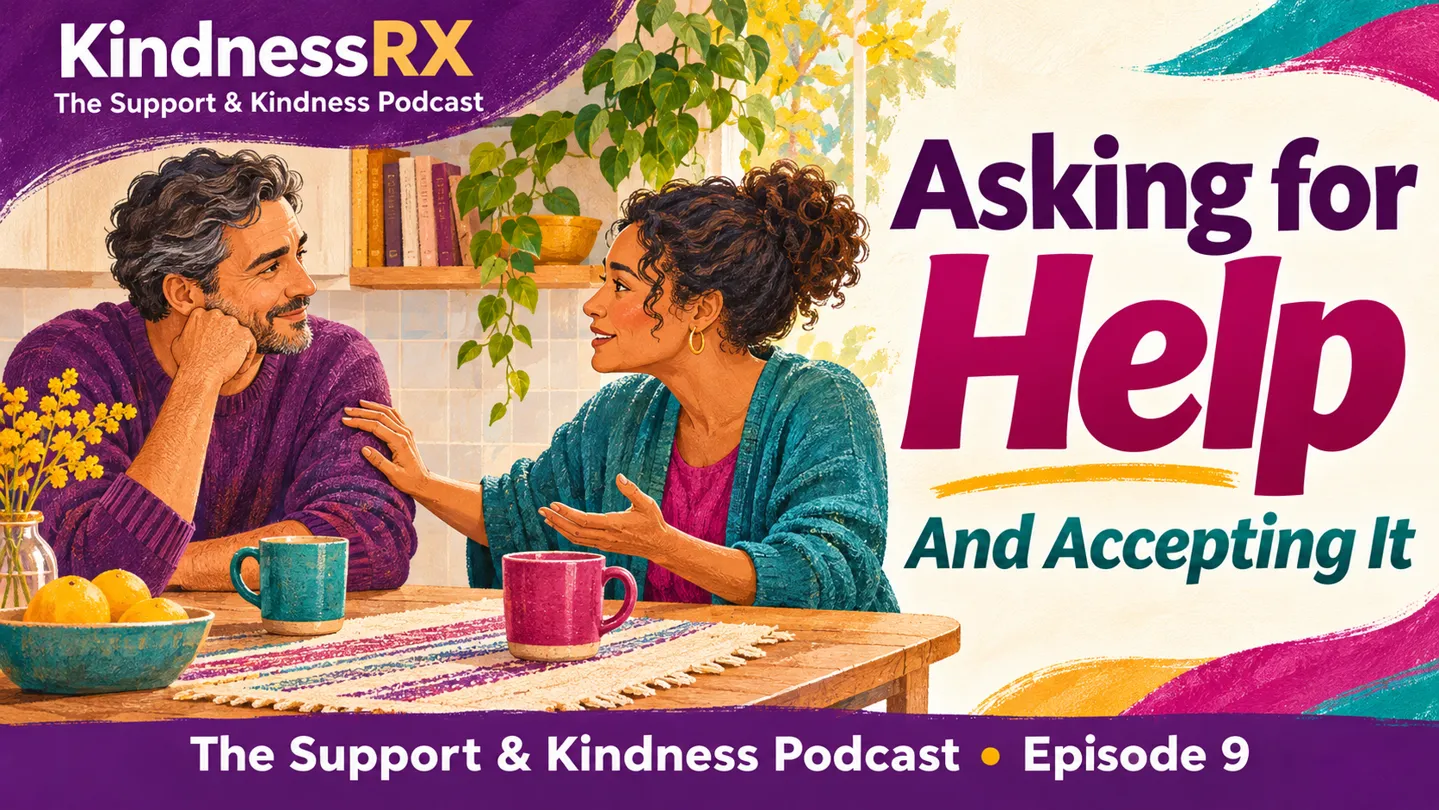
Episode 9: Asking for Help and Accepting It: Why Reaching Out Is a Strength
You need a lift. A second pair of eyes. Someone to listen for ten minutes.
You pick up your phone, then put it down. They are busy. You should be able to cope. What if they say no?
That small pause can leave us doing far too much alone.
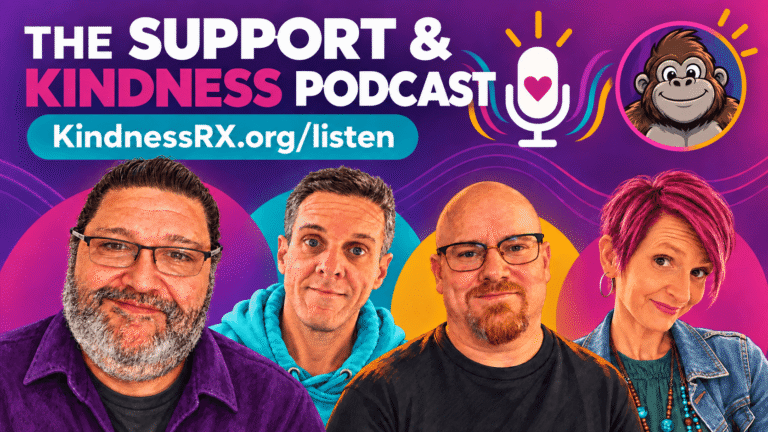
In Episode 9 of The Support and Kindness Podcast, Greg, Rich, Jay, and Liam talk about asking for help and accepting it. They bring stories about friendship, recovery, work, and changing health. They also ask what gets in the way when we know support could help.
This companion goes further. It looks at the research behind those fears, adds words you can use, and explores how to give help without taking control.
Asking for help means naming a need and inviting someone to respond. Accepting help means allowing support that fits your needs, choices, and limits. Neither makes you less worthy or less capable.
Listen to Episode 9
Open the original Episode 9 page.
You can also browse the podcast or find KindnessRX support groups.
This article shares peer experiences and general information. It does not replace medical care, mental health care, or addiction treatment.
Why is asking for help so hard?
Greg opens the conversation with a familiar question: when did you last need help and decide against asking?
Sometimes the task is simple. The feelings around it are not.
You may fear looking weak. You may worry about being a burden. You may have been taught that capable adults manage alone. Perhaps an earlier request was met with a joke, a lecture, or silence.
A past bad response can make a new request feel risky. That deserves care. It does not mean you are doing something wrong.
There can also be real barriers. Support may cost money. A service may have a waiting list. Transport, language, internet access, or an inaccessible building may get in the way. Some people have faced bias when they asked before.
A better mindset can help with fear. It cannot remove every barrier. People need useful services and fair access as well as kind words.
Start by asking yourself what is stopping you. Is it fear of a possible no? A person who has been unsafe before? Or a service you cannot reach? Each calls for a different next step.
What research says about asking for help
The episode raises a hopeful idea: we may expect more rejection than we get.
In their 2008 research, Francis Flynn and Vanessa Lake examined how people judged others’ responses to direct requests. Across their studies, help-seekers tended to underestimate how often others would agree. You can read the original study abstract and Stanford’s explanation of the findings.
This is useful evidence against treating every feared rejection as a fact. It is not a promise that every request will get a yes. A brief request in a research study is also different from asking for months of care, money, or a place to live.
There is another side to the findings. Saying no can feel awkward for helpers. A clear request should leave room for an honest answer. The aim is willing support, with respect on both sides.
The episode also talks about how good helping can feel. That may be true for many people. Still, you do not need to ask for help to make someone else feel useful. Your own need is reason enough to reach out.
A 2022 paper by Xuan Zhao and Nicholas Epley included studies involving 2,118 U.S. adults. People asking for help tended to underestimate willingness and the positive feelings helpers would experience. They also expected more inconvenience than helpers reported. These findings give us a reason to question our worst predictions. They do not guarantee that every person can help, or that every relationship is safe.
Gender and age: patterns without stereotypes
Greg mentions a 2025 Pew Research Center report on emotional support.
The report, published in January 2025, drew on a September 2024 survey of 6,204 U.S. adults. Pew found that 54% of women and 38% of men said they would be extremely or very likely to turn to a friend for emotional support. Men and women were similarly likely to name a spouse or partner. For mental health professionals, the figures were 24% among adults under 50 and 14% among those 50 and older.
These are findings about where surveyed U.S. adults said they would turn. They do not show that every woman finds asking easy, or every man struggles. They also do not tell us how much support someone actually received.
Rich describes making an effort to stay in touch with friends and his support network. That gives the numbers a useful human context. Having people in your life and feeling able to reach them are different things.
One practical step is to make contact before things reach a crisis. A short check-in can help keep a connection open. If you have lost touch, you can begin with a simple message: “I’ve been quiet lately. I’d like to catch up when you have time.”
You do not need a large circle. A few reliable people, plus services when needed, can form a useful network.

Accepting help while keeping your independence
Liam describes turning down an offered wheelchair ride. He did not want to burden anyone. He then tried to walk a distance that hurt him.
His story shows how an old habit can clash with a new need. Saying “I’m fine” may come out before we stop to check whether we are.
Accepting a lift, using a mobility aid, or asking for help with shopping can make it easier to do the things that matter to you. Support and choice can work together.
Rich also talks about the fear of losing independence. For some people, help sounds like the start of someone else making decisions. Northwestern Medicine discusses why some older adults hesitate to ask, including concerns about independence.
A helpful starting point is to separate the task from control over your life.
“I’d like help getting the groceries upstairs. I’ll put them away myself.”
“Please read this form with me. I want to make the final choice.”
“Yes, a ride would help. Please ask before moving my walker.”
You can accept one kind of support and decline another. You can change your mind. Help should leave room for your voice.
How to ask for help: small, specific, and time-based
Rich brings three useful words to the conversation: small, specific, and time-based.
A clear request helps someone understand what you need. It also helps you avoid asking for everything at once when you feel overwhelmed.
Name the task
Try replacing “I need help with everything” with the next task that would make today easier.
“Could you help me carry these bags to my door?”
“Could you read this letter and help me work out who to call?”
“Could you sit with me while I book the appointment?”
If you cannot name the task yet, say that. “I’m overwhelmed and don’t know where to start. Could you help me choose one next step?” is a clear request too.
Give a time frame
Tell the person when help is needed and roughly how long it may take.
“Could we talk for ten minutes this evening?”
“Would you be able to drive me to an appointment next Thursday?”
Be honest when you do not know the time involved. Leave room for the person to say what they can offer.
Say what kind of response you want
Someone may jump into problem-solving when you wanted to be heard.
“I need to talk this through. Could you listen first, without advice?”
“I’d like ideas, but please ask before calling anyone for me.”
“Could you write down the steps? I may not remember them all.”
Let the answer be real
You can add, “If you can’t, please tell me.” Then respect the answer.
If the need is urgent, say so clearly. Avoid making a small-sounding request when you need much more. Accurate information helps both of you plan.
You do not have to earn help by struggling first
Rich shares a comedy story about people stopping to help someone push a broken-down car. His point is that seeing the problem can make the need clearer.
That can be useful. Briefly explaining where you are stuck may help someone respond.
But there is a limit to this advice. You do not have to prove that you tried hard enough. You do not need to risk pain, injury, or collapse before your need counts.
For someone living with disability, chronic pain, fatigue, depression, or a brain injury, even starting a task may use energy they do not have.
“I can’t safely do this on my own” is a valid reason to ask. So is “I don’t understand this” or “I need support today.”
Help is a human need. It is not a prize for pushing yourself past your limits.
Accepting help without guilt
Sometimes the hardest part comes after someone says yes.
You may apologize over and over. You may feel a need to return the favor right away. Or you may keep checking whether they are annoyed.
Try pausing before that rush to make things even. A simple “Thank you. That helps” can be enough.
Liam talks about gratitude and making help a good experience. Warmth can make a shared task easier. But you do not owe anyone a cheerful performance. You may be tired, frightened, in pain, or low in mood.
You can be grateful and still have limits. You can appreciate a meal and explain that you cannot eat one ingredient. You can welcome a visit and need it to end after half an hour.
Nor does accepting help create a debt. You may give back another day, in another way, or to someone else. You may be unable to do that. Your right to care does not depend on repayment.
What if someone says no?
Greg names fear of being turned down as a major barrier for him.
A no can hurt, even when the person is kind. Try to keep the answer attached to the request. It does not measure your worth.
The person may lack time, money, skill, or energy. They may care and still be unable to help.
You might say, “Thanks for being honest. Is there another time that would work?” Or, “Do you know a service I could try?” They may not have an answer, and that is okay too.
Ask another suitable person or service rather than pushing the same person to change their no. If someone repeatedly shames you for having needs, consider whether they are the right person for future requests.
One difficult response does not mean every door will close.
Recovery: asking again is allowed
Jay speaks openly about addiction and the many times he asked for support with rehab when he was younger. He also describes taking a friend to meetings.
His story challenges the idea that you get one chance to ask. A continuing need is still a need. A setback does not cancel your right to support.
Jay connects this with service in Alcoholics Anonymous. AA’s Twelve Steps include carrying the message to others and practicing the principles in daily life.
Peer support can provide shared experience and connection. It can also sit alongside professional treatment. One person’s recovery path will not fit everyone.
If a meeting or service did not help before, you can talk with a qualified professional about other options. It may help to ask someone you trust to sit beside you while you make that first call.
How to help without taking over
Greg asks listeners to take it seriously when someone trusts them enough to ask.
Start by checking what the person wants. “Would listening help, or are you looking for ideas?” gives them a choice.
Make offers you can keep. “I can bring a meal on Friday” is clearer than “Let me know if you need anything.” If your plans change, tell them promptly.
Ask before touching a person, their mobility aid, or their belongings. Let them explain what works. A familiar task to you may have a particular method for them.
Avoid making help conditional on hearing every private detail. Someone can need transport without wanting to explain their whole medical history.
You can also have boundaries. “I can listen for twenty minutes, but I can’t lend money” is honest. If the need is beyond your skills, helping find suitable care may be the most useful thing you can offer.
Build a small support map
One person cannot meet every need. A simple list can make reaching out easier when your brain is tired.
Write down one person or service for each area: emotional support, practical tasks, health questions, and urgent help. Add contact details and the easiest way to reach them.
Include access needs too. Do you prefer text? Need a quiet call? Want written steps after a conversation? Could someone help you fill out forms?
Your list may be short at first. That is okay. A local service, a care team, a community group, or a peer group can be a starting point when family or friends are unavailable.
KindnessRX support groups offer a place to look for peer connection. Check the current group details and sign-up information before joining.
This week’s kindness challenge
Choose one small step. Keep it safe and within your energy.
Ask: Name one need and make one clear request to a suitable person. Try: “Could you help me with ___ for ___?”
Accept: If safe, useful help is offered, pause before your usual no. Ask yourself whether saying yes would make the day easier.
Offer: Give someone a specific choice. “I can pick up groceries on Friday. Would that help?” Let them decline.
Afterward, notice what happened. Was asking easier or harder than you expected? Did the help fit? What would you change next time?
There is no pass or fail. Writing the request down without sending it can be a first step.
Common questions about asking for help
Is asking for help a weakness?
It is a way to respond to a need. It can show awareness of your limits and a wish to protect your health, energy, or goals. You do not have to feel brave to ask.
How do I ask without feeling like a burden?
Start with a clear task and a time frame. Let the other person decide what they can offer. Feeling guilty does not mean you have done something wrong.
What if I have nobody to ask?
Look beyond your immediate circle. A care team, local community service, peer group, or other support organization may help you find a starting point. You can ask for help finding help.
Can I accept help and still say no to advice?
Yes. You can say, “The practical help is useful. I’m not looking for advice about that today.” Support should respect your choices.
Do I need to pay someone back?
Agree in advance if money or repayment is involved. A freely offered favor does not automatically require a matching favor. Clear expectations can prevent stress later.
Where to find practical or urgent support
If you are in the United States and need help with food, housing, bills, or other local needs, 211 can help you explore nearby resources. Availability and eligibility vary by area.
For mental health or substance use treatment options, FindTreatment.gov offers a U.S. treatment locator. You can ask a provider about cost, insurance, access needs, and waiting times before booking.
If you are struggling with suicidal thoughts or emotional distress in the United States, call or text 988, or visit the 988 Lifeline. You do not have to wait until things feel unbearable to reach out. For immediate physical danger or a medical emergency, call 911.
Further reading and resources
The following sources expand on ideas discussed in the episode:
- Pew Research Center: Where men and women turn for emotional support and social connection, for U.S. survey findings and methods.
- Flynn and Lake: Underestimating compliance with direct requests for help, for the original 2008 research abstract.
- Stanford: If You Want Something, Ask For It, for an accessible research explanation.
- Northwestern Medicine: Why Some Older Adults Are Reluctant to Ask for Help, for a discussion of independence and aging.
- Alcoholics Anonymous: The Twelve Steps, for the recovery framework Jay discusses.
- Heidi Grant: How to ask for help and get a “yes”, a practical TED talk about clear requests.
- Brené Brown: The power of vulnerability, further viewing about connection. These talks are companion recommendations, not links named in the recording.
- Zhao and Epley (2022): Surprisingly Happy to Have Helped, additional research on what helpers and help-seekers expect.
Related episodes
If shame or harsh self-talk gets in the way, try Episode 8: Taming the Inner Critic.
If you are unsure who to contact, Episode 5: What Do You Do When You Have Nobody to Talk To? explores the need for connection.
For the added strain of having needs people cannot see, listen to Episode 48: Invisible Illness, When You Don’t Look Sick.
You can also explore The Support and Kindness Podcast.
What makes asking for help hardest for you? And what kind of help feels easiest to accept? Share what feels right for you. Your experience may help someone else find the words for their own next step.