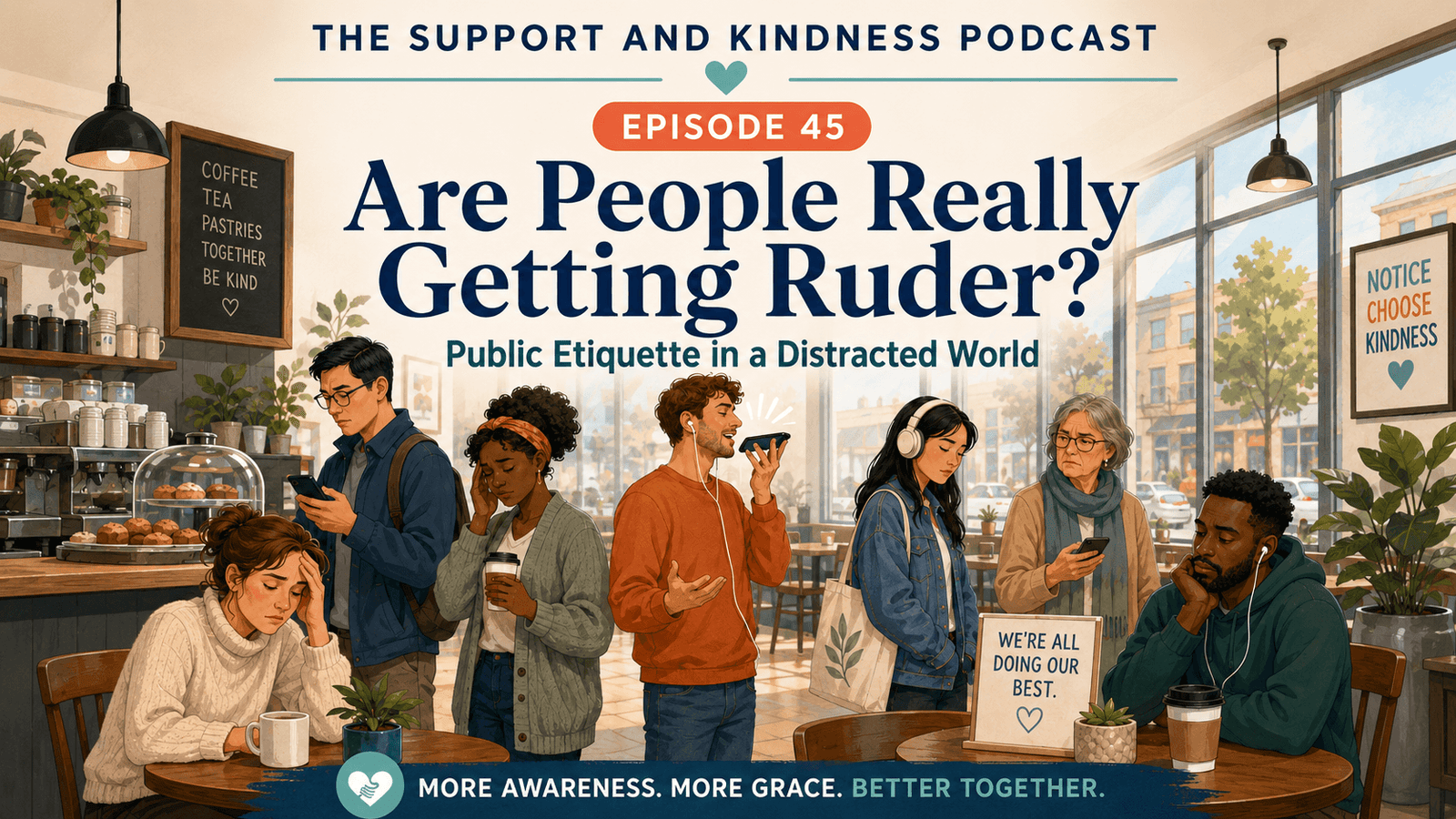
Episode 45: Are People Really Getting Ruder?
Are people really getting ruder — or does it just feel that way?
In late 2024, Pew Research Center asked more than 9,000 American adults a simple question: is public behavior ruder than it was before the pandemic? Almost half — 47% — said yes, with one in five saying “a lot” ruder. And yet, in the same survey, 84% of people said it was easy for them personally to know how to behave in public.
Sit with that for a second. Nearly everyone is sure they know the rules — and nearly half are sure everyone else is breaking them. Both of those things can’t be equally true. That gap is where this week’s episode lives. Greg, Rich, and Sarah spend an hour on a question that sounds like it belongs in an etiquette column but turns out to be about something much closer to home: how we read strangers, how much slack we give them, and how much we have left to give.
Rudeness is a gap, not a fact
Greg opens the episode with a reframe that reshapes the whole conversation. Rudeness, he argues, isn’t really a behavior. It’s a gap — the distance between what you expected in a shared space and what you actually got. That’s not just a nice metaphor; it maps onto how linguists describe politeness. Decades ago, Penelope Brown and Stephen Levinson built politeness theory around the idea of “face” — the public self-image we’re all trying to protect. Rudeness, in that framing, is a threat to face. And because we each walk into a room carrying our own expectations, the same act can threaten one person’s sense of order and barely register for another.
That’s why two reasonable people can watch the exact same thing and honestly disagree about whether it was rude. The Pew data bears this out in the most ordinary places. Playing music or a video out loud in public? 59% say that’s rarely or never acceptable — but 32% say it depends. Bringing a dog into a grocery store splits the country almost evenly: 45% rarely-or-never, 40% sometimes, 14% usually fine. As Greg puts it on the show, if a “rule” divides people three ways, is it really a rule — or is it just your preference wearing a rule’s clothes?
Even the disagreements have a pattern, and it isn’t the one you’d expect. The sharpest divide in the survey is age, not politics. On cursing out loud in public, 89% of adults 65 and older say it’s rarely or never acceptable — compared with just 38% of adults under 30. Pew found no meaningful split by political party. We’re not fighting about manners along the lines we fight about everything else. We’re mostly just standing in different generations, using different rulebooks, and calling each other rude.
Most rudeness is about capacity, not character
Here’s the finding that changes how you walk through the world. Christine Porath spent around two decades studying incivility, and when she asked people why they were rude, the answers weren’t sinister. About half said they were overwhelmed or overloaded — and only about 4% said they did it because it was fun and they could get away with it. Most rudeness, in other words, isn’t cruelty. It’s a person running on empty.
That reframe matters more than it sounds, because “empty” is often invisible. On the episode, Rich — who lives with a brain injury — describes the quiet exhaustion of being misread: staying seated on a moving bus because standing is genuinely dangerous for him, and feeling the pressure to explain himself to a stranger who’s already decided he’s rude. Sarah talks about being misjudged for something as small as a neutral facial expression. Not making eye contact, wearing headphones, moving slowly, keeping to yourself — from the outside it can all look like a snub. From the inside it’s often just coping. As Greg tells Rich in one of the episode’s warmest moments: you weren’t being rude — you were out of room.
There’s a structural piece underneath the personal one, too. We are, measurably, spending less time in each other’s company. The Bureau of Labor Statistics’ American Time Use Survey shows average time spent socializing in person fell from 47 minutes a day in 2003 to about 35 minutes in 2025 — and for young adults ages 15 to 24, it dropped from roughly an hour to 35 minutes. When you’re around other people less, the muscle for reading them, and for absorbing small friction gracefully, gets weaker. Rudeness isn’t only a moral story. It’s partly a practice story.
What the research says about why it feels worse
Step back from the episode for a moment, because the “is it really getting worse?” question has some careful answers worth knowing. Writing in Psychology Today, psychologist Susan Krauss Whitbourne makes the case that rudeness may not be rising so much as becoming more visible — endlessly filmed, posted, and replayed under a public microscope. “There have always been rude people,” she writes, “and there will always be rude people.” What’s changed is how much of it we see.
She also points to a useful mechanism researchers call the Principle of Impoliteness Reciprocity — rudeness begets rudeness in an escalating, tit-for-tat spiral. A 2025 study in the Journal of Pragmatics that modeled this found something counterintuitive: online rudeness doesn’t actually outpace face-to-face rudeness, partly because bystanders and moderators step in. The practical upside is the part that lands for a kindness podcast — you can break the spiral by refusing to return rudeness with rudeness, de-escalating one polite step at a time.
None of this means the frustration is imaginary. Surveys of frontline and customer-facing workers show real strain: in Porath’s 2022 research for Harvard Business Review, 76% of frontline employees reported experiencing incivility at least monthly, and most said customer rudeness had grown more common than five years earlier. The people who absorb the most public rudeness — retail staff, nurses, drivers, home health aides — aren’t imagining it. Which is exactly why “give the other person grace” has to sit alongside “and it’s okay to protect yourself.”
Practical takeaways: responding without escalating
The episode never pretends the answer is to smile and swallow everything. It’s more useful than that. A few things the panel keeps coming back to:
- Make one guess before you make a verdict. Before you decide what kind of person a stranger is, guess once at what they might be carrying — a hearing problem, a bad day, a body that hurts. You don’t have to be right.
- Ask whether it’s a safety issue or a preference issue. If someone’s behavior is genuinely unsafe, say something. If it’s just not how you’d do it, that’s often a preference — and preferences don’t need enforcing.
- Mind your tone if you do speak up. As Rich puts it, being right doesn’t give you a pass to be ugly about it. Correcting someone rudely just adds a second rude act to the first.
- For people you love, choose the quiet option. With chronic behavior from someone close to you, a private ask (“could you text me instead?”) beats a public correction every time.
- Let someone be wrong about you. You don’t owe every stranger the explanation. Sometimes the kindest thing — for your own nervous system — is to let the misread go.
Questions people ask about public rudeness
Is it rude to have a conversation on speakerphone in a waiting room? Most people would say yes — 59% think playing audio aloud in public is rarely or never okay. But the panel’s instinct is to check for context first. An older person holding the phone to their ear may have a hearing difficulty; someone getting medical results may not have had a choice about where the call landed. Rude is the safe guess — not always the right one.
Is someone rude for not giving up a seat to a pregnant or disabled person? It depends entirely on what they saw. If they never looked up, they may simply not know. And some people who stay seated have an invisible reason — a brain injury that makes standing on a moving bus dangerous, for example. The behavior that looks like entitlement can be self-protection.
Am I overreacting when public behavior bothers me? Probably not — and also, your reaction is the part you can actually control. It’s fine to be bothered. What the episode gently pushes back on is letting a stranger’s five seconds decide your next hour.
Is it rude when a friend cancels by text at the last minute? Sarah makes the case that repeated no-notice cancellations do disregard your time. Rich and Greg counter with grace: people have jobs, families, and bodies that don’t always cooperate. The resolution most of them reach is honesty — if chronic pain or anxiety is behind the cancellations, letting close friends in keeps them from being misread.
Should I say something when a stranger is being rude? Only if safety’s at stake, most of the panel agrees. Otherwise, weigh whether being right is worth becoming the second rude person in the room.
Watch next
If this episode stayed with you, spend twelve minutes with Katherine King’s TEDx talk, What Is Rude? An Opportunity for Understanding. She makes the case that stress and cross-cultural differences drive a lot of what we write off as rudeness — and that curiosity, not judgment, is the better first move. It’s a warm companion to this conversation.
Listen to the full episode
This is just the surface. The full conversation — including Sarah’s gas-station story, the six “Is it rude?” scenarios in full, and Liam’s 50th-birthday serenade — is on The Support and Kindness Podcast.
You’re not alone
If any of this hit close to home — if shared spaces feel harder than they used to, or you’re the one quietly explaining yourself for the twelfth time — you don’t have to sort it out by yourself. KindnessRX runs three free, peer-led support groups every week: Brain Injury on Mondays at 1:00 PM ET, Chronic Pain on Tuesdays at 12:00 PM ET, and Mental Health on Wednesdays at 7:30 PM ET. They’re free, online, and there’s no gatekeeping — just people who get it. You can sign up or RSVP at kindnessrx.org/groups.
About KindnessRX
KindnessRX is a peer-led community support platform — a weekly podcast and three free online support groups — built on a simple idea: everyone deserves a little kindness, and none of us should have to do the hard parts alone.
Sources & further reading
- Pew Research Center — Almost half of Americans say people have gotten ruder since the COVID-19 pandemic (Mar 2025): https://www.pewresearch.org/short-reads/2025/03/12/almost-half-of-americans-say-people-have-gotten-ruder-since-the-covid-19-pandemic/
- Susan Krauss Whitbourne — Is the World Becoming a Ruder Place?, Psychology Today (Sept 2025): https://www.psychologytoday.com/us/blog/fulfillment-at-any-age/202509/is-the-world-becoming-a-ruder-place
- Culpeper, Tantucci & Field — Impoliteness reciprocity online, Journal of Pragmatics (2025): https://doi.org/10.1016/j.pragma.2025.04.011
- Christine Porath — Civil Actions, Georgetown McDonough: https://msb.georgetown.edu/news-story/civil-actions/
- Christine Porath — Frontline Work When Everyone Is Angry, HBR (Nov 2022): https://hbr.org/2022/11/frontline-work-when-everyone-is-angry
- U.S. Bureau of Labor Statistics — American Time Use Survey: https://www.bls.gov/news.release/atus.nr0.htm
- Penelope Brown & Stephen Levinson — politeness theory / “face”: https://en.wikipedia.org/wiki/Politeness_theory
- Katherine King — What Is Rude? An Opportunity for Understanding (TEDxGramercy): https://www.ted.com/talks/katherine_king_what_is_rude_an_opportunity_for_understanding