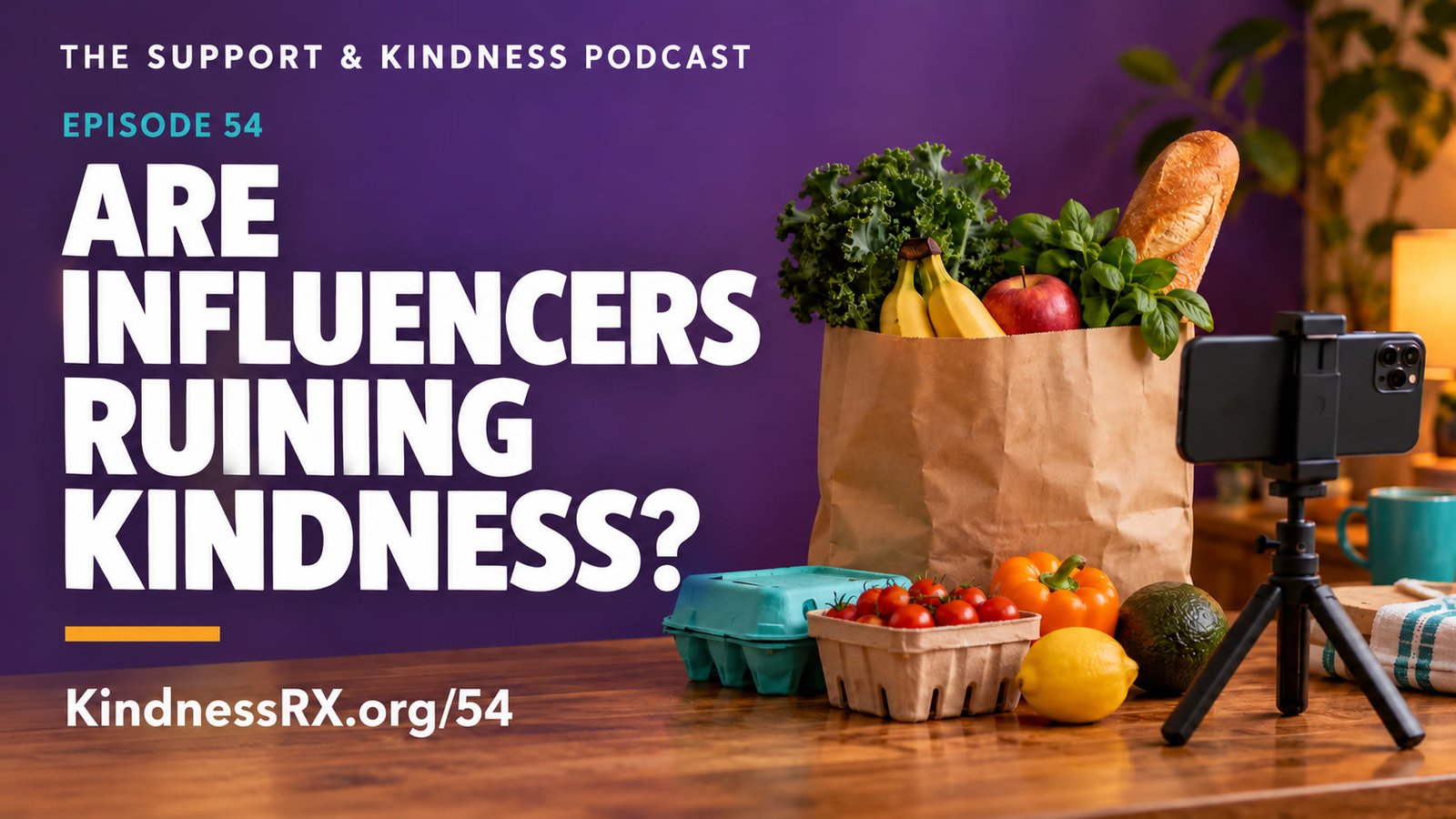
Are Influencers Ruining Kindness? Help, Consent, and the Camera
By Greg Shaw | KindnessRX | Companion to Episode 54 of The Support & Kindness Podcast
Someone is at the grocery checkout, putting things back because they don’t have enough money.
A stranger offers to pay. That could change their whole week.
Then a phone appears.
Maybe the person is relieved. Maybe they’re embarrassed. Maybe they have no idea how many people will see the video.
That’s where we started Episode 54. Rich, Liam, Sarah, and I talked about the good these videos can do, and the questions that come with them.
I don’t think every person making a kindness video is selfish. Some people have received real help through these videos. Viewers can feel encouraged to help too.
I also don’t think accepting groceries means someone has agreed to share their hardest day with the internet.
Listen to Episode 54 on Spotify.
Content note: We discuss money worries, homelessness, privacy, and public shame. The recording also includes occasional strong language.
Can someone say no without losing the help?
If you’re worried about feeding your children, refusing an offer of help may feel impossible.
Add a camera, and that decision gets harder. You might agree because you need the groceries. You might be too surprised to ask where the video will go.
Sarah put one possible response into words:
“I still need the help, but I don’t want to be filmed.”
That should be an option.
Before filming, explain what you’re making. Say where it will be posted, whether sponsors are involved, and who might see it.
Give the person time to think. Let them set limits. They may be comfortable sharing their own face but want their children kept out of it.
My view is that help should still be available when someone refuses the camera. Otherwise, their need becomes part of the pressure to agree.
Even with permission, think about what the video reveals. A school uniform, street sign, name badge, or hospital doorway can identify someone without you naming them.
Receiving help shouldn’t require a performance
We talked about videos where people have to prove they’re kind, grateful, or deserving before they receive anything.
I find that uncomfortable. Someone who is having a difficult day may be tired, startled, or overwhelmed. We don’t know their circumstances from a few seconds on a screen.
They may smile. They may cry. They may barely react.
None of those reactions tells us their whole story. If you offer help, leave room for the person to respond in their own way.
Sarah also questioned the idea that people need their kindness tested all the time. A staged situation can become entertainment for viewers while the person involved has no idea they’re being judged.
If a scene is acted or recreated, say so. People should be able to tell what they’re watching.
Can a good deed still be good when someone earns money?
Our conversation had more than one answer here.
Sarah was open about how much a major gift could mean to someone. Rich pointed out that television was earning money from emotional stories long before social media.
A person can receive useful help while the creator benefits too. We still need to ask whether the arrangement is fair.
Who receives the donations? What did the person agree to? Are there ongoing costs attached to the gift? What happens after the cameras leave?
In four experiments published in 2014, George Newman and Daylian Cain found that people sometimes judged an act benefiting both a charity and the giver more harshly than an act with no charitable benefit.
The study looked at how people judge motives. It didn’t measure the long-term benefit to people receiving help.
I take that as a reason to slow down before deciding we know someone’s heart. We can ask about consent, honesty, and outcomes even when motives are mixed.
A separate 2009 experiment by Ariely, Bracha, and Meier examined how visibility and financial incentives affect helpful behaviour. It offers background on reputation, but it wasn’t a study of today’s sponsored kindness videos.
For creators endorsing brands, the Federal Trade Commission’s influencer guidance says relevant brand relationships should be clearly disclosed. In video endorsements, that disclosure belongs in the video itself.
That guidance concerns endorsements and brand connections. It doesn’t mean every video earning platform income is a sponsored ad.
What the kindness research tells us
The research I mentioned in the episode was the American Psychiatric Association’s 2023 Healthy Minds Poll.
Morning Consult surveyed 2,210 U.S. adults. Ninety percent said receiving kindness made them feel at least a little better. Eighty-nine percent said giving kindness did.
Common acts included saying hello, holding a door, and giving a compliment.
It was a self-report poll. It didn’t test whether filming a good deed helps or harms the person involved.
Still, it reminds me how ordinary kindness can be. You don’t need to give away a house to make someone’s day easier.
Other research adds context. In a 2017 experiment involving 50 people, participants who committed to spending money on others showed greater increases in reported happiness than those who committed to spending it on themselves.
That was a small, controlled study. It doesn’t show that generosity treats depression or that every act of giving improves your mood.
The 2025 World Happiness Report also reviewed connections between caring, giving, and wellbeing. Its findings support taking everyday care seriously. They don’t settle the ethics of putting a recipient online.
What newer research adds about social media
The 2026 World Happiness Report looks at social media and wellbeing across different countries.
One chapter draws on a survey of more than 270,000 young people aged 15 to 16 in 47 countries. Relationships between use and life satisfaction varied by gender and region.
The report also describes differences between using technology to communicate and spending time with feeds built around scrolling and comparison.
This isn’t research specifically about kindness videos. Much of the evidence concerns associations, and the report includes different views about interpreting the wider research.
My practical takeaway is to notice what happens after you watch. Do you feel connected and ready to do something useful? Or do you feel ashamed that you can’t give as much as someone online?
If a feed leaves you feeling worse, you can step away. You can also turn an idea from a video into a small action that fits your money, health, and energy.
Sarah’s story shows another way to share kindness
One of my favourite parts of this episode was Sarah describing a family tradition.
At Christmas, she and her children would tape dollar bills around vending machines at Children’s Hospital. Family and people from their church community sometimes contributed too.
Someone working or staying at the hospital could use the money for a snack.
They took pictures of themselves doing it. They didn’t need to follow the people who used the money or capture their reactions.
Liam liked the idea of sharing the journey of helping. The preparation and time together can give viewers something they can try themselves.
Rich remembered helping pack food as a child. He described how doing something useful together can help people stay connected to their community.
If you want to share a good deed, you could show the volunteers, supplies, or preparation. You could explain how others can help. The person receiving support may never need to appear.
Ask the organisation first, especially in a hospital or another place where privacy matters.
Protect children and people who are vulnerable
A parent may welcome help while worrying about classmates seeing the family’s money problems.
A person without stable housing may be easier to locate once a video shows where they sleep. Someone escaping abuse may have reasons to keep their identity private that they can’t safely explain to a stranger.
We don’t have to demand those details before respecting a boundary.
UNICEF’s ethical reporting guidance puts children’s dignity, privacy, and best interests first. It also asks reporters to explain the purpose and intended use of interviews and images.
Those guidelines are written for reporting on children. I think they offer useful questions for anyone planning to share another person’s story.
A clarification about our episode: the conversation included broad claims about being allowed to film anyone in public. That is too sweeping. Recording rules vary, including rules about audio and private conversations. Publication and commercial use can raise further questions.
The Reporters Committee’s state-by-state recording guide is a useful U.S. starting point. For a specific project, get advice that fits your location and planned use.
You can disagree without joining a pile-on
You may see a video that feels wrong. You can question the behaviour without reposting the recipient’s face or private information.
If you want to discuss it, describe the concern. Ask whether there was informed permission. Ask what happened to the money.
Avoid guessing about someone’s diagnosis, character, or worth from a clip. Report harassment where appropriate, and think before giving harmful content more attention.
The same care should apply when we’re defending kindness. Someone who questions a video isn’t automatically against helping people.
TED Talks that take the conversation further
These talks weren’t discussed on air. They’re extra viewing for anyone who wants to keep thinking about the topic.
Elizabeth Dunn: Helping others makes us happier, but it matters how we do it
A useful place to start with the connection between giving and happiness. It can prompt a conversation about how to make helping feel personal and worthwhile.
Jon Ronson: When online shaming goes too far
This adds context to the damage a public pile-on can cause. It fits our discussion about responding to a troubling video without creating more harm.
Monica Lewinsky: The price of shame
Lewinsky speaks from her experience of public humiliation. Her talk asks us to consider the person living with the attention after the audience moves on.
TED Talks offer ideas and personal perspectives. They’re useful alongside the research, rather than as proof of every claim.
A small challenge for this week
If you’re low on energy, send a private thank-you. Tell someone their support mattered. You don’t need to share their reply.
If you can offer help, ask what would be useful. Picking up groceries or checking in may fit better than a surprise.
If you want to post about it, ask permission first. Make room for a no, and let the person choose how much of their story they share.
I’d love to hear your thoughts. What rule would you want every kindness creator to follow?
Listen to The Support & Kindness Podcast.
Find support and connection
KindnessRX offers free online peer support groups for brain injury, chronic pain, and mental health. Find the group details here.
We share experiences and support one another. The groups don’t replace therapy or medical care.
If this topic brings up distress and you need immediate emotional support in the U.S., call or text 988, or chat with the 988 Suicide & Crisis Lifeline. You can reach out for emotional distress as well as suicidal thoughts. If there is immediate physical danger, call 911.
Outside the U.S., Find A Helpline can help you look for support in your country.
This article shares peer perspectives and general information. It isn’t medical or legal advice. Research links were checked September 30, 2026.