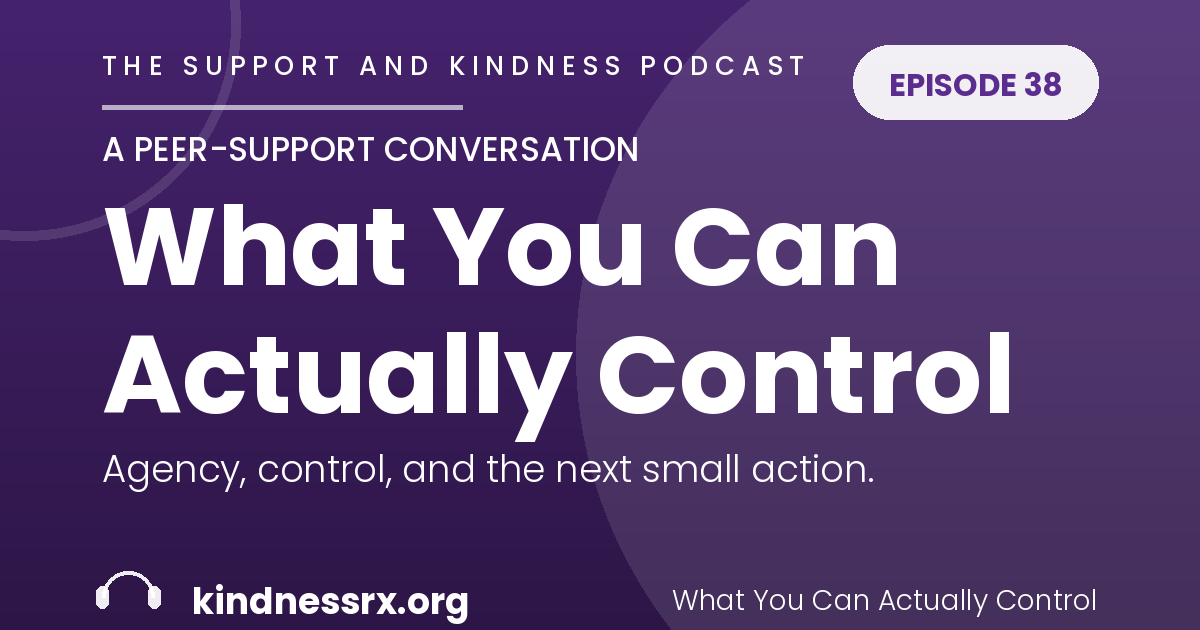
Episode 38: What You Can Actually Control
What You Can Actually Control
It usually doesn’t announce itself. It’s late, you’re scrolling, and there’s a low hum underneath everything — politics, prices, headlines, people you can’t reach, a future you can’t quite see. You’re not upset about one specific thing. You’re just heavy. And tired. And small. If you’ve felt that lately, you’re not imagining it, and you’re very much not alone.
On Episode 38 of The Support and Kindness Podcast, Greg sat down with co-hosts Rich, Derek, and Sarah to name that feeling out loud and ask a more useful question than “how do I fix the world?” The question was: when so much is genuinely out of your hands, what’s actually still yours?
The word for what’s missing is agency
Greg opened by defining the thing most of us feel the absence of before we have a name for it: agency. It’s the felt belief that what you do shapes what happens next — what researchers call an internal locus of control. The opposite is the sense that life just happens to you, that nothing you do moves the needle, that you’re along for the ride.
And here’s the misconception worth naming up front: a sense of agency is not the same thing as controlling everything. Nobody controls everything. What the episode is really about is smaller and more honest — knowing exactly where your power lives, and using it there.
The timing isn’t an accident. The Spring 2026 Harvard Youth Poll surveyed more than two thousand young Americans and found that the most defining shift compared to 2018 was a loss of perceived agency — a growing belief that what they do no longer shapes what happens next. Half of young adults now say people like them have no real say in what government does, and trust in the federal government dropped to fifteen percent, the lowest ever recorded in that poll. It’s a poll about young people, but the feeling it describes — “nothing I do matters” — isn’t limited to one age group. It’s in the kitchen, the group text, the doctor’s office, and the support group.
Why powerlessness isn’t weakness
Here’s where it starts to matter for your health. A 2025 study in Scientific Reports looked at nearly four thousand people and found that an internal sense of control — the belief that your choices affect your outcomes — was linked to a lower prevalence of depression. People who feel they have some say in their lives tend to be measurably less depressed and less anxious than people who feel they don’t.
That’s not a coincidence; it’s your nervous system listening. When you feel powerless, your body responds like you’re in danger. A 2025 review in Frontiers in Psychiatry pointed out that when people repeatedly perceive a lack of control, that experience is closely linked to the development of depression itself. Helplessness, in other words, isn’t only an emotion — it’s a pattern the nervous system can learn.
Which means your tiredness is not a character flaw. As Greg put it, it’s a response to genuinely overwhelming input. And the good news — the heart of the whole episode — is that the same brain that can learn helplessness can also learn the opposite. Researchers call it learned controllability: the brain learning that yes, you can respond effectively to what’s in front of you, and that learning builds resilience.
‘You can’t pour from an empty cup’
Asked how he stays grounded while hearing from struggling people all day, Greg reached for two images. The first was the empty cup: if yours is empty, you can’t pour from it. The second was the oxygen mask — the one they tell you to put on yourself before helping your child.
“If you put your child’s mask on but not your own and you pass out, it’s great that your kid doesn’t pass out — but who’s going to help them off the plane?” — Greg
He was honest that he learned it the hard way: trying to help everyone, burning out, and stepping back from social media and podcasting for a stretch. Caring about people, he realized, doesn’t obligate you to carry them. Rich added the flip side of why we get stuck in the first place: we’re creatures of habit, and repeating yesterday — even when it hurts — can feel safer than the one small step that might actually change things. It doesn’t protect us in the long run, Rich said. It just buys a feeling of protection in the present.
Control isn’t a dirty word
One of the episode’s most useful turns was a reframe. Greg admitted he used to hear “control” as something ugly — manipulation, controlling other people, controlling outcomes — and it took him years to see the other meaning. Rich located it precisely: control, in the healthy sense, is agency over yourself. He described not flying for a decade because the confined cabin took away his ability to simply get up and move — a small, vivid example of how much our well-being rides on autonomy.
Sarah brought the lived version. A self-described former “control freak,” she described a spinal cord injury that took away her ability to control much of anything, and the hard, freeing work of letting go and changing her thinking. Now, when the world feels chaotic, she picks one thing she can shape — a corner of a room, a part of the kitchen — and makes it functional. It’s small on purpose. “That helps me,” she said, “so maybe it can help somebody else.”
Attitude, gratitude, and the next small action
As the panel moved through what’s ours and what isn’t — our habits, our schedules, how we respond, our attitude on one side; politics, weather, other people’s opinions on the other — a theme emerged. Rich, drawing on a class he’s taking, noted that if you wake up expecting to hurt every day, you tend to; facing a day with a fresh attitude can change what you actually feel. Sarah pointed to people in prison, in poverty, in war-torn places who still find a sense of purpose, and concluded that if they can find one morsel to hold onto, the rest of us can too.
Greg landed it on gratitude: draw a line down a page, what you can’t control on one side and what you can on the other, and notice the running water, the roof, the food in the fridge.
Then Derek offered the image the episode will be remembered for. In the middle of describing the “organized chaos” he lives in, he talked about a hummingbird that showed up on his parents’ property for the first time in his life — something completely outside his control that quietly beautified the day. Sarah, delighted, had seen one that same week. Sometimes, Derek said, the thing you couldn’t control is the thing that brightens everything.
What you can actually do this week
The episode’s point isn’t to pretend the big stuff doesn’t matter. It’s to stop spending all your energy on the parts of the map you can’t reach. A few practical anchors from the conversation:
- Name where your power lives — your body, attention, time, relationships, community, and the next small action. That’s not a short list; it’s most of an actual life.
- Take ownership of the basics. Bedtime, wake time, your morning routine, caring for a pet. If that’s all you can control today, take responsibility for that and let tomorrow be its own day.
- Take a beat before responding. Sarah’s “count to ten” and Rich’s patience are real agency — you usually can choose your response.
- Make one deposit. Pick one area where you feel powerless, ask whether it’s truly outside your control, then do one small thing you genuinely have power over. Notice how you feel five minutes later.
Listen to the full episode
This is just the surface. The full conversation — including Greg’s oxygen-mask story, Sarah on rebuilding control after injury, and Derek’s hummingbird — is on The Support and Kindness Podcast. Listen on Spotify.
You’re not alone
If what you read here sounds familiar, you don’t have to carry it by yourself. KindnessRX hosts three free, peer-led support groups every week: Brain Injury Support on Mondays at 1:00 PM ET, Chronic Pain Support on Tuesdays at 12:00 PM ET, and Mental Health Support on Wednesdays at 7:30 PM ET.
No experts, no fees — just real people showing up for each other. You’re welcome exactly as you are. Find the full schedule at kindnessrx.org. And if you’re in crisis right now, in the U.S. you can call or text 988 for the Suicide & Crisis Lifeline, free and confidential, 24/7.
About KindnessRX
KindnessRX is a peer-led wellness community built on honesty, kindness, and zero judgment. Through The Support and Kindness Podcast and three free weekly support groups, we make space for the invisible things — chronic pain, mental health, brain injury, and the ordinary weight of being human — to be seen and gently met. Learn more at kindnessrx.org.