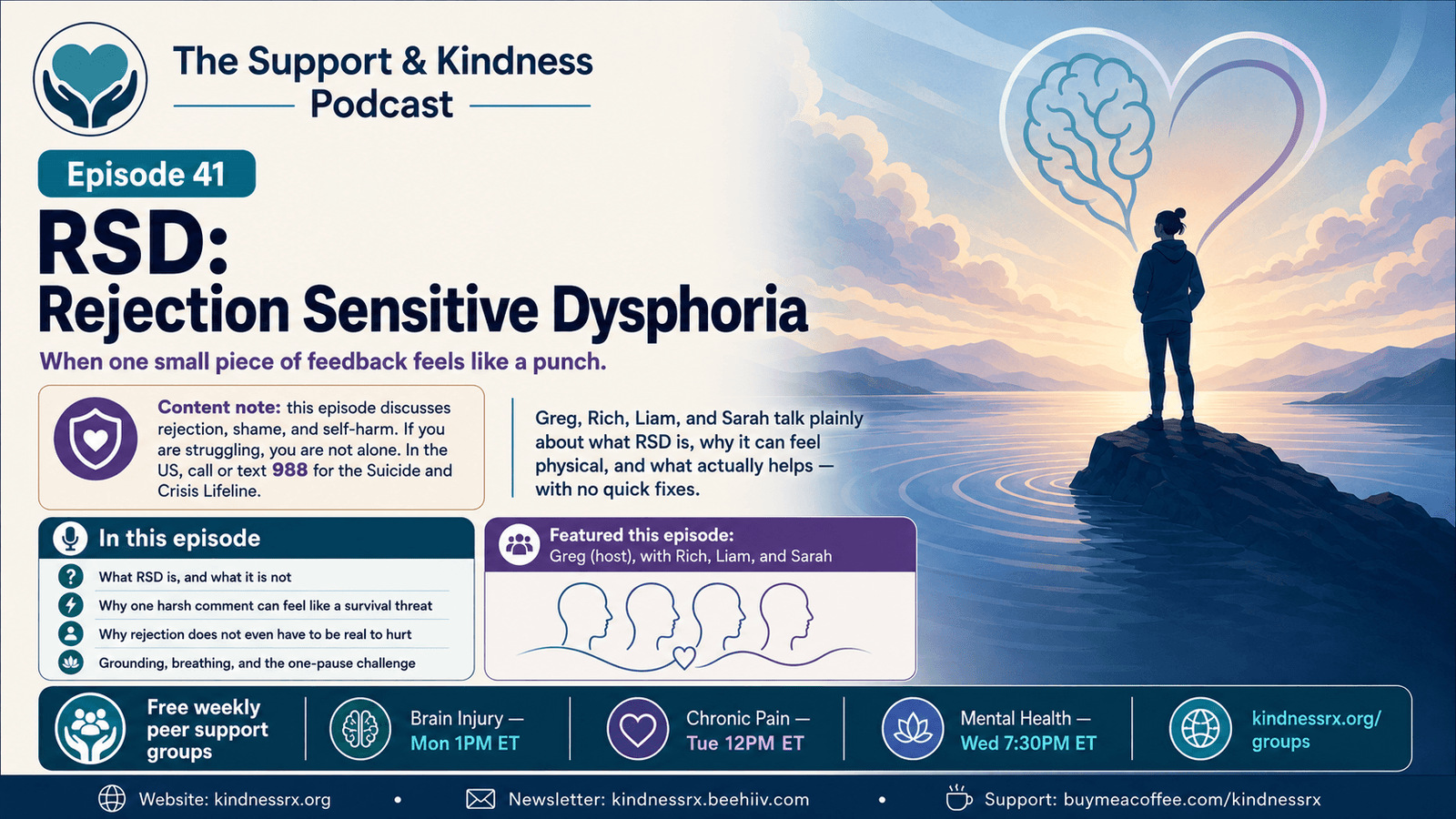
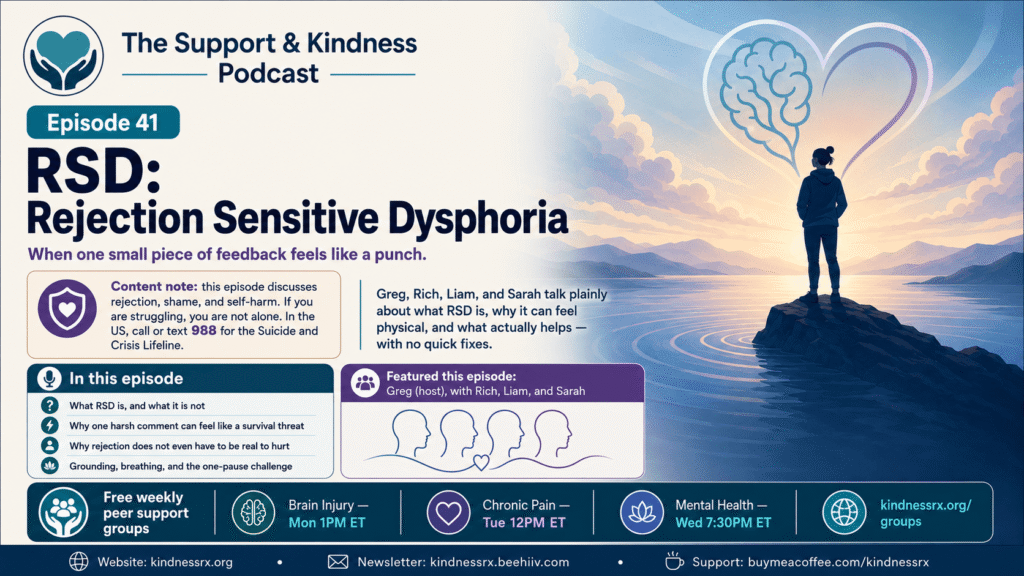
Episode 41: RSD: Rejection Sensitive Dysphoria
What rejection sensitive dysphoria actually is
You hand someone something you worked hard on. A report, a message, a meal, a favor. They look at it and say, “This is good, but we need to make a few changes.” For a lot of people, that is nothing. They say “okay, got it,” and move on. But maybe for you it does not land that way. Your stomach drops. Your face goes warm. And before you can think it through, your brain has already written the whole story: they think I am awful at this, everyone thinks I am awful at this, I am about to be found out.
That gap, between one small piece of feedback and the earthquake it sets off inside you, has a name. It is called rejection sensitive dysphoria, or RSD. It describes an intense, sometimes overwhelming emotional response to rejection, criticism, or failure, whether it is real or only perceived. The word “dysphoria” comes from Greek and means “difficult to bear,” which is about as honest a description as you will find (ADDitude / Dr. William Dodson).
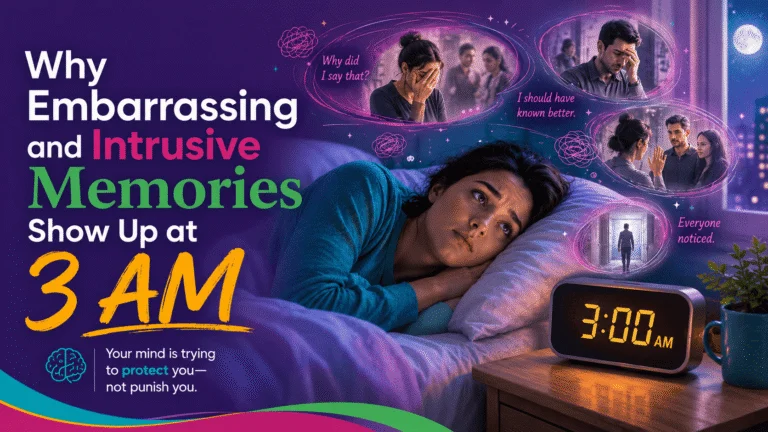
On this episode of the podcast, Greg, Rich, Liam, and Sarah sat with rejection sensitive dysphoria for a while, because it is the kind of thing that sounds small from the outside and feels enormous from the inside. One sentence of feedback, and you are up at three in the morning replaying every word, every pause, every facial expression. Some people call it an emotional sunburn, where everything suddenly feels too raw to touch.
Why it is not “being too sensitive”
Here is the part worth saying plainly: rejection sensitive dysphoria is not the same as being dramatic, and it is not a character flaw. It is a pattern clinicians describe, even though it is not listed in the DSM-5, the manual doctors use. The term was brought into wider use by psychiatrist Dr. William Dodson starting in the 1990s, and honestly, the research is still early and fairly limited.
You can see that in the numbers, which is where it gets interesting. Dodson, who put RSD on the map, estimates that up to 99% of his adult ADHD patients experience it at some point, and that about a third of them call it the single hardest part of living with ADHD. Broader research lands lower, with a range of roughly 30 to 70% of adults with ADHD struggling to manage their emotions in this way. So which number is right? We do not fully know yet.
But notice what that disagreement is actually about. As Greg put it on the episode, they are arguing about how common it is. They are not arguing about whether it is real, and none of them are calling it “too sensitive.” Liam made the same point from a different direction: “To say you are too sensitive, I do not think that can ever be correct, because whatever you have lived through, you are going to have your own reactions and your own viewpoint.”
Sarah, hearing the term for the first time, said something a lot of people will recognize: “As the gender that has been left out of the ADHD conversation for the entire existence of the condition, I did not even know this was a thing. So thank you for the validation.”
Why one criticism drowns out ten compliments
If you have ever collected ten kind comments and one harsh one and then carried only the harsh one around for a week, you are not broken. Rich framed it as survival wiring: “Our brains are evolutionarily wired to treat negative information as a survival threat that requires immediate attention, while kindness and praise get treated as safe and optional.” He added a number that stuck with the group: it can take five to seven positive interactions to counter a single negative one.
There is a physical layer underneath that, too. In a brain wired this way, the emotional response seems to come on faster and harder, with less of a pause between “something happened” and “I feel it.” And researchers have found that social rejection activates some of the same areas of the brain as physical pain. So when someone with RSD says “that hurt,” it is not just a figure of speech. It is closer to literal than we tend to assume.
Not just ADHD, and what that means
Rejection sensitive dysphoria gets talked about alongside ADHD most often, and for good reason, but it is not locked to it. It also shows up with autism, anxiety, mood disorders, and trauma histories, and it can affect people who are not neurodivergent at all (Newport Institute). On the episode, Rich put it simply: anyone can feel rejection, the bride left at the altar does not need a diagnosis. What seems to come with the ADHD brain is the frequency and the depth, the daily, low-grade version that most people do not see.
That same source names something important and worth not skipping past: when RSD turns inward, it can raise the risk of anxiety, depression, self-harm, and suicidal thoughts (Newport Institute). That is exactly why naming it matters, and why doing it alone is the hardest way to do it.
What actually helps in the moment
Nobody on the episode pretended there is a cure for rejection sensitive dysphoria. What there is, instead, is a set of tools you can keep close. Rich pointed to grounding techniques like the 5-4-3-2-1 exercise, where you name what you can see, hear, and touch to keep your thoughts from spiraling. Greg talked about slowing the breath right down, counting to five on the inhale, the hold, and the exhale, which slows the heart rate and takes the edge off the whole thing. He also described a visualization he uses from EMDR work: picturing a safe place and walking slowly through what you can see, smell, and hear there.
Liam offered the most physical one, the tool he keeps in his “utility belt”: a frozen water bottle held against the side of the neck. The cold gives you something immediate to focus on and helps settle the body. And nearly everyone came back to the same two anchors. Therapy, which Greg called probably the best tool for it, better over time than medication alone. And talking about it out loud, which Liam said is one of the first and biggest steps toward feeling less alone with the sensitivity, or at least more comfortable carrying it.
A small framework: name it, pause, reframe
If you want one structure to hold onto, the episode kept circling back to three moves. First, name it. Just saying “this is RSD, this is the wiring, not the truth” puts a little space between you and the spiral. Second, build a pause. The feeling comes on fast, so the goal is not to stop it, it is to slow the second between the sting and the story you tell about it. Third, reframe by checking the facts. Ask what you actually know is true, separate from what your brain is narrating, and then offer yourself the sentence you would offer a friend.
If you want to take that further, a good next step is self-compassion as a practiced skill rather than a mood. Dr. Kristin Neff’s work on self-compassion breaks the hardest part of RSD, treating yourself like someone you actually care about, into something you can practice on a normal Tuesday, not just a hard one.
Practical takeaways
- Name the pattern when it hits: “this is RSD, not a verdict on me.”
- Slow your breathing, or try 5-4-3-2-1 grounding, before you respond to anything.
- Keep a physical anchor handy, like a cold water bottle on the neck.
- Check the facts against the story your brain is telling, and keep only the facts.
- Say to yourself what you would say to a friend in the same spot.
- Talk about it with someone. Therapy helps, and so does saying it out loud in a group that gets it.
Questions people ask about RSD
Is RSD real, or am I just too sensitive?
It is real. Rejection sensitive dysphoria is a recognized pattern that clinicians describe, even though it is not a formal DSM diagnosis. The experts disagree about how common it is, not about whether it exists, and “too sensitive” is not the same thing as a nervous system that processes rejection faster and harder than most.
Why does one small comment ruin my whole day when I forget the ten good ones?
Because your brain files a harsh comment as a threat and a kind one as optional. As Rich put it on the episode, the negative one reaches the survival part of the brain, so it sticks, while the good ones often fade in a few days. It can take several positive interactions to balance out a single negative one.
Is this just anxiety or depression?
The panel was clear that it can stand on its own. Sarah, who lives with both anxiety and depression, said rejection sensitive dysphoria feels separate from them. Research backs the idea that it is its own thing while still overlapping with mood and anxiety conditions (Newport Institute).
Do you have to have ADHD to feel rejection this strongly?
No. Anyone can feel rejection deeply, and rejection sensitive dysphoria is not exclusive to ADHD. What seems to come with ADHD and other neurodivergence is how often and how intensely it shows up day to day (LifeStance Health). And it does not even have to be a real rejection, a perceived one can hit just as hard.
What helps in the moment, before the spiral takes over?
Grounding (5-4-3-2-1), slow breathing, and a physical anchor like a cold water bottle can interrupt the surge. Longer term, therapy and talking about it openly tend to do the most. The goal is a pause, not perfection.
Watch next
If you want a warm, funny, surprisingly moving take on facing the sting of rejection head-on, Jia Jiang’s TED Talk “What I Learned From 100 Days of Rejection” is worth twenty minutes. It is about deliberately seeking out “no” until it loses some of its grip, which is relevant to anyone who flinches at the word.
Listen to the full episode
This is just the surface of the conversation about rejection sensitive dysphoria. The full conversation, including Rich on survival wiring, Liam on a lifetime of being judged as a musician, and Sarah finding out this has a name, is on The Support and Kindness Podcast.
You are not alone
If what we talked about regarding rejection sensitive dysphoria sounds familiar, and you are carrying more than people can see right now, you do not have to carry it by yourself. KindnessRX runs three free, peer-led support groups every week, online and confidential. Brain Injury on Mondays at 1:00 PM ET, Chronic Pain on Tuesdays at 12:00 PM ET, and Mental Health on Wednesdays at 7:30 PM ET. No experts, no fees, just real people showing up for each other. You do not have to turn your camera on or say a word if you would rather just listen. Come whenever it feels right. Sign up or RSVP at kindnessrx.org/groups.
About KindnessRX
KindnessRX is a peer-led wellness community built on honesty, kindness, and zero judgment. We host The Support and Kindness Podcast and three free weekly support groups for people living with brain injury, chronic pain, and mental health challenges. We are not experts. We have lived experience, and we care.
Sources and further reading
ADDitude / Dr. William Dodson, what RSD is: https://www.additudemag.com/rejection-sensitive-dysphoria-and-adhd/
ADDitude / Dr. William Dodson, prevalence in his ADHD patients: https://www.additudemag.com/rejection-sensitive-dysphoria-adhd-emotional-dysregulation/
Cleveland Clinic, RSD overview and the brain-pain link: https://my.clevelandclinic.org/health/diseases/24099-rejection-sensitive-dysphoria-rsd
Psychology Today, the actual research on RSD: https://www.psychologytoday.com/us/blog/if-i-be-waspish/202604/rejection-sensitivity-dysphoria-the-actual-research
LifeStance Health, the 30 to 70% range: https://lifestance.com/blog/rejection-sensitive-dysphoria-adhd/
Newport Institute, RSD beyond ADHD and the risks: https://www.newportinstitute.com/resources/mental-health/rejection-sensitive-dysphoria/
PMC, lived-experience research on rejection sensitivity in ADHD: https://pmc.ncbi.nlm.nih.gov/articles/PMC12822938/
ADDA, plain-language guide to rejection sensitivity: https://add.org/rejection-sensitivity/
Jia Jiang TED Talk, What I Learned From 100 Days of Rejection: https://www.ted.com/talks/jia_jiang_what_i_learned_from_100_days_of_rejection
Great content! Keep up the good work!