Episode 40: The Cost of Kindness
Content note: This episode is warm and largely light, but one segment includes a co-host’s personal story of childhood family violence. If that’s heavy for you, it’s okay to skip ahead. You’re not alone — in the US you can call or text 988 (Suicide & Crisis Lifeline), or reach the National Domestic Violence Hotline at 1-800-799-7233.
Why we got the phrase backwards
Think about the last time someone was kind to you when they didn’t have to be. A stranger who waved you into traffic. A coworker who noticed you were having a rough day and just checked in. Odds are you still remember it — a three-second kindness that stuck. Now flip it around: the last time someone was sharp or dismissive with you probably stuck too, maybe even longer. That contrast is the whole episode.
We called it “The Cost of Kindness,” and the title is a little bit of a trap. It sounds like kindness is the thing that costs you — a tax on your time and energy. But that’s not what the research shows, and it’s not what five people who actually try to live this way found when they talked it through. The real cost isn’t kindness. It’s holding kindness back. (If you’ve been with us a while, this is the workplace sequel to Episode 32: Kindness as Medicine — we took the body science from that one and walked it into the office.) Understood that way, the cost of kindness isn’t what you pay to be kind — it’s what you lose when you hold kindness back.
Is kindness actually measurable, or is it just a nice idea?
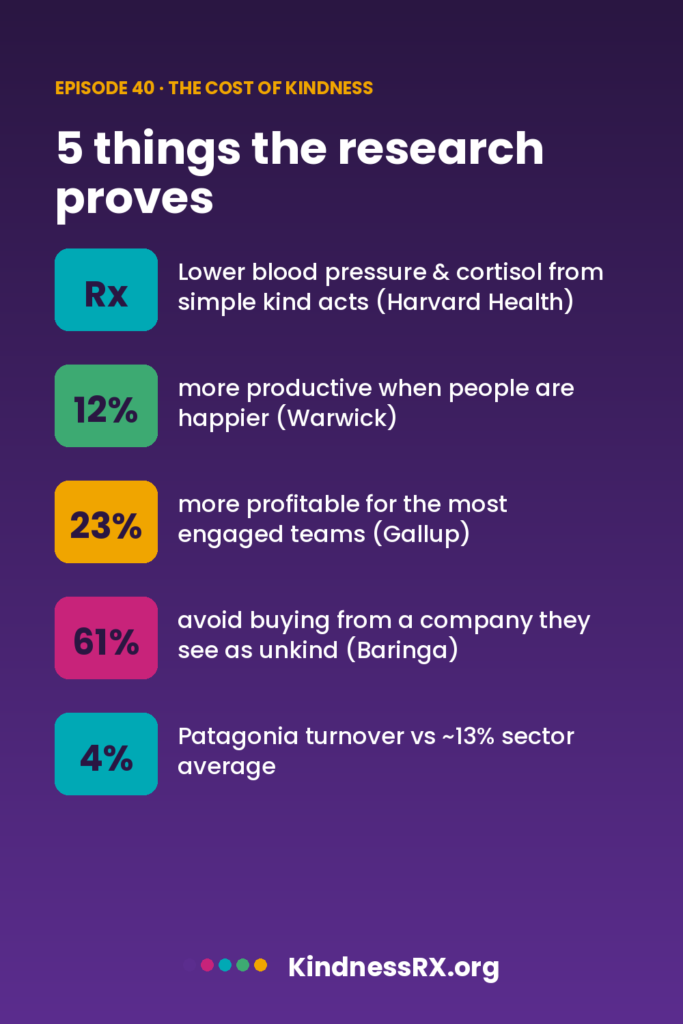
It’s measurable — start with the body. Harvard Health pulled the research together in 2025 and found that simple acts of kindness are linked to lower blood pressure and lower cortisol — your main stress hormone. Being kind literally helps settle your body down. And it spreads: researchers describe a “profound contagiousness to kindness,” where one kind act tends to make the receiver kinder to the next person. Liam put the neuroscience in his own terms on the show — “warm fuzzies” — which, as Greg pointed out, is a pretty fair nickname for the oxytocin released when we give or receive kindness.
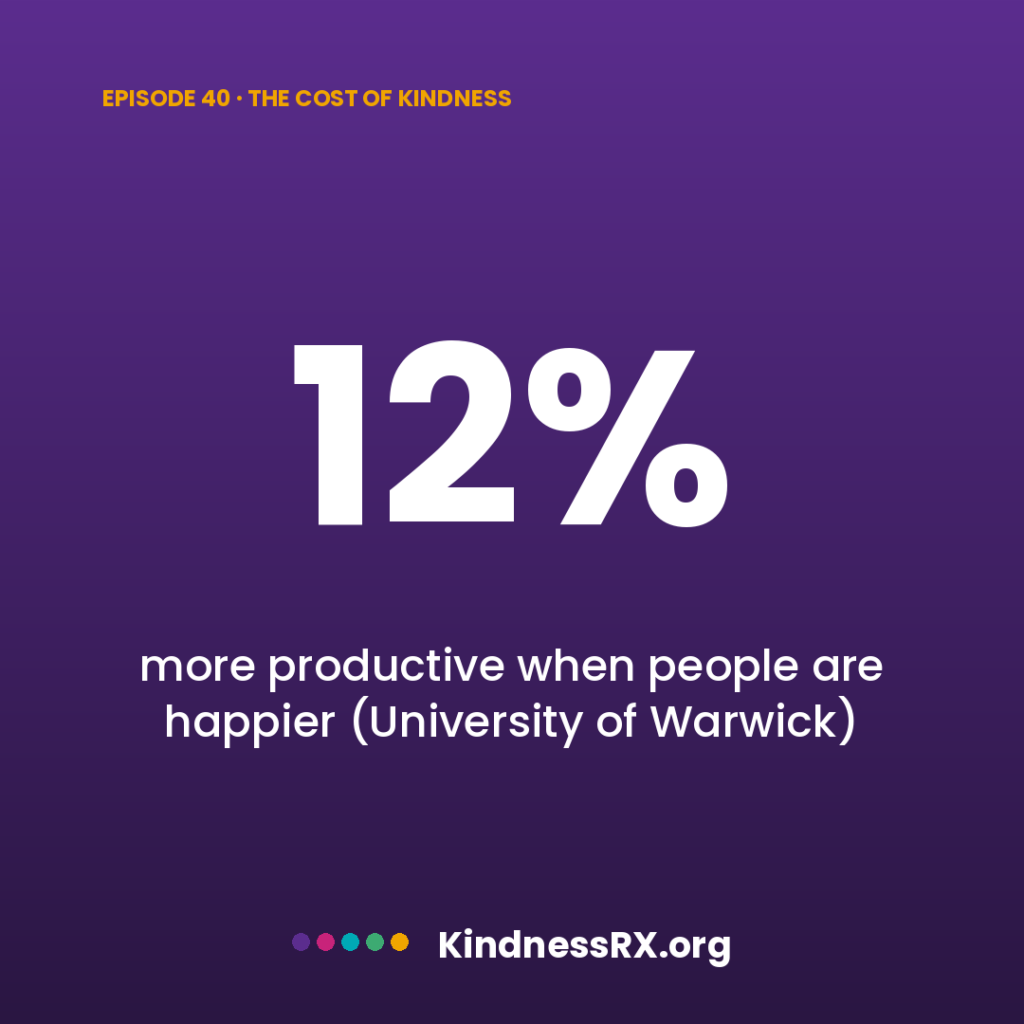
Then there’s the work side. Economists at the University of Warwick ran a series of experiments and found that happier people were about 12% more productive — not because they rushed, but because they used their time better. That thread runs through the whole episode: most of us spend a huge chunk of our lives at work, and the kindness (or unkindness) we meet there follows us home. It shapes our stress, our sleep, and how much we have left for the people we love.
So what does unkindness actually cost?
Christine Porath, a Georgetown researcher, has spent two decades studying rudeness at work — what she calls incivility. Not screaming matches; the small stuff. The dismissive reply, the eye-roll, the email with an edge, getting cut off in a meeting. Among people treated that way, 80% lost work time just dwelling on it, 66% said their performance got worse, 78% said they cared less about the company, and about one in eight quit over it (Harvard Business Review). One unkind culture, and people quietly check out, do worse work, and walk out the door. That’s not soft. That’s expensive.
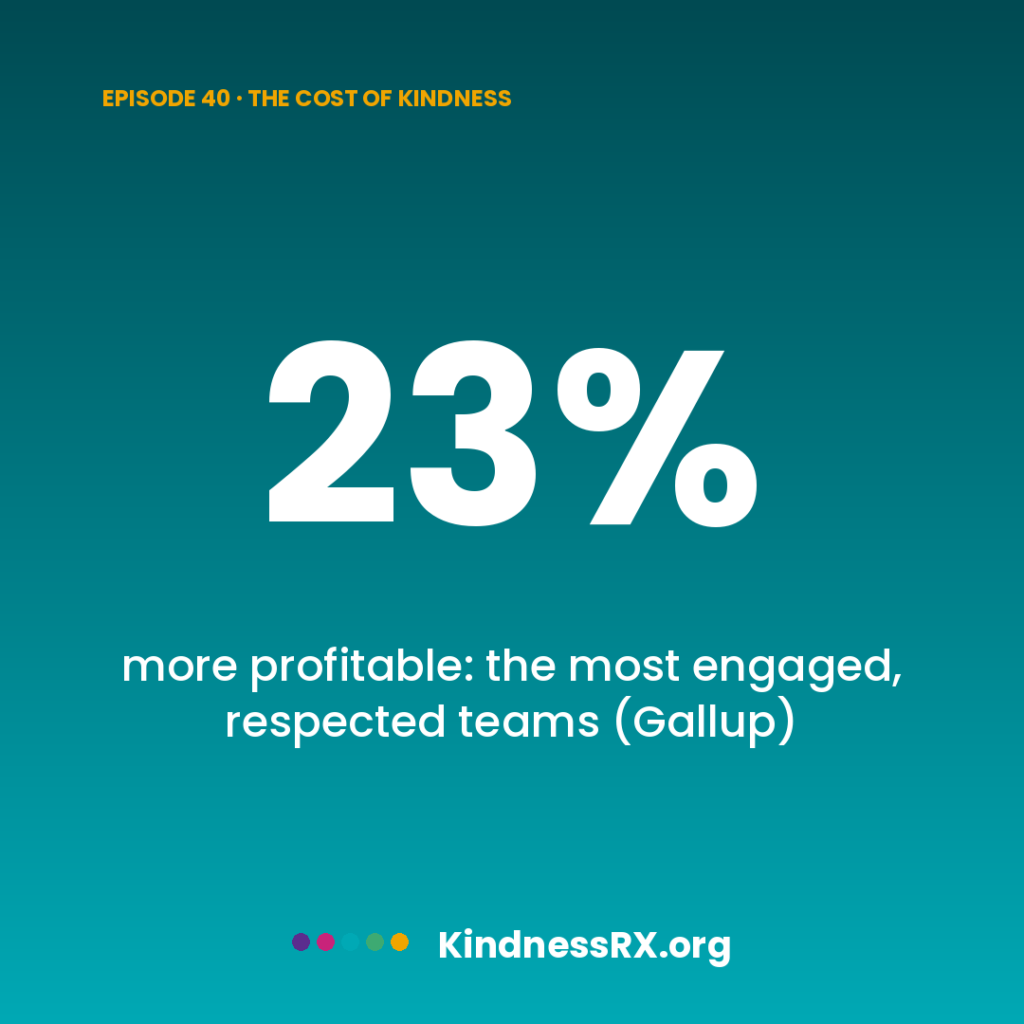
Turn it around and the picture flips. Gallup runs one of the largest workplace studies in the world, across hundreds of thousands of teams, and the most engaged ones — where people feel valued and respected — are about 23% more profitable, with lower turnover and fewer absences. It reaches customers, too.
The consulting firm Baringa found that 61% of people had avoided buying from a company in recent years because they believed it was unkind. People vote with their wallets. Patagonia keeps annual turnover around 4% against a sector average near 13%, partly by investing in its people since it opened on-site childcare back in 1984. And when Satya Nadella made empathy central at Microsoft in 2014, people stopped working in fear — and in the decade that followed the company’s value grew from roughly $300 billion to about $3 trillion. Many things drove that, but Nadella says the culture shift came first.
But doesn’t kindness just get you walked on?
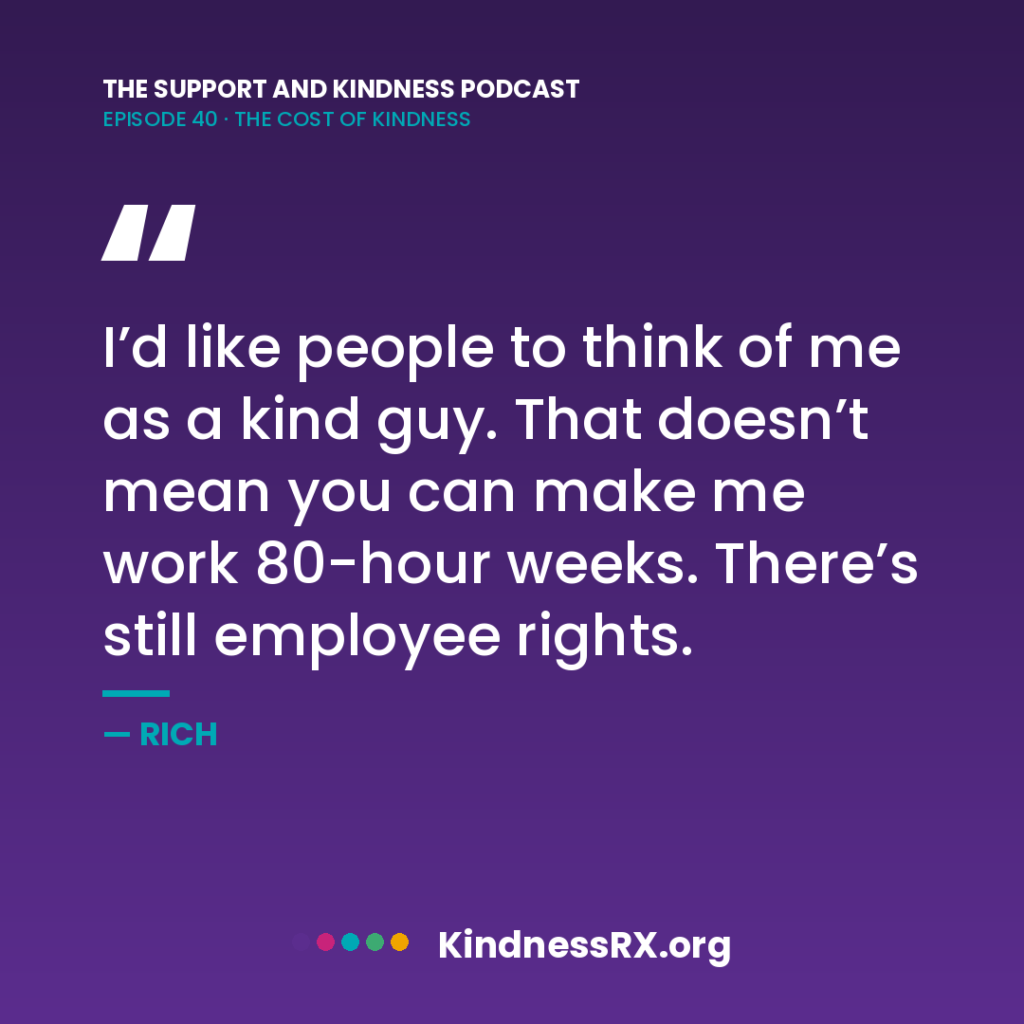
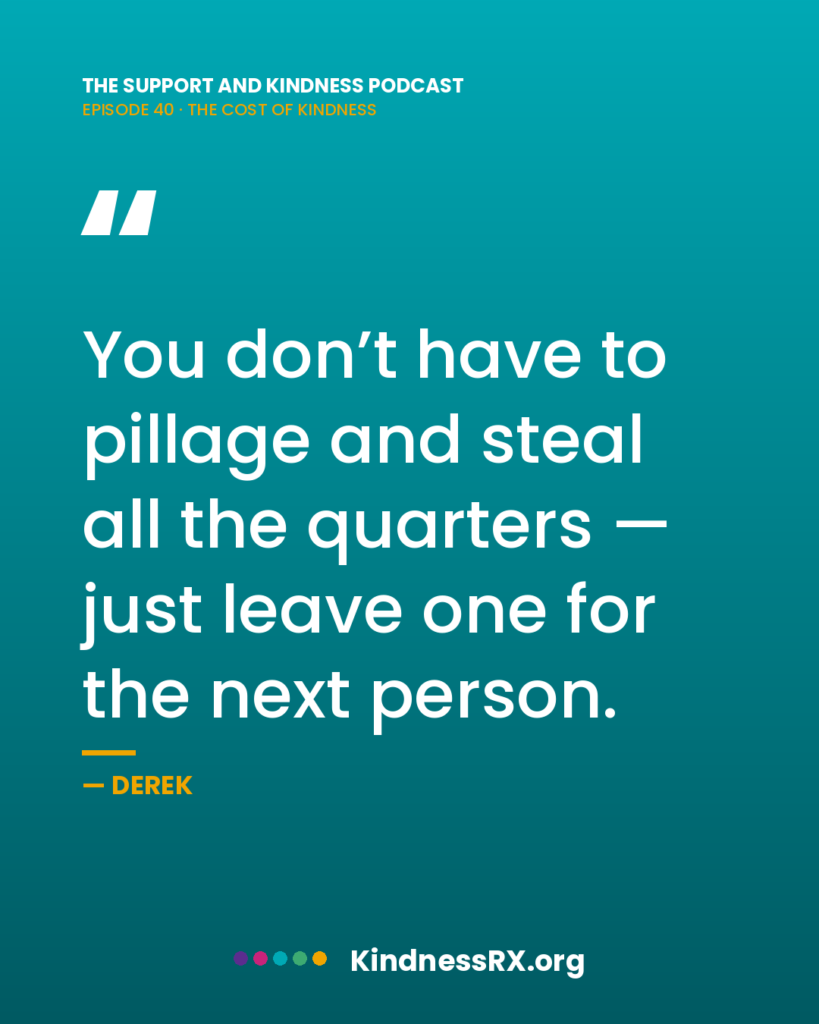
This is where the panel got honest. Sarah named it plainly: two of her kids are kind at work and both get walked over — moved around, taken advantage of by management — because they struggle to find the line between kindness and standing up for themselves. Rich drew that line clearly: “I’d like people to think of me as a kind guy. That doesn’t mean you can make me work 80-hour weeks. There’s still employee rights.” Kindness, in other words, is not a pushover. As Greg put it, no is a complete sentence. Setting that limit is part of the cost of kindness too — it protects the kindness so it can last.
Liam added the part that matters for anyone running a team: the kind person who always covers the weekend shift is the one who gets asked again and again — until they burn out and leave. “Then you’ve got to replace them, retrain them, and the next person might not be anywhere near as good.” If you single out your kindest employee to absorb everyone’s slack, you don’t have a kind culture anymore. You have a hostile one with better branding.
What’s the difference between kindness and people-pleasing?
The panel drew a sharp distinction worth keeping. Kindness is genuine and authentic; people-pleasing is manufactured. “If you’re people-pleasing, you have an agenda — you’re looking for an outcome,” Liam said. “With kindness you get an outcome too, but it also works toward the person you’re engaged with.” Rich summed it up: kindness comes from a genuine place; people-pleasing can have any number of motives behind it. The tell is the boundary. Kind people can still say no.
What about being kind to yourself?
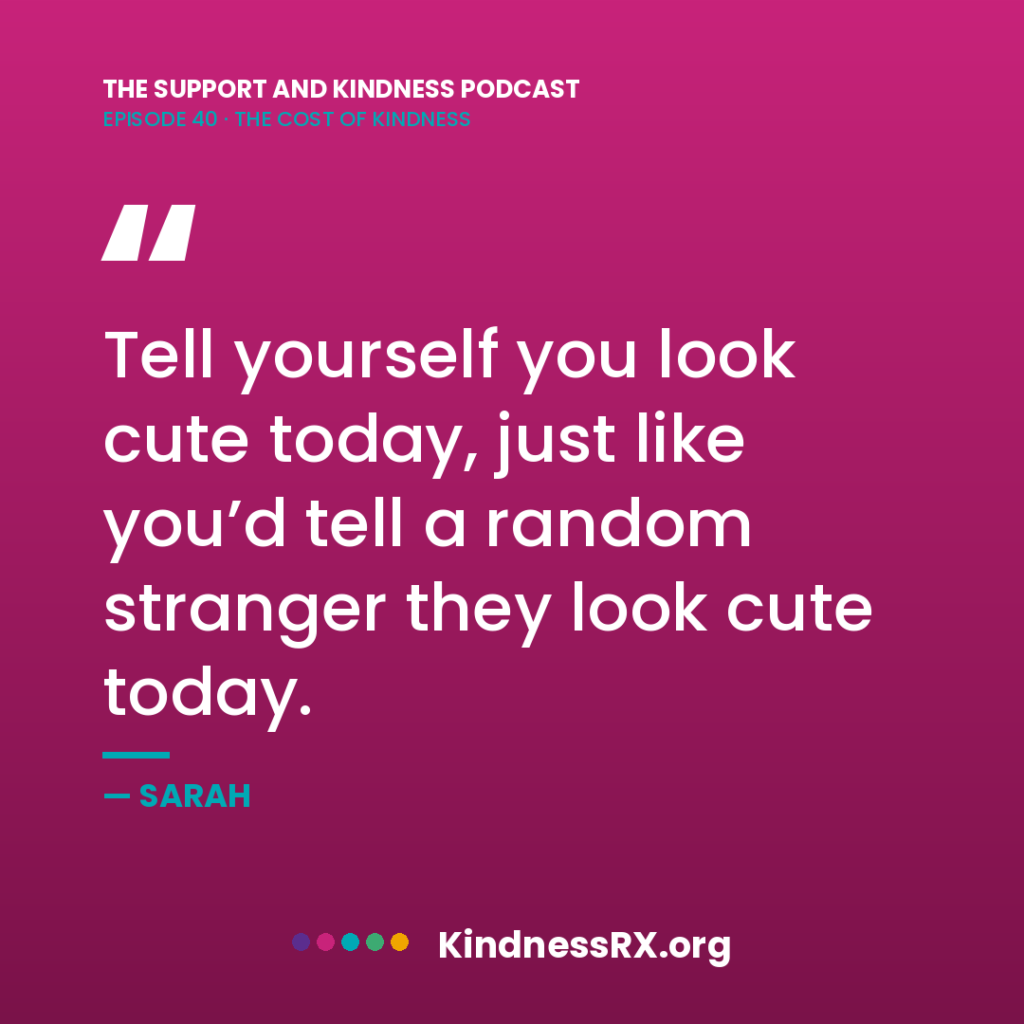
For all the workplace numbers, the episode kept circling back to something quieter: we forget to be kind to ourselves. Sarah’s version is the one that stuck — “Tell yourself you look cute today, just like you’d tell a random stranger they look cute today.” Derek offered the lowest-effort entry point for the days you’ve got nothing left: just show gratitude. The simplest word or gesture still counts as an act of kindness. (We dug into that fully back in Episode 17: Gratitude.)
Quick answers: your kindness questions
Does being kind really lower stress?
Yes. Harvard Health (2025) links simple kind acts to lower blood pressure and lower cortisol, and kindness tends to spread from one person to the next.
Is kindness a weakness at work?
No — but kindness without boundaries can be exploited. Pair it with clear limits: “no” is a complete sentence, and good cultures don’t dump everyone’s slack on their kindest person.
How do I tell kindness from people-pleasing?
Check the motive. Genuine kindness expects nothing back. People-pleasing is angling for an outcome — and usually can’t say no.
What’s one thing I can do this week?
Pick one person who made your week a little easier and tell them exactly what they did and why it mattered. Be specific — “You stayed late to help me. I noticed, and it really helped.” It takes less than a minute and tends to travel farther than you’ll ever see.
Practical takeaways
- Reframe it: kindness isn’t the cost. Withholding it is — in your health, your relationships, and your work. That reframe is the whole point of the cost of kindness.
- Set the boundary with the kindness, not instead of it. “No” is a complete sentence.
- Watch your kindest people. If the same person always covers everyone’s slack, that’s a culture problem waiting to become a turnover problem.
- Check your motive: genuine kindness expects nothing back; people-pleasing is angling for something.
- Turn it inward. Talk to yourself the way you’d talk to a stranger you wanted to be nice to.
This is just the surface. The full conversation — including Liam’s green-and-red-employees analogy, the “kill ’em with kindness” stories, and Greg’s Home Depot lesson on what a single customer is really worth — is on The Support and Kindness Podcast. If this episode shifted how you think about the cost of kindness, that conversation goes deeper.
Listen to The Cost of Kindness – Listen on Spotify
Related episodes
- Episode 7: Kindness — the foundational conversation that started this whole thread.
- Episode 37: Your Emotional First Aid Kit
You’re not alone
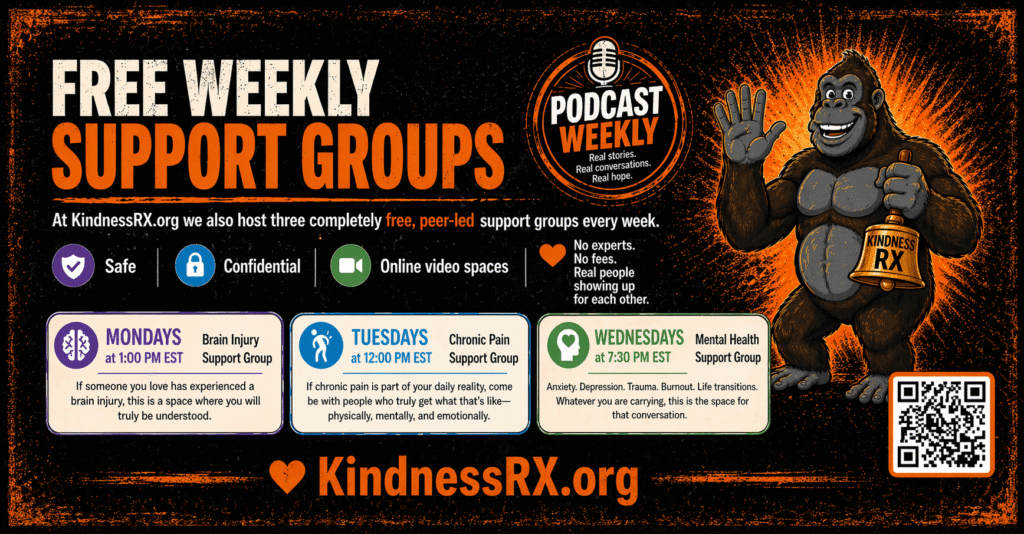
If this one felt familiar — if you’re carrying more than people can see — you don’t have to carry it by yourself. KindnessRX runs three free, peer-led support groups every week: Brain Injury on Mondays at 1:00 PM ET, Chronic Pain on Tuesdays at 12:00 PM ET, and Mental Health on Wednesdays at 7:30 PM ET. They’re safe, confidential, online video spaces — no experts, no fees, just real people showing up for one another. Sign up or RSVP any time on our Luma calendar.
About KindnessRX
KindnessRX is a peer-led wellness community built on honesty, kindness, and zero judgment. We make a weekly podcast and host three free support groups so no one has to hold it all together alone. Learn more at kindnessrx.org, subscribe to the newsletter, or help keep the groups free at Buy Me a Coffee.
This episode featured Greg with co-hosts Rich, Derek, Liam, and Sarah.