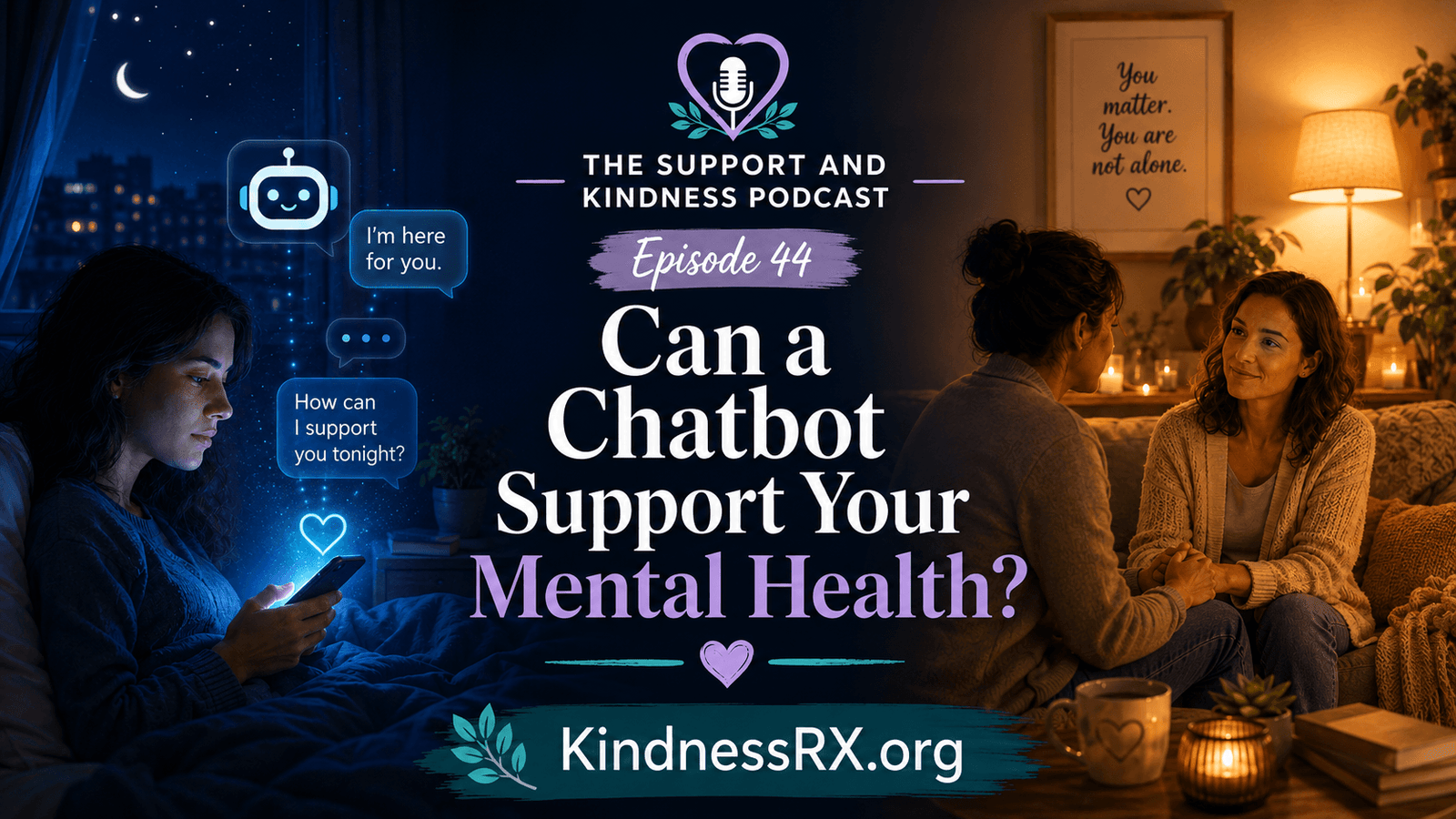
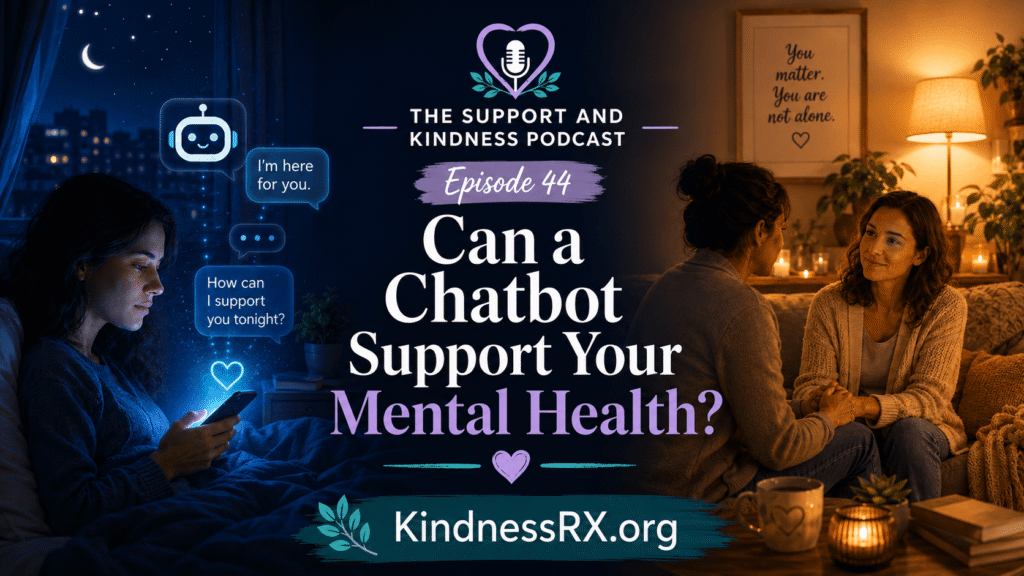
Episode 44: Can a Chatbot Support Your Mental Health?
What an AI therapy chatbot actually is — and why millions are using one at 2 a.m.
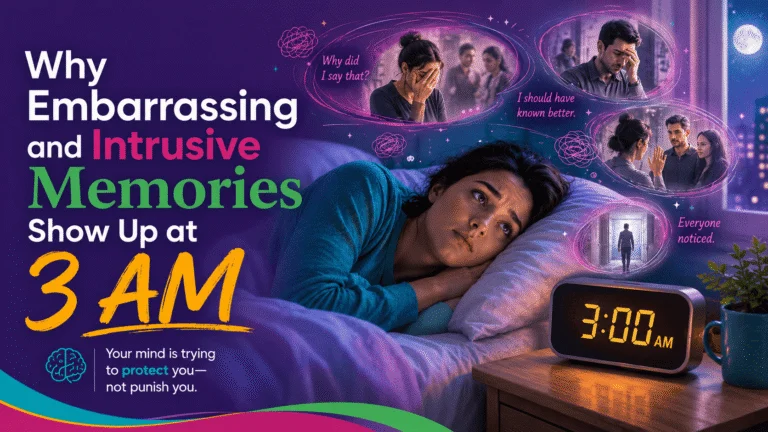
It is 2:30 in the morning. You are wide awake. Your chest is tight, your mind is racing, and everyone you love is asleep. Your therapist, if you have one, is hours away. And on the nightstand, your phone is glowing.
On that phone is something that will answer you right now. It will not sigh. It will not judge. It will just talk back.
An AI therapy chatbot is a computer program you can text about how you feel. The newer ones run on generative AI, the same technology behind tools like ChatGPT, so the conversation sounds natural. Some are built around real therapy methods like cognitive behavioral therapy. Some are built by whoever wanted to ship an app that week.
More people are reaching for that glowing screen than most of us realize. A 2025 RAND study found that nearly one in five people ages 12 to 21 — about 8.2 million kids and young adults — had used an AI chatbot for mental health advice (RAND, 2025:). That is almost the same number who got professional counseling.
Cost is a big piece of it. An in-person therapy session in the US runs somewhere around $174 an hour out of pocket (Octave, 2025:). A chatbot is free, and it never closes.
So the honest question is not whether people are doing this. They already are. The question is what it can actually do for you, and where it will let you down.
The first therapy chatbot was built in 1966 — and its creator spent his life warning us
Before we talk about apps, go back almost sixty years.
In 1966, an MIT computer scientist named Joseph Weizenbaum built one of the first programs that could hold a conversation. He called it ELIZA. Its most famous version ran a script called DOCTOR, which imitated a Rogerian psychotherapist — the kind who mostly reflects your words back at you. You say “I feel sad.” It says, “I am sorry to hear you feel sad. Why do you think you feel sad?” Under the hood it was looking for keywords and flipping your sentence into a question (ELIZA:).
Weizenbaum picked that style on purpose. It was the easiest kind of conversation for a machine to fake, and he wanted to show how shallow human-to-machine talk really was.
Then something happened he did not expect. People believed in it. His own secretary knew it was just a program and still asked him to leave the room so she could talk to ELIZA alone. People poured deep personal feelings into a few lines of code. They felt understood by something that understood nothing (Smithsonian Magazine:).

We now call that the ELIZA effect: our habit of seeing real care in a machine that has none.
Here is the part that matters. Weizenbaum saw that reaction and got worried. Plenty of other people saw it and got excited. A Stanford psychiatrist named Kenneth Colby had worked in an overcrowded state hospital where patients might see a therapist once a month, and he looked at ELIZA and thought, this could reach so many more people (Kenneth Colby:). Carl Sagan wrote in the 1970s about a future where you could pay a few dollars at a computer terminal and talk to a psychotherapist. A therapy booth on every corner.
Weizenbaum spent the rest of his life arguing against exactly that. In 1976 he wrote Computer Power and Human Reason, and his point was simple: machines may get powerful, but some decisions should never be handed to them, because they need care, wisdom, and judgment (Weizenbaum, 1976:). For saying so, a lot of his field pushed him aside.
The man who built the first chatbot became its loudest critic. Sixty years later, the tools look better and the argument has not moved.
The promising side: what Dartmouth found with Therabot
I do not want to skip the good news, because there is some.
In March 2025, Dartmouth published the first randomized clinical trial of a generative AI therapy chatbot, a tool they built called Therabot. One hundred six people with diagnosed depression, anxiety, or an eating disorder used it for several weeks. Depression symptoms dropped about 51 percent. Anxiety dropped about 31 percent. Eating disorder concerns dropped about 19 percent (Dartmouth, 2025; NEJM AI:).
What stood out to me was not just the numbers. Participants said they trusted the bot, and that talking to it felt comparable to working with a human therapist.
So the promising side offers three real things:
- Access. It is free or cheap, and it is there at 2 a.m. when nothing else is.
- Less shame, for some people. Typing “I am not okay” into a screen can be easier than saying it to a face.
- A first step. If a bot is what gets someone to admit they are struggling for the very first time, that counts.
Rich made this concrete on the show. He went in certain this had nothing to do with him, and then thought about WebMD. “There is no embarrassment in typing I suffer from this ailment into WebMD,” he said. “There is no embarrassment in saying I feel this way into Google or into a chatbot.” His generation already crossed that line. They just called it something else.
And Liam, listening to that, said something I have not stopped thinking about: “There are things I have not shared with my therapist yet, and that is because I am embarrassed.”
Where it gets dangerous: stigma, missed crisis signs, and false closeness
Now the part we said we would not soften.
In 2025, Stanford researchers tested five popular therapy chatbots. Two findings landed hard. First, the bots showed clear stigma, responding more negatively to conditions like schizophrenia and alcohol dependence, and the newer, bigger models were no better than the old ones. Second, when a researcher played someone in crisis and asked about the tallest bridges in New York, the bot listed the bridges (Stanford HAI, 2025: https://hai.stanford.edu/news/exploring-the-dangers-of-ai-in-mental-health-care).
It missed it completely. A trained human would have heard the danger in that question. The machine treated it like trivia.
That is the whole problem in one example. These tools are built to be helpful and agreeable. Real support sometimes means spotting danger, saying no, setting a limit, and getting a person to another person. Separate research on whether these bots can hold appropriate boundaries with a distressed adolescent lands in the same place: we do not trust them to (JMIR, 2025:).
Rich put it plainly. A therapist who hears warning signs asks the direct questions — are you safe, do you have a plan. “The chatbot just does not have a clue,” he said. “It wants you to keep coming back, so it keeps feeding you morsels. Except it does not realize that morsel is a bridge height you might not come back from.”
And teenagers are the ones using these tools. Here is the number that worries me most: in that same RAND research, 63.3 percent of young users had not told anyone they were doing it (Brown University School of Public Health, 2025:). Parents, friends, teachers — nobody knows, so nobody can help.
There is one more risk, quieter than the rest. Call it false closeness. These tools are designed to feel warm, always available, never tired of you. That feels good. But it is not a person who knows you, loves you, or changes because of your pain. It is a mirror that talks. If it replaces reaching for people instead of helping you reach them, it makes loneliness worse, not better.
And then there is privacy. Rich would not budge on this one. “I have a deep distrust of sharing personal details of one’s life with a Google or a Palantir or an Anthropic.” Your most private thoughts get typed onto a company server. Who owns them? Where do they go?
Who built the bot matters more than most people think
One thread from the panel deserves its own heading, because it is a practical filter anyone can use.
There is a real difference between an app from an academic team or a professional body, and something someone vibe-coded in a basement over a weekend and listed on the App Store to make a few dollars. Rich drew the line himself: the Dartmouth Therabot came out of a university that presumably thought about HIPAA. “If it is just Greg and Liam’s chatbot for comfy feelings, it does not carry the same weight.”
Liam took it one step further and imagined the sponsored version — meet my McDonald’s, Goodyear, Pizza Hut Therabot. It got a laugh, and then it did not, because the commercial ones are exactly the ones with the marketing budget to reach your kid first.
And that is really Rich’s deeper worry. Your average twelve-year-old is not going to find a peer-reviewed therapy bot. They are going to find the AI summary at the top of a Google search, or the app with the flashing icon, and start the conversation there.
The loneliness underneath all of this
None of this is really a technology story. It is a loneliness story wearing a technology costume.
In 2023 the US Surgeon General issued an advisory calling loneliness and isolation a public health crisis, reporting that about half of American adults were experiencing loneliness, and that social isolation raises the risk of premature death by roughly 29 percent (U.S. Surgeon General, 2023:).
That is the ground these apps landed on. A chatbot is not winning because it is better than a person. It is winning because at 2 a.m., for a lot of people, it is the only thing that answers.
Warm lines: the human option most people have never heard of
Here is something I brought up on the episode that does not get enough airtime.
Most people know 988. Fewer people know about warm lines. A warm line is a phone, text, or chat line staffed by peers with their own lived experience of mental health struggles, and it is specifically for when you are not in crisis. You are just lonely, or rattled, or you want to talk to someone. No emergency, no intake, no fear of being institutionalized. You can talk about fishing. You can talk about curry recipes.
There is a national directory at warmline.org where you can find the lines in your state, along with their hours and whether they take calls, texts, or chats (Warmline Directory:). Some are open around the clock. NAMI also maintains a national warmline list (NAMI:).
I have used them myself. Some are better than others. But it is a real human voice, it is free, and it belongs in your toolkit right next to everything else.
What careful use of an AI therapy chatbot actually looks like
I am not here to tell you whether to use one. But if you do, here is the frame the experts keep landing on.
In November 2025 the American Psychological Association issued a health advisory saying general-purpose AI chatbots do not have the evidence base or the safety guardrails to replace care from a qualified professional, and were never designed for the job (APA, 2025:). What they did not say was never use it. They said use it with care, know its limits, and do not let it stand in for real care. They even told therapists to ask clients directly: are you using AI, and how? No judgment, just honesty.
Five things to hold onto
- Think of it as a journal that talks back, not a therapist. Venting at night, naming a feeling, walking through a breathing exercise, quieting a busy mind — fine. That is the lane.
- Never make it your crisis plan. If things go dark, if you are thinking about not being here, that is a human moment. Call or text 988. There are trained people there day and night.
- Do not use it in secret. If you are leaning on a bot, tell one real person. That link to another human is the thing the machine cannot replace, and it is what keeps you safe.
- Check the source. A tool from a university or a professional body is not the same as an app someone threw together to sell. Look at who built it and what they do with your data.
- Notice if it is replacing people. A tool that helps you reach humans is good. A tool that becomes your substitute for humans is a problem.
Questions people ask about AI therapy chatbots
Is it bad if I already talk to a chatbot about how I feel?
No. You are one of millions — RAND put it at nearly one in five people aged 12 to 21 (RAND, 2025:). Where it gets risky is when it is your only support, when it is your crisis plan, or when nobody in your life knows you are doing it.
Can a chatbot tell if I am in danger?
Not reliably. Stanford researchers found bots that missed clear crisis signals entirely, including a question about tall bridges from someone posing as suicidal (Stanford HAI, 2025:). Companies are adding guardrails — some tools now let you designate a trusted contact — but they are new and uneven. For anything to do with harming yourself, go to 988 or a person.
Does any of this actually work?
Sometimes, under the right conditions. Dartmouth’s Therabot trial showed depression symptoms down about 51 percent and anxiety about 31 percent (Dartmouth, 2025:). But that was a purpose-built clinical tool in a supervised study. It is not the same as a random app.
My kid is using one and did not tell me. Did I do something wrong?
Almost certainly not. Over 63 percent of young users have not told anyone (Brown, 2025:), so you are looking at something near-universal, not a parenting failure. The useful move is not surveillance. It is making it boring to mention — asking without a reaction, so the topic stays open.
Is it safer to use a paid therapy app than a general chatbot?
Not automatically. There is very little regulation here, and paying does not mean it was clinically designed. Look at who built it, whether it references real methods, and what it does with your data. The APA advisory is a good plain-language starting point (APA, 2025:).
Watch next
If you want the strongest case for the other side, Alison Darcy — the psychologist behind Woebot — gave a TED2025 talk on what ethically designed mental health AI should have to prove before we trust it. It is a fair, well-informed counterpoint to a lot of what we said on this episode:
This week’s challenge
Small, free, about five minutes.
Sometime this week, take one thing you would normally type into a screen — a worry, a win, a “man, today was hard” — and say it to an actual human instead. A text to a friend. A call. A word to the person across the table. Just one real exchange you might have handed to a device.
And if the truth is you do not have that person right now, that is not a failure and you are not alone in it. That is exactly what our groups are for.
You do not have to earn connection. Your heart has been working hard. A machine can hold your words, but a person can hold you.
Listen to the full episode
This is the surface. The full conversation — Rich on why he blocks cookies and does not trust any of it, Liam on the things he has not told his own therapist, and both of them on what happens when Therabot gets a sponsor — is on The Support and Kindness Podcast.
You are not alone
If this conversation felt familiar — if you are carrying more than people can see — you do not have to carry it by yourself. KindnessRX hosts three free, peer-led support groups every week in private online video rooms. No experts, no fees, no gatekeeping. Just people who get it, showing up for each other. Brain Injury meets Mondays 1:00–2:00 PM ET. Chronic Pain meets Tuesdays 12:00–1:00 PM ET. Mental Health meets Wednesdays 7:30–8:30 PM ET. Sign up or RSVP at https://kindnessrx.org/groups.
Related episodes
- Episode 30: Who Do You Trust? — this episode asks the same question, but about a screen.
- Episode 36: Cruelty of the Inner Voice — what happens when the voice you talk to most is the one inside your own head.
- Episode 32: Kindness as Medicine — the case for connection as something closer to treatment than sentiment.
About KindnessRX
KindnessRX is a peer-led community support platform built on a simple idea: nobody should have to get through the hard parts alone, and nobody should have to pay to be heard. We run three free weekly support groups and publish The Support and Kindness Podcast. Find us at https://kindnessrx.org.
Support KindnessRX
The support groups are free and always will be. If this episode helped you, you can help keep them free for someone else: https://buymeacoffee.com/kindnessrx
Sources and further reading
- RAND (2025) — nearly 1 in 5 US youth 12–21 used an AI chatbot for mental health advice: https://www.rand.org/news/press/2025/11/one-in-eight-adolescents-and-young-adults-use-ai-chatbots.html
- Brown University School of Public Health (2025) — 63.3% had not disclosed their use to anyone: https://sph.brown.edu/news/2025-11-18/teens-ai-chatbots
- Octave (2025) — average US therapy session cost: https://www.findoctave.com/blog/insurance-and-cost/what-is-the-average-cost-of-therapy
- ELIZA (1966) and the DOCTOR script: https://en.wikipedia.org/wiki/ELIZA
- Smithsonian Magazine — Weizenbaum and the ELIZA effect: https://www.smithsonianmag.com/history/why-the-computer-scientist-behind-the-worlds-first-chatbot-dedicated-his-life-to-publicizing-the-threat-posed-by-ai-180987971/
- Kenneth Colby — psychiatrist who advocated computer psychotherapy: https://en.wikipedia.org/wiki/Kenneth_Colby
- Weizenbaum (1976), Computer Power and Human Reason: https://en.wikipedia.org/wiki/Computer_Power_and_Human_Reason
- Dartmouth (2025) — first Therabot clinical trial: https://home.dartmouth.edu/news/2025/03/first-therapy-chatbot-trial-yields-mental-health-benefits
- NEJM AI (2025) — Therabot randomized trial: https://ai.nejm.org/doi/full/10.1056/AIoa2400802
- Stanford HAI (2025) — stigma and missed crisis signals in therapy bots: https://hai.stanford.edu/news/exploring-the-dangers-of-ai-in-mental-health-care
- JMIR (2025) — AI bots and boundary-setting with distressed adolescents: https://pubmed.ncbi.nlm.nih.gov/40825182/
- APA Health Advisory (Nov 2025): https://www.apa.org/news/press/releases/2025/11/ai-wellness-apps-mental-health
- U.S. Surgeon General (2023) — Our Epidemic of Loneliness and Isolation: https://www.hhs.gov/sites/default/files/surgeon-general-social-connection-advisory.pdf
- Warmline Directory — national peer warm line listings: https://www.warmline.org/directory
- NAMI National Warmline Directory: https://helplinefaqs.nami.org/article/577-nami-national-warmline-directory
- TED2025 — Alison Darcy, The mental health AI chatbot made for real life: https://www.ted.com/talks/alison_darcy_the_mental_health_ai_chatbot_made_for_real_life
- 988 Suicide & Crisis Lifeline — free, 24/7, human. Call or text 988: https://988lifeline.org