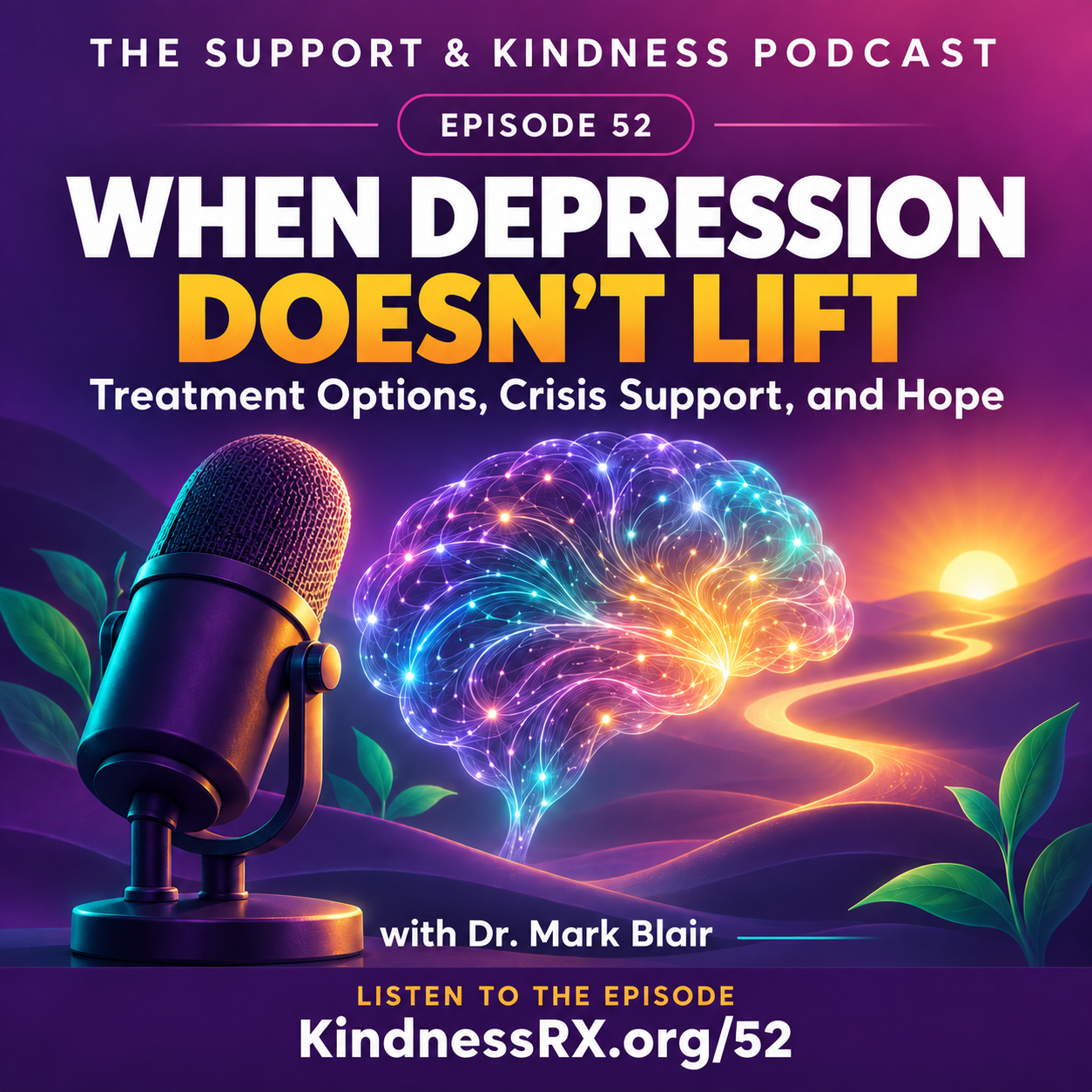
Episode 52: When Depression Doesn’t Lift—Treatment Options, Crisis Support, and Hope with Dr. Mark Blair
The Support & Kindness Podcast · Episode 52
By KindnessRX | A companion to The Support & Kindness Podcast
If you need help right now
In the United States, call or text 988 or use the 988 Suicide & Crisis Lifeline chat. The Lifeline is available 24 hours a day, every day, and you may contact it for yourself or because you are worried about someone else.
If there is immediate, life-threatening danger, call 911 or go to the nearest emergency department. Do not leave a person alone when you believe they cannot remain safe.
Outside the United States, use your local emergency number or find a country-specific crisis service through Find A Helpline.
Content note: This article and episode discuss depression, suicidal thoughts, suicide prevention, and mental-health crisis care. Please pause or step away whenever you need to.
When depression does not improve enough after medication, therapy, or both, it can begin to feel as though the available choices are disappearing. In Episode 52 of The Support & Kindness Podcast, psychiatrist Mark E. Blair, M.D., joins Greg, Rich, Liam, and Sarah to explain what treatment-resistant depression can mean, why a careful reassessment matters, and how treatments such as transcranial magnetic stimulation, Spravato, intravenous ketamine, and electroconvulsive therapy differ.
The conversation also addresses a subject that cannot wait: how to recognize a mental-health crisis, ask directly about suicide, respond without judgment, and prepare a written safety plan before it is urgently needed.
What This Episode Covers
- How clinical depression can differ from sadness, grief, or a difficult period
- What clinicians commonly mean by “treatment-resistant depression”
- Why diagnosis, dose, duration, adherence, sleep, substance use, pain, trauma, and medical conditions may need another look
- How traditional TMS and BrainsWay Deep TMS differ
- The practical differences between Spravato and IV ketamine
- Where ECT may fit when depression is severe or urgent
- Questions to ask any provider offering an interventional treatment
- Warning signs that depression may be becoming a crisis
- How to ask about suicide directly and compassionately
- What belongs in a written safety plan
Listen by Chapter
- 00:00 Welcome, content note, and 988 information
- 02:00 Meet Dr. Mark Blair
- 03:05 Lessons from hospital and crisis care
- 05:05 Depression, grief, stress, and when to seek an evaluation
- 06:50 What treatment-resistant depression means
- 08:45 Rechecking the diagnosis and other contributing conditions
- 10:30 How clinicians weigh treatment options
- 12:55 Traditional TMS and BrainsWay Deep TMS
- 16:20 Spravato versus IV ketamine
- 21:05 Choosing a responsible treatment provider
- 23:20 Signs that depression may be becoming a crisis
- 25:15 Asking directly about suicide and deciding what to do next
- 27:20 Helpful language, harmful responses, and written safety plans
- 29:00 A practical next step when it feels as though everything has been tried
- 31:25 “What’s on Your Heart?” and the podcast’s first anniversary
- 35:00 Why reaching out matters
- 37:00 Key takeaways, Kindness Challenge, and KindnessRX groups
About Dr. Mark Blair
Mark E. Blair, M.D., is a psychiatrist certified by the American Board of Psychiatry and Neurology and the founder and medical director of Optimum Wellness & TMS in Columbus, Ohio. He has more than 25 years of experience in psychiatry, including leadership roles at SUN Behavioral and Columbus Springs. He is also a U.S. Air Force veteran. His current practice focuses on interventional psychiatry and offers TMS, Spravato, IV ketamine, medication management, and related psychiatric consultation.
Optimum Wellness & TMS
Website: optimumwellnessandtms.com
New-patient information: Two Ways to Begin
Phone: 614-933-4200
Email: info@optimumtms.com
Address: 500 E. Main Street, Suites 110 & 130, Columbus, OH 43215
The practice states that it is not a 24/7 crisis service. For urgent crisis support in the U.S., call or text 988; use 911 or an emergency department for immediate danger.
What Does “Treatment-Resistant Depression” Mean?
There is no single definition used in every study or health system. A common clinical definition is major depression that has not improved adequately after at least two appropriate antidepressant trials. “Appropriate” matters: the medication, dose, length of treatment, consistency of use, tolerability, and degree of partial improvement all affect whether a trial has truly been adequate.
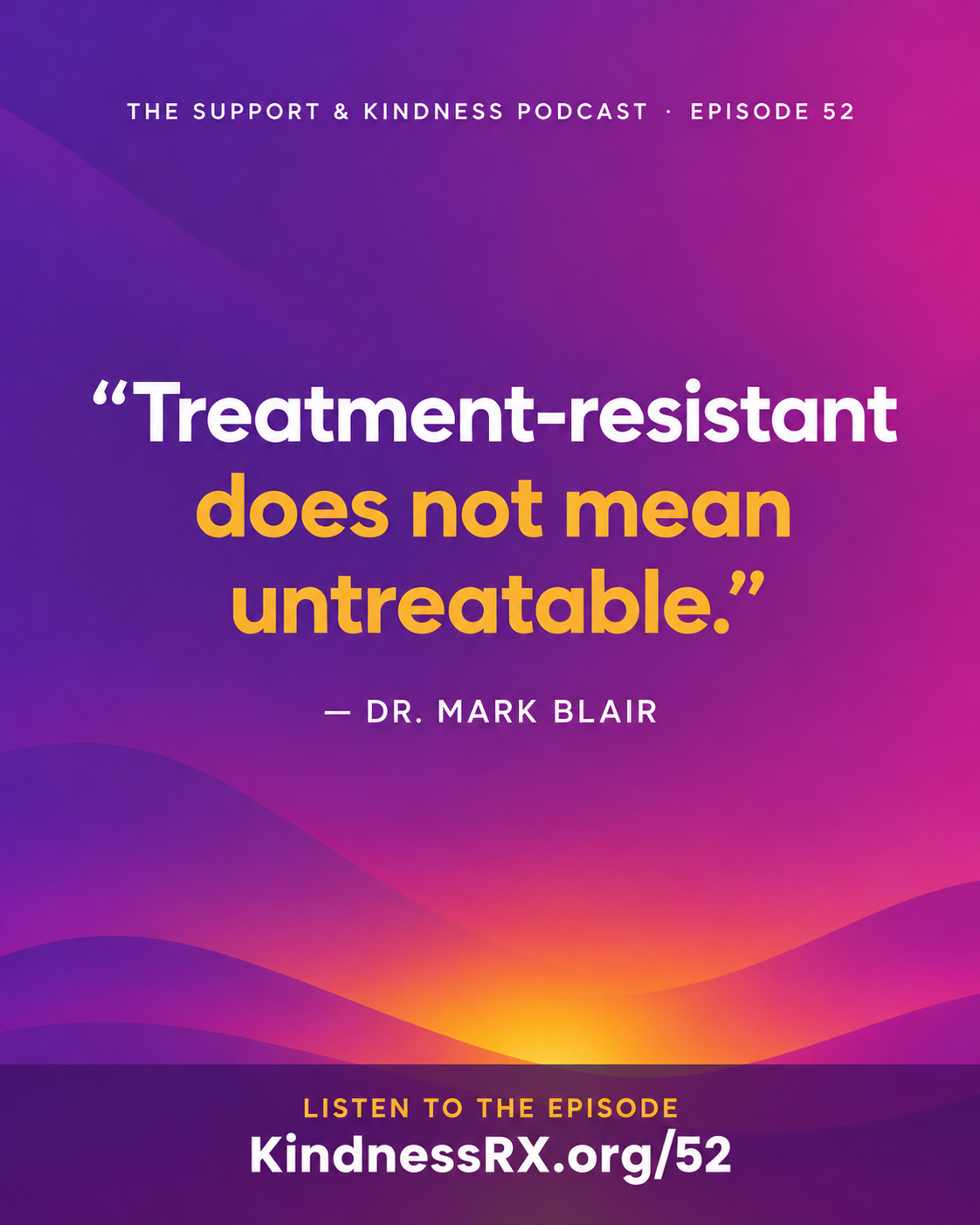
“Treatment-resistant” does not mean “untreatable.” It means the treatments tried so far have not been sufficient, and the illness may need to be approached differently.
Dr. Mark Blair, Episode 52
Before adding another treatment, Dr. Blair recommends stepping back and checking the full clinical picture. That can include screening for bipolar disorder, trauma, anxiety, alcohol or other substance use, sleep apnea, chronic pain, thyroid disease, anemia, medication effects, and other medical conditions. A detailed medication history—including the dose, duration, benefit, and side effects—can reveal that a previous treatment helped partly, was stopped too soon, or was aimed at an incomplete diagnosis.
The National Institute of Mental Health overview of depression explains common symptoms and routes to care. Persistent symptoms, declining function, hopelessness, or thoughts of suicide deserve professional attention; suicidal thoughts should not wait for a routine appointment.
Treatment Options Discussed in the Episode
These treatments are not interchangeable, and none is right for everyone. A qualified clinician should consider diagnosis, symptom severity, urgency, medical history, previous treatment, possible side effects, access, insurance, transportation, and the patient’s preferences.
| Treatment | How it is given | Practical considerations discussed |
|---|---|---|
| TMS / Deep TMS | Magnetic pulses delivered through a coil positioned at the head | Noninvasive; generally no anesthesia; frequent office visits over several weeks; headache or scalp discomfort can occur |
| Spravato (esketamine) | Patient-administered nasal spray in a certified healthcare setting | REMS requirements; monitoring and at least two hours of observation; transportation home is needed |
| IV ketamine | Ketamine delivered by intravenous infusion | Use for depression is off-label; dosing and maintenance are individualized; medical monitoring is important; insurance coverage may differ |
| ECT | Electrical stimulation under anesthesia to produce a controlled therapeutic seizure | May be considered for severe, psychotic, catatonic, suicidal, or otherwise urgent depression; possible confusion and memory effects should be discussed |
TMS and BrainsWay Deep TMS
Transcranial magnetic stimulation uses rapidly changing magnetic fields to stimulate neural circuits involved in mood and cognitive control. Traditional systems commonly use a focal figure-eight coil. The BrainsWay Deep TMS system discussed in the episode uses a helmet-based H-coil designed to stimulate a broader field.
A typical course involves weekday sessions across several weeks, although the protocol and session length vary. Unlike ECT, TMS ordinarily does not require anesthesia and does not intentionally induce a seizure. Common short-term effects can include scalp discomfort, facial-muscle sensations, headache, lightheadedness, or dizziness. Seizure is a rare but recognized risk. The NIMH guide to brain-stimulation therapies provides a neutral overview of both TMS and ECT.
A careful note about the Stanford research mentioned
The episode refers to recent Stanford research involving intermittent theta-burst stimulation. The most directly relevant Stanford program we could identify is Stanford Neuromodulation Therapy, formerly called SAINT: an accelerated, imaging-guided form of iTBS studied for treatment-resistant depression. Its schedule, targeting method, intensity, and research setting are not the same as a standard outpatient iTBS course or BrainsWay Deep TMS. Readers should not assume that results from one protocol automatically apply to another.
- Double-blind randomized controlled trial of Stanford Neuromodulation Therapy
- ClinicalTrials.gov record NCT03068715
- Stanford Medicine’s plain-language report on the study
Spravato (Esketamine Nasal Spray)
Spravato is the brand name for esketamine nasal spray. It is not a take-home medication. It is supplied and administered through certified healthcare settings under an FDA-required Risk Evaluation and Mitigation Strategy, or REMS. The patient uses the spray under supervision and remains for monitoring for at least two hours because sedation, dissociation, blood-pressure changes, and other effects can occur. Patients need transportation home and should follow the prescriber’s driving restrictions.
IV Ketamine for Depression
Ketamine has long been approved as an anesthetic. Intravenous ketamine used to treat depression is an off-label use, meaning the medicine is legally prescribed for a purpose that is not included in its FDA-approved labeling. It is related to esketamine, but it is not the same product or delivery method as Spravato.
Infusions are generally delivered over time with medical observation. Temporary dissociation, sedation, nausea, dizziness, and increased blood pressure can occur. Because there is no single FDA-defined IV-ketamine protocol for depression, provider qualifications, screening, monitoring, outcome measurement, and follow-up planning deserve close attention. The NIMH article “Cracking the Ketamine Code” explains the research history and the distinction between ketamine and esketamine.
ECT: Electroconvulsive Therapy
ECT—sometimes mistakenly written as “UCT”—stands for electroconvulsive therapy. It is performed under general anesthesia and uses a controlled electrical current to produce therapeutic seizure activity. It may be considered when depression is very severe, when a rapid response is needed, or when other treatments have not helped enough. Headache, muscle aches, nausea, confusion, and memory problems can occur; electrode placement and pulse width affect the risk of cognitive side effects. See the NIMH explanation of ECT for more detail.
How to Evaluate a Treatment Provider
Dr. Blair’s central advice is to begin with the person, not the procedure. Before starting TMS, Spravato, ketamine, or another intervention, consider asking:
- Who will complete the psychiatric evaluation and confirm the diagnosis?
- Why is this treatment a reasonable fit for my symptoms and history?
- What medical and psychiatric risks will be screened?
- Who will supervise the treatment, and what training do they have?
- How will vital signs, side effects, safety, and symptom changes be monitored?
- What happens if an emergency occurs during treatment?
- What costs are covered by insurance, and what could be out of pocket?
- What is the follow-up or maintenance plan if the treatment helps?
- What is the next plan if it does not help enough?
Promises of a cure, a guaranteed response, or a “miracle” outcome are warning signs. Responsible care includes an honest discussion of benefits, limitations, uncertainties, alternatives, and practical demands.
“Why do you believe this is the right treatment for me, how are you going to monitor my safety and my progress, and what is the plan if it works—or if it doesn’t?”
A question Dr. Blair recommends asking
When Depression May Be Becoming a Crisis
A single sign does not tell the whole story. Pay particular attention to a rapid or serious change from the person’s usual behavior, especially after a loss, painful event, or major change. Possible warning signs discussed in the episode include:
- Increasing isolation or no longer responding to family and friends
- Stopping work, school, eating, showering, or other basic self-care
- Spending nearly the entire day in bed
- Escalating alcohol or other substance use
- Statements such as “Everyone would be better without me” or “There is no point anymore”
- Researching suicide methods or obtaining access to lethal means
- Giving away important belongings, saying goodbye, or preparing for death
- Psychosis, severe impairment, or being unable to care for oneself safely
Current suicidal intent, a plan with access to the means, a recent or ongoing attempt, or an inability to keep the person safe is an emergency. Call 911 or go to an emergency department. Stay with the person while help is being obtained when it is safe for you to do so.
How to Ask About Suicide
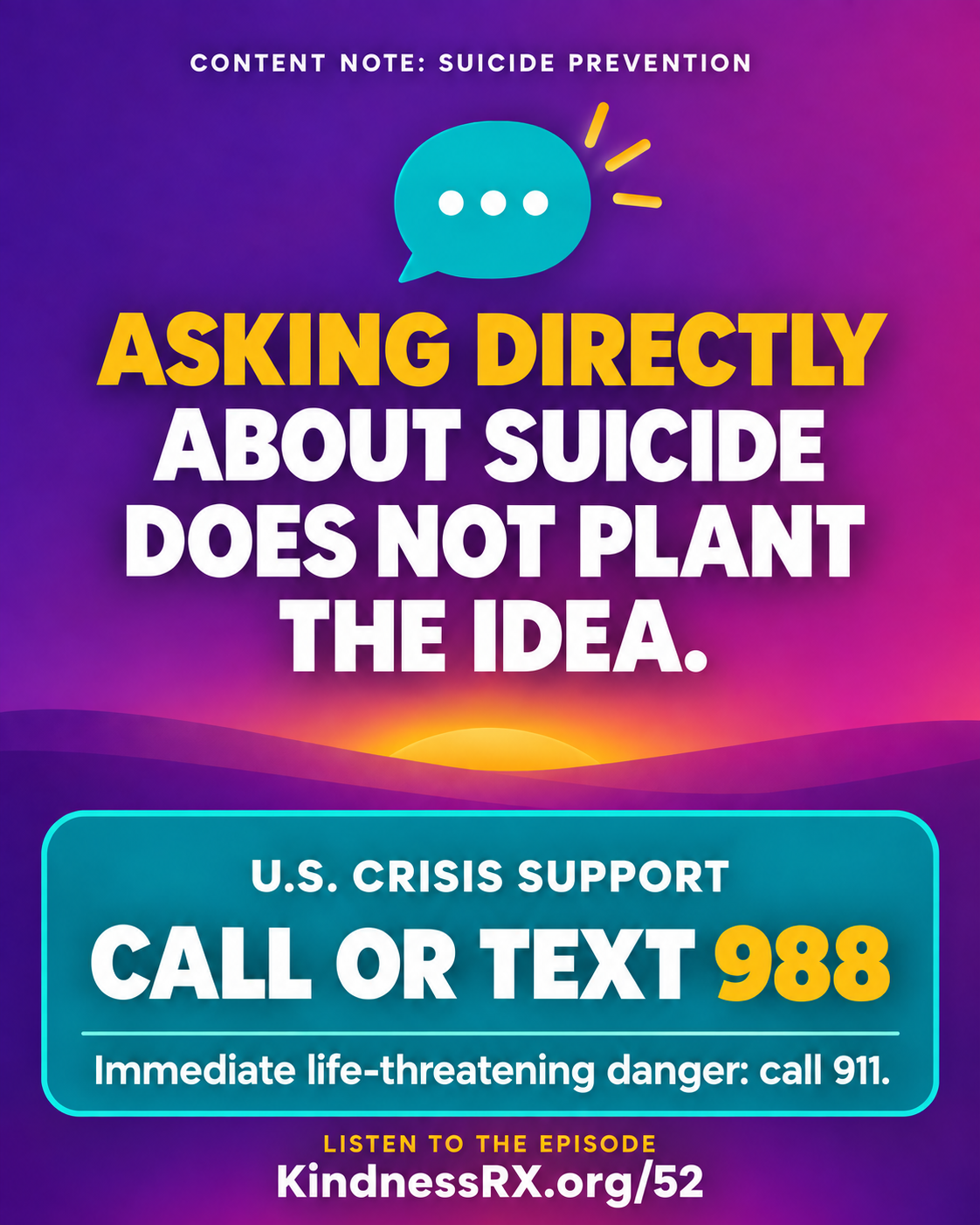
Asking directly does not plant the idea of suicide. It can give someone who feels frightened, ashamed, or alone an opening to tell the truth. Use calm, plain language:
- “I’ve noticed you seem very hopeless lately, and I’m worried about you. Have you been thinking about suicide?”
- “Are you thinking about suicide right now?”
- “Have you thought about how you would do it?”
- “Do you have access to what you would use?”
- “I’m glad you told me. I’m here with you, and we’re going to get some help.”
If there is not immediate danger but suicidal thoughts are present, contact the person’s mental-health provider, involve trusted supports, and call or text 988 for guidance. A family member or friend can contact 988 because they are worried about someone else. The 988 guide for helping someone else recommends asking, being present, helping the person stay safe, helping them connect, and following up.
Helpful responses
- Listen without arguing or rushing to fix the situation.
- Thank the person for telling you.
- Be direct, calm, and nonjudgmental.
- Help connect them with crisis and professional support.
- Take steps to reduce access to firearms, medications, or other lethal means.
- Follow up after the immediate crisis.
What to avoid
- Do not minimize the pain with “Everybody feels that way sometimes.”
- Do not debate, lecture, shame, dare, or act shocked.
- Do not use guilt, such as “Think what this would do to your family.”
- Do not promise to keep serious suicidal thoughts or a suicide plan secret.
- Do not offer glib reassurance or guarantees.
Make a Written Safety Plan Before a Crisis
A safety plan is a prioritized, practical list of coping steps and sources of support to use when suicidal thoughts or crisis warning signs appear. It is best developed when the person is relatively stable, ideally in collaboration with a qualified clinician. It is not the same as asking someone to sign a “no-suicide contract,” and it does not replace a risk assessment or emergency care.
- Personal warning signs that a crisis may be developing
- Internal coping strategies the person can try on their own
- People and safe places that can provide healthy distraction
- Trusted people who can be told directly that help is needed
- Clinicians, crisis services, 988, and local emergency contacts
- Concrete steps to make the environment safer by reducing access to lethal means
Create or download a safety plan
Create an interactive safety plan at MySafetyPlan.org, or download the blank safety-plan PDF. MySafetyPlan is provided by Vibrant Emotional Health, which administers the 988 Lifeline.
Clinicians and readers who want to understand the evidence-based framework can also visit the Stanley-Brown Safety Planning Intervention.
A Realistic Form of Hope
“Don’t confuse ‘I’ve tried many things’ with ‘there are no things left to try.’”
Dr. Mark Blair
One practical next step is a comprehensive second opinion from a clinician who regularly works with difficult-to-treat depression. Bring a written history of medications and treatments, including doses, duration, partial benefits, side effects, and the reasons anything was stopped. A careful review may uncover a missed diagnosis, an incomplete trial, a treatment worth optimizing, or a reason to consider another category of care.
“Hope isn’t saying, ‘I guarantee everything will be okay.’ Hope is saying, ‘We haven’t stopped looking for the next reasonable option.’”
Dr. Mark Blair
Further Reading and Trusted Resources
- National Institute of Mental Health: Depression
- National Institute of Mental Health: Brain Stimulation Therapies
- CDC: Suicide Prevention Resources
- NAMI HelpLine — information and resource navigation, not a crisis line
- 988 Suicide & Crisis Lifeline
- 988: Help Someone Else
- Find A Helpline: International Crisis Support
- Official Spravato Patient Information
- BrainsWay Deep TMS
- TED Talk: Andrew Solomon, “Depression, the secret we share” — a lived-experience talk, not clinical guidance
Continue the Conversation
Listen to Episode 52: When Depression Doesn’t Lift, learn more about the work at KindnessRX.org, and explore the free online peer-support groups at KindnessRX.org/groups.
Kindness Challenge: Make one conversation a little easier to start. If you are struggling, write down one thing you want your healthcare provider to know. You might begin with: “I’m still struggling, and I need help figuring out what comes next.” If you are supporting someone else, ask, “How are you really doing?”—and give them room to answer.
Educational disclaimer: This podcast and article are for general education and are not medical advice, diagnosis, treatment, or a substitute for care from a qualified healthcare professional. Treatment decisions must be individualized. Outcomes vary, and no treatment is guaranteed. IV ketamine for depression is an off-label use. KindnessRX peer-support groups do not provide clinical treatment, emergency services, or crisis care. If you may be in immediate danger, call 911 or go to the nearest emergency department. In the United States, call or text 988 for crisis support. Outside the U.S., use your local emergency service or a country-specific crisis line.
Editorial disclosure: This episode and article are not sponsored, promoted, or endorsed by Optimum Wellness & TMS, BrainsWay, Spravato/Janssen, Stanford University, or any treatment manufacturer. Dr. Blair participated as an invited guest and gave permission for KindnessRX to use his approved professional information and image. He did not co-author or medically review this article.