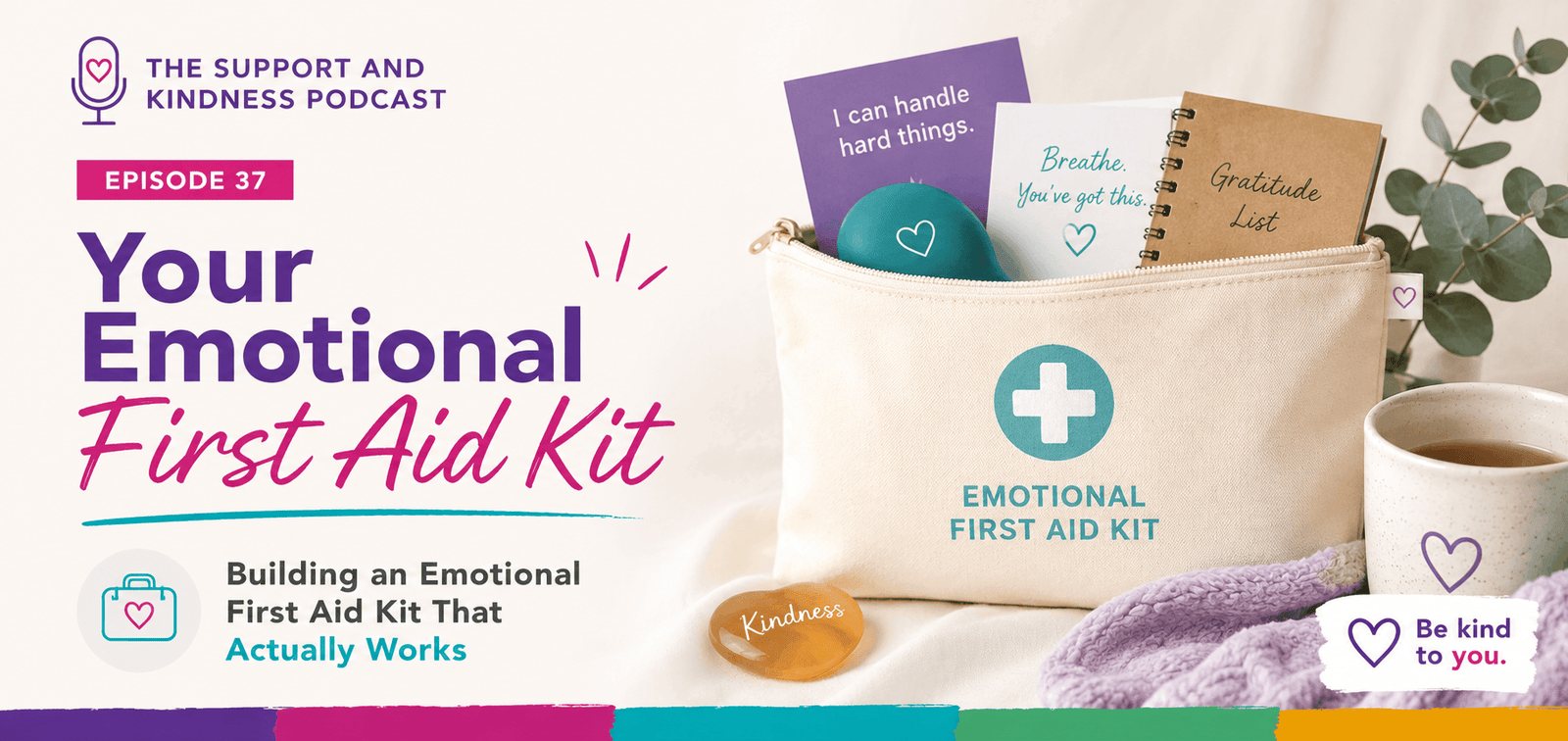
Episode 37: Your Emotional First Aid Kit
Building an Emotional First Aid Kit You Can Use
It is three in the morning, your thoughts are looping, and you are not sure what would help. An emotional first aid kit is a small collection of comforting objects, reminders and contact details you can turn to when you feel overwhelmed.
A personal kit is not therapy, a diagnosis or emergency care. It can help you remember your options; it cannot tell you whether a physical symptom is caused by anxiety. Do not dismiss chest pain as panic. For sudden chest pain that does not go away, or chest pain with breathlessness, sweating or feeling faint, contact emergency services. The NHS chest pain guidance explains the warning signs; use your local emergency number.
Why So Many of Us Don’t Have One
You do not need a statistic to justify preparing for a difficult day. Some people have never been shown how to make a coping plan. Others know what helps but struggle to remember it when they are overwhelmed.
Cost, waiting lists, stigma and previous experiences can make professional support difficult to reach. A personal kit does not remove those barriers. It is one practical way to keep useful reminders and contacts within reach while seeking the support you need.
Psychological First Aid is a separate, evidence-informed approach developed by the National Child Traumatic Stress Network and the National Center for PTSD for the aftermath of disasters and terrorism. It is not the same as a personal comfort kit. We can value practical support and connection without presenting a household kit as a tested treatment or a substitute for trained care.
What Actually Goes In It
Here is where the conversation on the podcast went somewhere I didn’t expect. Liam, with the kind of grin you can hear on a microphone, suggested we drop the “emotional first aid kit” framing entirely and call it an emotional utility belt instead of an emotional first aid kit. “Like Batman has,” he said. “You could have your little grappling hook, which might be your frozen water bottle. You could have your countdowns with your senses. You can be quick on the draw, you don’t waste any time.”
It sounds playful — and that’s the point. The kit only works if you can reach for it without thinking. The Batman bit isn’t a gimmick; it’s a usability principle. A tool you have to hunt for during a panic attack is a tool that doesn’t get used.
With that frame, the panel mapped out what people actually keep on hand. Rich keeps Bodhi balls — small Chinese meditation balls with chimes inside — and rotates them in his palm to come back to the present. Liam described using a frozen water bottle as a sensory prompt. That is his personal experience, not a recommendation for everyone. He also keeps a stuffed animal he calls his sobriety sidekick (named Claire), which is small enough to grab from anywhere — even from the fetal position, he pointed out, with the kind of dark honesty that earns trust on a mental health podcast.
Derek leans on music — not single songs but full albums, the kind that take you through a whole emotional arc. Sarah keeps a wider toolkit: jewelry-making (beading, she said, is unreasonably cathartic), naps, coloring, a funny movie or action movie to disappear into, and what she lovingly called rage cleaning. Greg admitted on air that he doesn’t have a kit yet either, which is half the reason this episode exists.
A note on cold objects: do not put ice or frozen packs directly on skin. NHS guidance on cold treatment describes precautions. If you have reduced sensation, circulation problems or another condition that makes cold risky, choose a different grounding option and ask your clinician.
If you want a starter shelf, the panel’s combined list looks something like this:
- Grounding options: simple counting, noticing objects around you, or holding a familiar object. Choose something comfortable and stop if it increases distress.
- Tactile comfort: a stuffed animal you can squeeze, a soft blanket, scented lotion, a fidget object, Bodhi balls.
- Audio anchors: a playlist of grounding songs, a full album that mirrors the emotional journey you need, a comfort show or favorite scene.
- People: the names and numbers of two or three humans you can text or call without explaining yourself first.
- Movement or rest: an activity that fits your mobility, energy and care plan. Sitting comfortably or resting is a valid choice too.
- Outlets: a notebook for brain-dumping without judgment, a coloring book, beading, or — yes — angry cleaning.
Sarah’s Counting Story, and Why It Matters
One of the most quietly powerful moments in the episode came when Sarah described what grounding actually did for her. After a spinal cord injury, she began experiencing episodes of autonomic dysreflexia — and then, layered on top, PTSD-style panic attacks that mimicked the same symptoms. Her blood pressure would spike, she’d think she was dying, and she’d end up in the ER. Someone on a mental health line taught her two techniques: count your fingers; name five things you can see, four you can hear, three you can smell.
“That was so helpful for me,” she said, “because it made me concentrate on something else. I don’t know how I would have gotten through all of that if it would not have been for those techniques.” Later in the freeform section, she added the simplest version of all: “When your body goes into fight or flight, just start counting. Any number. Pick a number. I made my daughter count with me, and it just kept me in the moment.”
Sarah describes what helped her; her story cannot tell another person whether their symptoms are panic or something else. Autonomic dysreflexia is a medical emergency, not something to manage with counting. MedlinePlus explains the risks and need for prompt treatment. If you are at risk, follow your clinician’s emergency plan and get urgent medical help for suspected symptoms.

When the Kit Isn’t Enough
The panel was clear-eyed on the limit of all of this. An emotional first aid kit isn’t a substitute for professional care; it’s a bridge. Rich put it cleanly: “It is, as I said before, a tool for the here and now, but not for the long-term mental health support. That’s something that you should seek professional help with.” Derek also spoke about the relationship that ongoing counseling can build. A comfort kit does not diagnose or treat the underlying cause of distress.
Greg raised warning signs such as thoughts of self-harm, a preoccupation with death and giving away valued possessions. For a direct, non-leading way to start the conversation, NIMH recommends asking, “Are you thinking about suicide?” Listen without judgment, help the person connect with support and follow up. A denial does not mean you should ignore other concerning signs. You do not have to handle the situation alone.
In the United States, call or text 988 for 24-hour Suicide & Crisis Lifeline support, including guidance when you are worried about someone else. If there is immediate danger or a medical emergency, contact emergency services. Outside the US, use your local crisis service or emergency number.
You May Already Be Using Yours
The line from this episode that stayed with me longest came from Rich during freeform sharing. He had spent the week trying to figure out what was in his kit — and walked outside one afternoon to find his son sitting on the porch. “I had this big grin when I saw him,” he said. “We sat there listening to the birds chirping, talking about the world passing by… That’s one of my emotional first aid kits. I just didn’t realize I have them.”
If the whole concept feels foreign, start there. Look at what you already reach for instinctively — the walk you take when you’re tense, the song you replay, the friend you text first, the routine you fall back into when the day frays. Those are tools. They count. Name them. Add to them. Notice which ones work and which ones don’t anymore. Sarah’s reminder that the kit evolves is worth repeating: as you change, the kit changes.
This Week’s Challenge
Greg’s closing challenge is the kind you can actually do. Build one thing for your emotional first aid kit this week. Just one. Write down a person you can text without preface. Pick a grounding technique and practice it once, in the calm, so your body knows the moves. Make a five-song playlist. Journal for five minutes. Bookmark the support group calendar. Whatever it is — start somewhere. The time to build the kit is not when you’re in crisis. It’s now.
Listen to the Full Episode
This is just the surface. The full conversation — including Liam’s full utility belt rant, Sarah’s counting story, Rich’s porch moment, and Greg’s honest admission that he hasn’t built his own kit yet — is on The Support and Kindness Podcast.
Listen on Spotify
You’re Not Alone
At KindnessRX we run three free, peer-led support groups every week — with no fee or insurance required. Check the event listing for registration and participation details.
- Brain Injury Support meets Mondays from 1:00 to 2:00 PM ET.
- Chronic Pain Support meets Tuesdays from 12:00 to 1:00 PM ET.
- Mental Health Support meets Wednesdays from 7:30 to 8:30 PM ET.
Sign Up For Groups Here
https://luma.com/calendar/cal-oyT0VPlVTKCPxBw
All groups meet online and you can find the schedule and RSVP at kindnessrx.org. Consider it a permanent line item in your kit. Peer support offers connection, not medical treatment or crisis care.
About KindnessRX
KindnessRX is a peer support community for adults navigating brain injury, chronic pain, and mental health. We host weekly free support groups and publish The Support and Kindness Podcast every week, hosted by Greg Shaw and a rotating panel of co-hosts who’ve lived what they talk about.