Episode 13: Holiday Stress, Family Pressure, and Finding a Little Breathing Room
By Greg Shaw | A companion to Episode 13 of The Support & Kindness Podcast
Content note: This episode and article discuss family conflict, substance use, self-harm, and suicidal thoughts. There are no graphic details. In the United States, call or text 988 for crisis support. Call 911 for immediate, life-threatening danger.
The holidays can ask a lot of us. Be cheerful. Show up. Buy gifts. Get along. Make memories. Somehow find the money, the energy, and the right thing to say.
But what if you are tired before any of it starts?
What if a crowded shop makes your chest tighten? What if the person you want to call is no longer here? What if a family visit means hours of trying to keep the peace?
Holiday stress is the strain that can come from seasonal demands, expectations, and changes in routine. It can involve money, travel, family tension, grief, loneliness, or too much noise and activity. You can enjoy parts of the season and still find other parts hard.
In Episode 13, Rich, Liam, Derek, and I talk about those mixed feelings. We share what has happened in our own lives, along with small things that have helped. This article builds on that conversation with research, practical examples, and support resources.
You do not have to create a perfect holiday. It may help to make one part of it easier.
Listen to Episode 13: Holiday Stress
Open the original Episode 13 page. This archive episode was first published in November 2025. The research and extra exercises below expand on the recorded conversation.
Browse The Support & Kindness Podcast.
Holiday stress is common, but it does not look the same for everyone
A 2023 American Psychological Association survey asked 2,061 U.S. adults about the holidays. Nearly nine in ten, 89%, reported at least one holiday stressor. Spending too much or not having enough money to spend was a concern for 58%. Missing loved ones was a concern for 38%.
These were people’s survey responses, not mental-health diagnoses. The findings do not mean nine in ten people have an anxiety disorder. They tell us that feeling strain during the holidays is far from unusual.
A separate American Psychiatric Association poll from November 2025 found that 41% of 2,203 U.S. adults expected more holiday stress than the year before. That answer was more common among adults aged 18 to 34, at 49%, than among those aged 65 and older, at 27%.
The same poll also found that more people saw a positive effect on their mental health from the holidays than a negative one. Both experiences deserve room. A person can love the lights and dread the bill. They can want company and need quiet.
These are different surveys with different questions. We should not treat them as a single trend or label them as 2026 results.
When crowds and travel make everything harder
Rich talks about the strain of new people, crowds, and changes to his usual routine. Travel can affect food, sleep, medication schedules, and the small habits that help a day feel manageable.
That is easy to overlook. Someone may see a simple invitation. You may see a long list of tasks: arrange a ride, pack what you need, find out whether there are stairs, work out when you can eat, and save enough energy to get home.
If you live with a brain injury, ADHD, chronic pain, anxiety, or sensory needs, planning can take effort before you even leave. There is no need to prove that a gathering is difficult enough to deserve an adjustment.
Ask a few clear questions beforehand:
- Is there a step-free entrance and an accessible bathroom?
- Can I sit somewhere with less noise?
- Is there a quiet room where I can take a break?
- When will food be served, and can I bring what I need?
- Could I join for a shorter time or connect by video?
An energy budget can matter as much as a money budget. If travel uses most of your energy, staying for a whole afternoon may be too much. A short visit can still be a real visit.
For more on reducing the load when everything feels too much, read Episode 2: What to Do When You Feel Overwhelmed.
Try a pause before you reach your limit
Rich describes taking a few breaths before going into a stressful situation. Derek shares how stepping away to the bathroom gives him a few minutes to collect himself.
Neither story is a promise that a short break will fix anxiety. They show how a small pause can create room to choose a next step.
You might sit in a quiet spot and notice the chair beneath you. Look around and name a few things you can see. Feel the texture of a sleeve or a smooth stone in your hand. Let your breathing stay gentle and comfortable.
If focusing on breathing makes you feel worse, try looking at something steady instead. There is no need to force deep breaths or hold your breath. If you feel dizzy or uncomfortable, stop the exercise.
The World Health Organization’s Doing What Matters in Times of Stress offers a free guide with grounding and other stress-management skills. These are tools to practise, not a test of how well you cope.
A bathroom break may help some people. Others may need a quiet room, a nearby seat, or a way to leave. Choose what is safe and accessible for you.

Money pressure can turn love into a price tag
Liam talks about limited money and a family understanding that being together matters more than giving expensive gifts. That takes some pressure out of the season.
Not every family has that agreement. You may worry that a small gift will look careless. You may feel pushed to spend money needed for food, rent, transport, or medication.
The answer is not always to find a cleverer bargain. Sometimes the kindest budget is a firm limit.
Try saying it early: “I’m keeping gifts small this year.” Or: “I can’t take part in the gift exchange, but I’d still like to spend time with you.”
A no-gift agreement, one shared meal, or a short phone call may fit better than a long shopping list. A handmade gift can be lovely if you have the time and energy. It should not become another task you feel bad about missing.
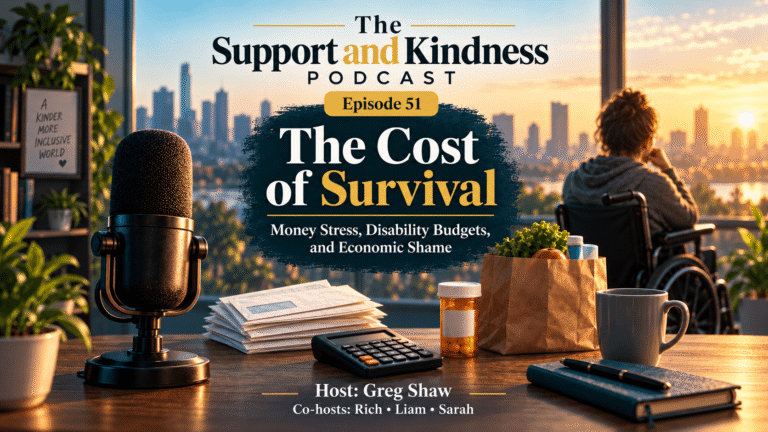
Do not promise future spending to soften a boundary you need today. Your care for someone is not measured by what you can afford. For more on money and shame, listen to Episode 51: The Cost of Survival.
Family tension needs more than a cheerful smile
Derek describes how family gatherings could revolve around one person’s mood and needs. Other people would fall into familiar roles. The holiday ritual could include trying to ease tension with alcohol.
Many of us know that feeling of walking into a room and becoming an older version of ourselves. You may be the peacemaker again. The person who stays quiet. The one expected to keep everyone happy.
Liam shares that a warm greeting can help him break the ice. Where the relationship feels safe, that may be a useful choice. It does not mean that everyone should set aside painful history or make contact with someone who harms them.
A holiday is not a deadline for forgiveness. Estrangement can bring sadness, relief, guilt, or several feelings at once. You can miss someone and still need distance.
A boundary works best when it says what you will do:
- “I’m not talking about my health at dinner.”
- “If the shouting starts, I’ll leave.”
- “I can stay for an hour.”
- “I’m not coming this year. I’d welcome a short call another day.”
You do not have to persuade everyone that the boundary is fair before you use it. If a situation is unsafe, focus on getting support and making a safe plan rather than winning the argument.
Have an exit plan that can actually work
In the episode, I suggest agreeing on a rescue text or code word with someone you trust. The important part is agreeing on what happens next.
Does the word mean “call me”? Does it mean “help me leave”? Does it mean “sit beside me for a few minutes”? A clear plan is easier to use when you are overwhelmed.
Transport matters, too. “Just leave” is not much help if you depend on a booked ride, a family driver, or accessible transport that needs notice. Find out what options you have before the event. Where possible, arrange a shorter visit from the start.
Keep the plan somewhere easy to find. A phone note or small card can be enough. Your support person does not have to fix the whole gathering. They need to know the one thing you are asking them to do.
If you leave earlier than planned, try not to turn the trip home into a review of everything you think you did wrong. You noticed a limit and responded to it. Episode 3 explores cancelling plans and the guilt that can follow.
Alcohol, substance use, and protecting recovery
Liam speaks openly about using substances before family get-togethers in the hope of making them easier. He explains that it often made things worse. Painful history, awkward conversations, and substance use could become tangled together.
Derek and Rich also discuss how using something to settle the nerves could become part of a family routine. Their stories help us see a pattern without pretending every person’s experience is the same.
There is an important distinction here. Taking medication as prescribed is not the same as misusing a substance. Rich mentions doctor-prescribed anxiety medication. Do not change prescribed treatment because of a podcast conversation. Ask your prescriber or pharmacist about concerns, including alcohol interactions.
The National Institute on Alcohol Abuse and Alcoholism encourages people to respect another person’s choice not to drink. A host can help by offering appealing alcohol-free options without questions or pressure.
If you are protecting recovery, consider the support you want before, during, and after an event. That might be a recovery meeting, a trusted contact, an alcohol-free gathering, or choosing not to go. Have a way home that does not depend on someone who may be drinking.
If you are struggling with substance use, FindTreatment.gov can help you look for treatment in the United States. You do not need to wait until things get worse to ask what help is available.
Grief and loneliness do not take a holiday
A missing person can change the whole shape of a day. The empty chair, a familiar song, or a food they used to make can bring grief close again.
You may want to keep a tradition. You may want to skip it. You may feel fine in the morning and fall apart later. Those changes do not mean you are grieving badly.
It can help to make room for one choice: say the person’s name, share a memory, leave a quiet space, or do something entirely different this year. Ask rather than assume what another grieving person wants.
Loneliness also deserves care when it is not connected to a death. Divorce, estrangement, illness, distance, poverty, and lack of transport can all affect who gets to be together. An invitation is only useful if the person can reach it and take part.
Try one specific, manageable connection. “Would you like a ten-minute call on Thursday?” is easier to answer than “We must get together sometime.” If a call feels hard, a brief message may be enough.
Our article on phone anxiety and checking messages offers ways to lower the pressure around staying in touch. You can also explore KindnessRX peer support. Peer groups offer connection, but they are not crisis services or a replacement for treatment.
Holiday stress is not the same as seasonal depression
The National Institute of Mental Health distinguishes seasonal affective disorder, or SAD, from holiday blues. SAD is depression with a recurring seasonal pattern. Holiday pressures can happen at the same time, but they are not the same condition.
If low mood, loss of interest, sleep changes, or difficulty managing daily life persist or worsen, talk with a health professional. You do not have to work out the diagnosis on your own. Do not postpone needed care simply because the calendar is busy.
One other point needs care. Discussing suicide during a holiday episode does not mean suicide peaks at Christmas. The Annenberg Public Policy Center’s review of U.S. data explains that December typically has a low average daily suicide rate compared with other months.
A population pattern never tells us how safe one person is. Take suicidal thoughts seriously in any season. In the U.S., call or text 988 for support. For immediate, life-threatening danger, call 911.
A five-step holiday plan you can keep on your phone
This is an added companion exercise based on the episode’s themes. It is not a clinical treatment plan. Use the parts that fit your life.
- Name the pressure. Write the one thing that worries you most: noise, money, a person, travel, or being alone.
- Choose one limit. Decide what you can spend, how long you can stay, or which topic you will not discuss.
- Pack one comfort. Bring something useful, such as headphones, a familiar item, or food you can manage. Keep necessary medication and care supplies available.
- Agree on support and an exit. Choose a contact, explain the signal, and work out transport or a quiet break.
- Plan the time afterward. Leave room to rest, eat, contact someone, or return to a helpful routine.
Keep it short enough to read when you are tired. A plan that fits your phone screen may be more useful than a page you cannot take in.
If you are hosting, make the invitation easier to accept
Ask privately what would help. Give clear information about timing, food, noise, access, and who will be there. Do not make someone explain their whole medical history to request a chair or a quieter place.
Let people decline hugs, alcohol, food, games, and photographs. Offer a way to take part for a short time. Avoid announcing that a guest has “finally come out” or asking everyone to persuade them to stay.
If someone cannot attend, keep the door open without guilt: “We’ll miss you. Would you like a short call another day?”
A welcoming gathering gives people choices. It does not make them earn their place by hiding their needs.
Remember that not everyone observes the same holidays, follows the same faith, or celebrates at all. Ask what matters to your guest. An invitation can be warm without assuming everyone shares the same traditions.
This week’s companion challenge: Remove one pressure
Choose one small change before the next holiday event. Set a spending limit. Ask about access. Arrange a check-in. Shorten a visit. Tell someone you are skipping gifts.
If you are supporting another person, offer one clear choice: “Would a call, a quiet visit, or some space help most?” Accept the answer.
This challenge is an addition to the companion article. The goal is to reduce one demand, not create another list to complete.
Questions people ask about holiday stress
Is it wrong to feel sad when everyone else seems happy?
No. Holidays can bring joy, grief, worry, and loneliness together. You do not owe anyone a cheerful performance. If distress persists or affects daily life, seek professional support.
Can I skip a family gathering?
You can make choices about attendance, time, and contact. Consider your safety, health, access needs, and support. A shorter visit, another day, or no visit may fit better.
What can I say when I cannot afford gifts?
Try: “I’m not buying gifts this year, but I care about you.” You can offer time or contact if you want to. You do not need to replace a gift with unpaid work you cannot manage.
What if a breathing exercise does not help?
Stop if it feels uncomfortable. Try a quieter place, noticing what you can see, or contacting someone you trust. A coping tool that does not help you is not a personal failure.
Further reading and TED talks
These resources expand on the conversation. The TED talks are personal and educational perspectives, not clinical treatment evidence.
- SAMHSA: Supporting Your Mental Health During the Holiday Season.
- NIMH: Seasonal Affective Disorder.
- WHO: Doing What Matters in Times of Stress, a free illustrated guide.
- Nora McInerny: We don’t “move on” from grief. We move forward with it.
- Susan David: The gift and power of emotional courage.
- KindnessRX: Practicing Self-Compassion.
Resources mentioned in Episode 13
Services have different purposes, eligibility rules, costs, and hours. Check the provider’s current details. A directory listing is not a guarantee of access or availability.
- 988 Suicide & Crisis Lifeline: U.S. crisis support by call, text, or online chat.
- Crisis Text Line: text-based crisis support.
- The Trevor Project: support for LGBTQ+ young people.
- SAMHSA National Helpline: treatment referral and information.
- FindTreatment.gov: U.S. treatment search.
- National Alliance on Mental Illness: education, advocacy, and support.
- GriefShare: grief support groups with a Christian approach.
- My Grief Angels: grief resources and peer support.
- Well Beings: mental-health stories and resources.
- Partnership to End Addiction: support and information for families affected by substance use.
- TAPS: the Tragedy Assistance Program for Survivors, serving people grieving a military loss.
- Herren Project: substance-use and recovery support.
- Psychology Today therapist directory: a directory to help find providers.
- Open Path Psychotherapy Collective: lower-cost therapy options; check fees and membership requirements.
- Find A Helpline: a directory of support services by country. Availability and hours vary by service.
For more conversations, listen to the podcast. For community, explore our free online peer support groups and check the event calendar for current meeting details.
If this episode helped, share it with someone who might need a little less pressure this season. You do not need the right words to deserve support.