Episode 27: Keeping Friendships Alive When You’re Struggling

You see a message from a friend. You care about them. You want to answer. But you are tired, in pain, or trying to get through the next hour.
You tell yourself you will reply later. Then later turns into days. Now the message carries something extra: guilt.
Keeping friendships alive when you’re struggling can start with a small, honest message and a plan that fits your energy. You do not need a long call or a busy social calendar. You need room to care for each other in ways you can both manage.
In Episode 27 of The Support & Kindness Podcast, Greg, Rich, Jay, Derek, and Liam talk about friendship during hard seasons. They share what silence can mean, how to reconnect, and why quiet company still counts.
This companion expands their conversation with research and practical ideas. The examples below are suggestions you can adapt, rather than promises that one message will fix every friendship.
Listen to Episode 27
Open the Episode 27 page. The recording runs about 30 minutes.
Why friendship can feel hard when you care deeply
Sometimes the problem is not knowing what to say. It is having enough energy to say anything.
In the episode, Greg describes how pain, low mood, transport problems, and low energy can make meeting in person difficult. A plan that sounds simple to someone else may involve getting dressed, arranging a ride, sitting through pain, and recovering afterward.
There can be mental effort too. You may worry about sounding cheerful. You may fear another question about your health. Or you may not want every conversation to become an update on what is wrong.
The National Institute of Mental Health’s guide to depression lists fatigue, trouble concentrating, and withdrawal among possible symptoms. These can make contact harder. A missed message alone does not tell you whether someone has depression.
There may also be grief, money worries, caring duties, or a week that has simply asked too much. Before calling yourself a bad friend, ask a kinder question: What part of keeping in touch has become difficult?
The answer can help you change the plan. If travel is the problem, try a call. If talking is hard, try a text. If remembering is hard, a reminder may help. If the friendship feels unsafe, more contact may not be the right next step.
What the research says about loneliness and friendship
Pew Research Center’s January 2025 report surveyed 6,204 U.S. adults in September 2024. It found that 16% felt lonely or isolated all or most of the time; 38% felt that way sometimes. Frequent loneliness was reported by 22% of adults under 50, compared with 9% of those aged 50 and older.
Pew found no significant difference between men and women in frequent loneliness. Women were more likely to say they would turn to a friend for emotional support: 54%, compared with 38% of men. These are group patterns, not rules about any person.
The episode also refers to a May 2021 American Perspectives Survey. It found that 49% of Americans reported three or fewer close friends, including 12% who reported none. That is a pandemic-era finding, rather than a new estimate for this year.
A small circle is not a personal failure. Neither is wanting more connection than you have. The useful question is whether your relationships give you enough care, trust, and room to be yourself.
The CDC’s social connection overview includes the number and variety of relationships, the support they provide, and their quality. Counting contacts alone misses part of the picture.
Small, honest, and steady
Greg gives the conversation three simple words: small, honest, and steady.
Small means choosing something you can manage. Honest means letting someone know what is happening without sharing more than you want. Steady means finding a rhythm that can survive an ordinary hard week.
This does not have to mean daily messages. Some friends enjoy frequent contact. Others stay close with longer gaps. What matters is talking about expectations instead of making each other guess.
You might say: “I love hearing from you, but I cannot keep up with daily messages. Could we try a short check-in on Sundays?”
Your friend may need something different. Let that be a conversation. A routine works best when both people have a say.
A short message can be one manageable way to keep in touch. Illustrative AI-generated image.
Start with one honest line
You do not owe a friend your whole medical history. You can explain your capacity and your care in the same sentence.
Here are a few examples:
- “I care about you. My energy is very low, so I may reply slowly.”
- “I saw your message. I cannot talk today, but I am glad you sent it.”
- “I have been quiet because things are hard. You have not done anything wrong.”
- “I want to hear your news. Could you send a text instead of calling?”
These are sample messages, not quotes from the panel. Change them until they sound like you.
If even a sentence feels too much, you could agree on a simple signal with a trusted friend. A heart might mean, “I saw this and care, but cannot answer yet.” Agree on the meaning first. An emoji cannot explain something your friend has never been told.
You can also set a limit: “I would rather not talk about my health today.” A boundary does not cancel affection.
Reconnect after a long silence
Jay describes the relief that can come when an old connection opens again. Derek talks about using shared memories, photos, and small messages to make contact easier.
There is research behind trying a gentle hello. In a series of experiments reported in 2022, involving more than 5,900 participants, people tended to underestimate how much others appreciated being contacted. That finding offers encouragement. It does not guarantee that a particular person will welcome contact or that an unresolved hurt will disappear.
Try a message with three parts: acknowledge the gap, express care, and offer a small opening.
“I am sorry I went quiet. Things have been hard, and then I felt awkward about the gap. I still care about you. Would you be open to catching up by text?”
You do not need to punish yourself to make the apology sincere. But your friend may have feelings about the silence. Give them room to say they were worried, confused, or hurt.
If they do not reply, pause. Their silence may have many causes. Avoid sending repeated messages asking them to prove they still care. You have made an invitation. They get to choose their response.
Make the plan fit your body and your day
Rich talks about small signs of care, including a clip, a quote, or a brief message. Greg describes how virtual contact can help when being there in person is difficult.
Here are ways to reduce the effort of a plan:
| If this is difficult | Try this instead |
|---|---|
| A long phone call | A five-minute call with an agreed ending |
| A meal out | Tea at home, if a visit feels manageable |
| A noisy group | One person, a quieter space, or text |
| Being on camera | An audio call or camera-off conversation |
| Replying right away | Messages with no expectation of an instant answer |
| Travel or walking | A seated visit, phone call, or shared online activity |
Technology can help, but it is not equally easy for everyone. Data costs, poor internet, hearing needs, screen fatigue, and unfamiliar apps can all get in the way. Ask which format works. Captions may help some people. An ordinary phone call may work better for others.
The recording mentions Zoom, WhatsApp, Discord, Messenger, FaceTime, and Google Meet. These are options, not requirements or endorsements. Use a service you both feel comfortable with.
Do less than your best-day energy would allow. A manageable plan is easier to repeat than one that leaves you needing days to recover.
When you have to cancel again
Cancelling can hurt, even when the reason is real. Your health needs matter. So does your friend’s time.
If you can, tell them as soon as you know. Keep the explanation clear. Avoid promising a new date before you know what you can manage.
“My pain is too high for me to come today. I know you made time, and I am sorry to change the plan. Could we try a short call instead, or leave rescheduling until next week?”
If cancellations keep happening, change the kind of plan. You might need flexible visits, a smaller time window, or an agreement that either person can switch to text.
Our Episode 3 companion on guilt after cancelling plans explores this further. The aim is to make room for your limits while treating the other person with care.
Let friendship include ordinary life
You do not have to give a full account of your pain every time someone asks how you are.
 |
 |
 |
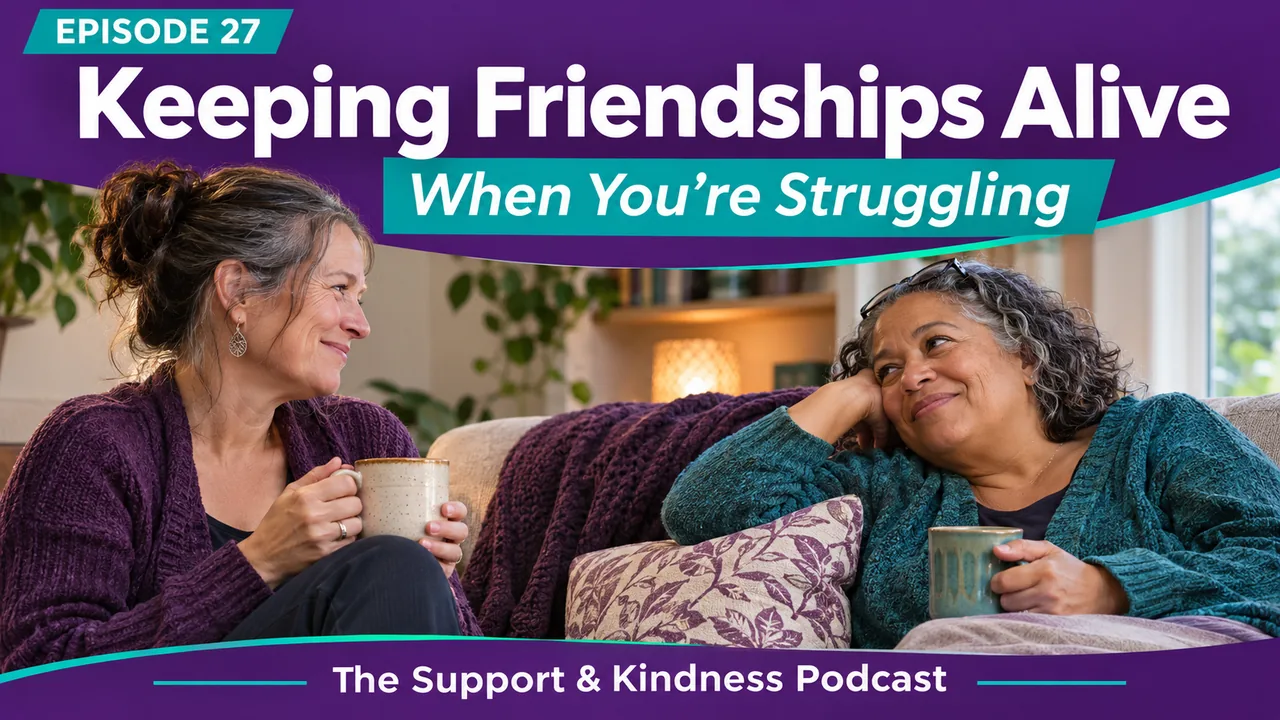
Sometimes you may want to talk about a television show, a garden, a pet, or a photo from years ago. Light conversation can offer a break. You can share a laugh and still be struggling.
Derek’s use of old photos and shared memories is a useful example. Familiar things can make an opening feel less formal. You do not have to invent an important topic before saying hello.
Try: “I am having a rough day and do not want to unpack it. Tell me something ordinary from your day.”
You can also share quiet company. Read in the same room. Watch something together. Sit outside if that suits your body. Ask before visiting or sending a long voice note. What feels easy to one person may take effort from another.
Shared memories can make it easier to begin a conversation. Illustrative AI-generated image.
If your friend keeps pulling away
Being the person who keeps reaching out can feel lonely too. You may wonder whether you are helping or adding pressure.
Liam’s contribution returns to gentleness, honesty, and giving someone room. A useful starting point is a clear offer with a choice.
“I care about you. Would you like a short call, some messages, or a bit of space?”
If they want space, ask whether a later check-in would be welcome. Do not say “no need to reply” if you plan to become upset when they do not answer. Offer only the freedom you can actually give.
You can care and set limits: “I can talk for twenty minutes tonight. I will need to rest after that.”
Avoid treating withdrawal as proof of rejection. Also avoid assuming you know its cause. Listen to what your friend says about their own life.
If you are worried, ask them directly how they are doing. In ordinary situations, ask before contacting family or passing on private information. If there is an immediate safety emergency, getting urgent help takes priority. Choose support based on the situation, rather than making a quiet friend feel watched.
Ask for help in a way someone can answer
“I need support” is honest, but it can leave both people unsure what to do next. A specific request gives the conversation somewhere to go.
You might ask:
- “Do you have ten minutes to listen? I do not need advice.”
- “Could you check in on Friday?”
- “Would you sit with me while I make this difficult call?”
- “Could you help me find a local group?”
Ask whether they have the capacity. A caring friend may still need to say no or suggest another time. That can be disappointing without meaning you do not matter.
It can help to have more than one source of support. One friend might be good at quiet company. Another may understand a health condition. A peer group, community space, or professional may offer something different.
For more on receiving support, listen to Episode 9: Asking for Help (And Accepting It).
Find places where you can become familiar
Rich describes friendships growing through regular group contact. Greg shares how returning to Pathway Clubhouse, a familiar community space, helped him feel welcomed.
This points toward a practical idea: look for a place you can return to, at a pace you can manage. You do not have to become close to everyone. Learning a few names and being recognized can be a beginning.
A library activity, accessible hobby group, community program, or peer-support meeting may offer that chance. Check cost, access, transport, and the group’s rules before committing. You can try a group and decide it is not the right fit.
Explore the KindnessRX online support-group calendar for current brain injury, chronic pain, and mental health meetings. Check each listing for details. Peer support offers shared experience; it does not replace clinical care.
If you do not have a friend to message today, you have not failed this article. Your next step might be looking at one group listing, or asking a local service what is available.
Contact and feeling connected are different
A newer study, published November 11, 2026, in Social Indicators Research, examined responses from 398 Australian adults. It found overlap and differences among several measures of loneliness and social connection.
One useful way to read that finding is that counting interactions does not tell us everything about how connection feels. This was a study of measurement and associations, not a test showing that a particular friendship exercise improves health.
For everyday life, try asking: “Did I feel heard?” “Could I be myself?” “Did the way we spent time suit us both?” Those reflections may tell you more than a target number of messages.
Care includes boundaries
Keeping a friendship alive should not require accepting threats, humiliation, pressure, or constant guilt. You are allowed to step back from a harmful relationship.
Healthy friendships can also have conflict. Someone may be hurt by a long silence and still care about you. Repair means listening as well as explaining. It does not mean proving who had the hardest week.
Friends can offer care, but they cannot carry every need alone. If distress keeps affecting daily life, consider speaking with a qualified health professional. You can seek help and keep reaching for friendship at the same time.
If you or a friend is in emotional crisis in the U.S., call or text 988. You can also contact 988 because you are worried about someone else. Read its guidance on helping someone. Call 911 for an immediate life-threatening emergency. Outside the U.S., use your local crisis or emergency service.
This week’s kindness challenge
The recorded episode closes with one small invitation: pick one friend and send one short, honest message.
You might write, “Thinking of you,” or, “Rough week. Still care about you.” You can suggest a short call if you have the energy.
Choose someone it feels safe to contact. Send what is manageable. Then let the invitation stand without turning their response time into a test.
You do not need to have everything sorted out before you matter to someone.
Questions people often ask
How do I keep friends when I have no energy?
Explain what you can manage, choose a smaller way to connect, and agree on expectations. A short message or quiet visit may fit better than a long outing. Let your friend say what works for them too.
Is it too late to reconnect after months of silence?
You can offer an honest apology and a gentle invitation. Some people welcome renewed contact; others may need time or decline. Reconnection is an opening, rather than a guaranteed outcome.
How often should friends talk?
There is no single schedule for every friendship. Find a rhythm that suits both people and revisit it when life changes. Frequency alone does not show whether a relationship feels caring.
Further reading and viewing
These resources expand the topic. The TED resources were added for this companion and were not mentioned in the recording.
- Marisa G. Franco: The secret to making new friends as an adult, a TED conversation about adult friendship.
- Shasta Nelson: Frientimacy, the three requirements of all healthy friendships, an independently organized TEDx talk offering a friendship framework. Educational perspective, not treatment guidance.
- U.S. Surgeon General’s 2023 social connection advisory, a broader public-health resource mentioned in the episode.
- Episode 26: Understanding Loneliness, for more of our conversation about feeling alone.
- Episode 28: How to Be a Better Listener, for the other side of a caring conversation.
Research sources are linked where discussed above. This article offers education, lived experience, and practical suggestions. It is not medical advice.