Episode 50: Living in Medical Limbo When Answers Take Time
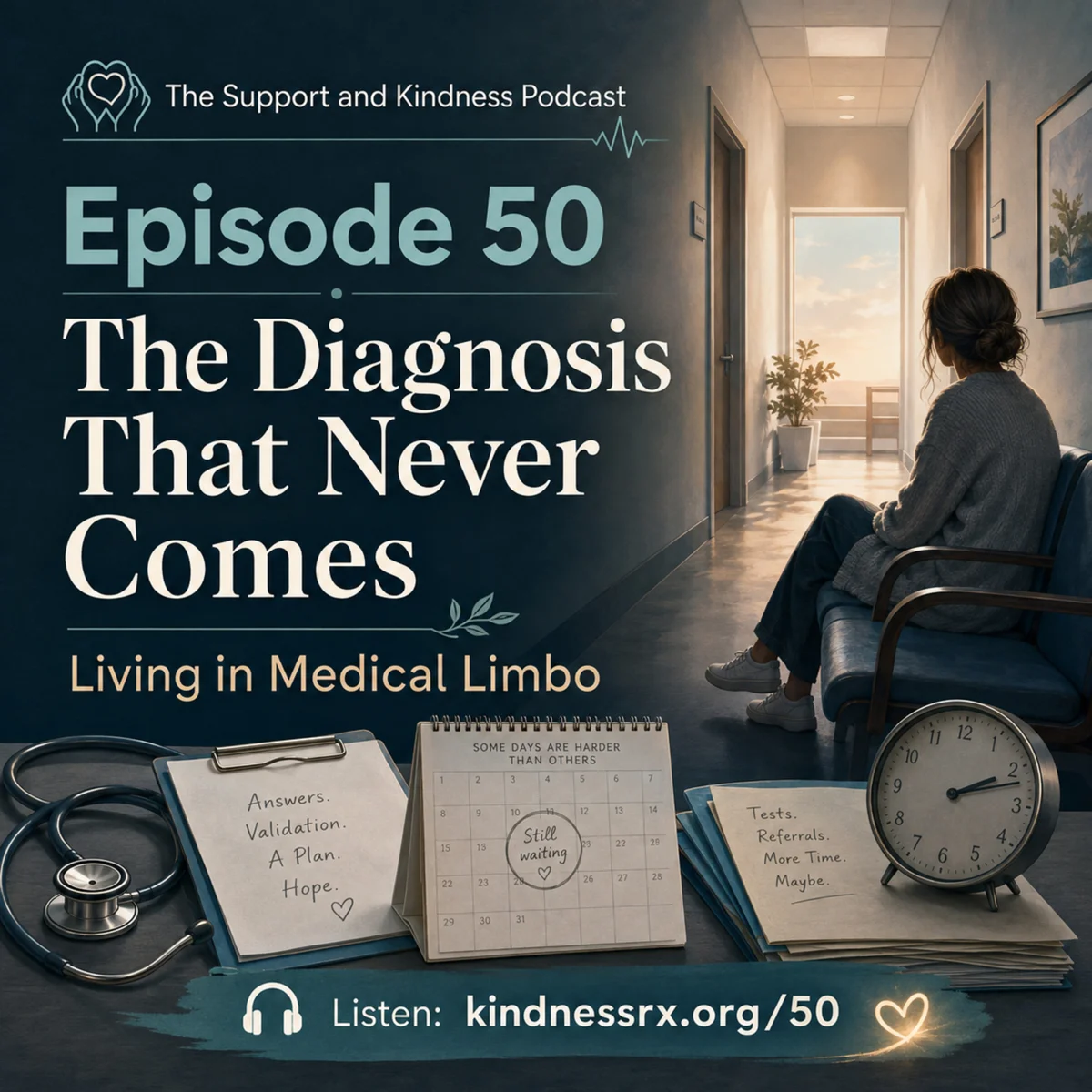
Living in medical limbo means facing symptoms without a clear explanation yet. A test result can arrive before an answer does. You may know that one possibility has been ruled out and still have symptoms that interrupt your day. Then comes another appointment, another referral, and another stretch of waiting.
In Episode 50 of The Support and Kindness Podcast, Greg, Rich, and Liam talk about that unsettled space. They discuss self-advocacy, relationships, mental health, and the relief an explanation can bring, even when it does not offer a simple solution. This companion builds on that conversation with practical tools and clearly identified research and further reading.
Content note: unexplained symptoms, diagnostic uncertainty, and the emotional strain of waiting for answers. This is peer support and general information, not medical advice.
Listen to Episode 50
The Diagnosis That Never Comes: Living in Medical Limbo
If the player does not load, open the Episode 50 listening page.
What medical limbo can feel like
When you have no diagnosis to name, it can be hard to explain what you need. You may be making decisions about work, plans, and everyday responsibilities without knowing how you will feel tomorrow. A friend asks whether you are better. You do not know how to answer. Nothing has been explained, but life has not stopped while you wait.
The uncertainty itself deserves room in the conversation. It is possible to feel glad that a test did not find a particular problem and disappointed that it did not explain your symptoms. Those reactions can sit alongside each other. Wanting an answer does not mean wanting to be ill.
The panel explores why an explanation can bring relief. A diagnosis can give a person a name for what they are facing and a clearer conversation about next steps. It can also bring difficult news. There is no correct emotional response, and nobody has to feel grateful for a hard diagnosis.
You do not have to know the diagnosis before asking for help with symptoms and their effect on your life. The useful question is not only “What is this?” It is also “What support and follow-up make sense while we are still figuring it out?”
Normal test results still need context
A normal result is information, not a full explanation of every symptom. MedlinePlus explains how to understand laboratory results: reference ranges, your medical history, examination, and other tests all matter. A result within a reference range does not guarantee good health. Equally, an out-of-range result does not automatically mean disease.
That does not mean ignoring reassuring findings or assuming a hidden illness must be present. It means asking what the result tells you in your situation. Try: “What did this test look for? What does the result make more or less likely? How does it fit with the symptoms I still have?” Ask your clinician to explain unfamiliar terms rather than trying to interpret every number alone.
Keep new or worsening symptoms in the conversation, even if you already have a diagnosis for something else. Describe what has changed rather than deciding in advance whether it is part of the old condition. Your clinician can help assess that distinction.
What the research says about delayed answers
The episode raises two different issues: diagnostic error and the time some people spend seeking a diagnosis. They overlap, but they are not the same. A long wait does not by itself prove that a clinician made an error.
The National Academies’ 2015 report, Improving Diagnosis in Health Care, cited a conservative estimate that 5% of U.S. adults seeking outpatient care experience a diagnostic error each year. The report also concluded that most people will experience at least one in their lifetime. These are population estimates from that report, not the chance that your own diagnosis is wrong.
For rare diseases, a EURORDIS Rare Barometer survey report released in May 2024 (PDF) described an average of 4.7 years between first symptoms and a confirmed diagnosis. The survey ran in 2022. Women in the surveyed population reported longer average delays than men: 5.4 years compared with 3.7 years. These findings describe people represented in a rare-disease survey, not everyone with unexplained symptoms. They cannot predict one person’s wait or explain every difference between groups.
Chronic pain: useful context, not an undiagnosed-illness count
Many listeners know the burden of persistent symptoms. In the CDC’s analysis of the 2023 National Health Interview Survey, 24.3% of U.S. adults reported chronic pain, and 8.5% reported high-impact chronic pain that frequently limited life or work activities. Chronic pain was reported by 25.4% of women and 23.2% of men. It was more common among adults aged 65 and older (36.0%) than those aged 18–29 (12.3%).
These figures show why conversations about daily functioning matter. They do not tell us how many people lack a diagnosis, and they are not evidence that a particular clinician dismissed someone. Keep the distinction clear: pain, an unexplained symptom, a rare disease, and a diagnostic error are not interchangeable categories.
Make a one-page Medical Limbo Map
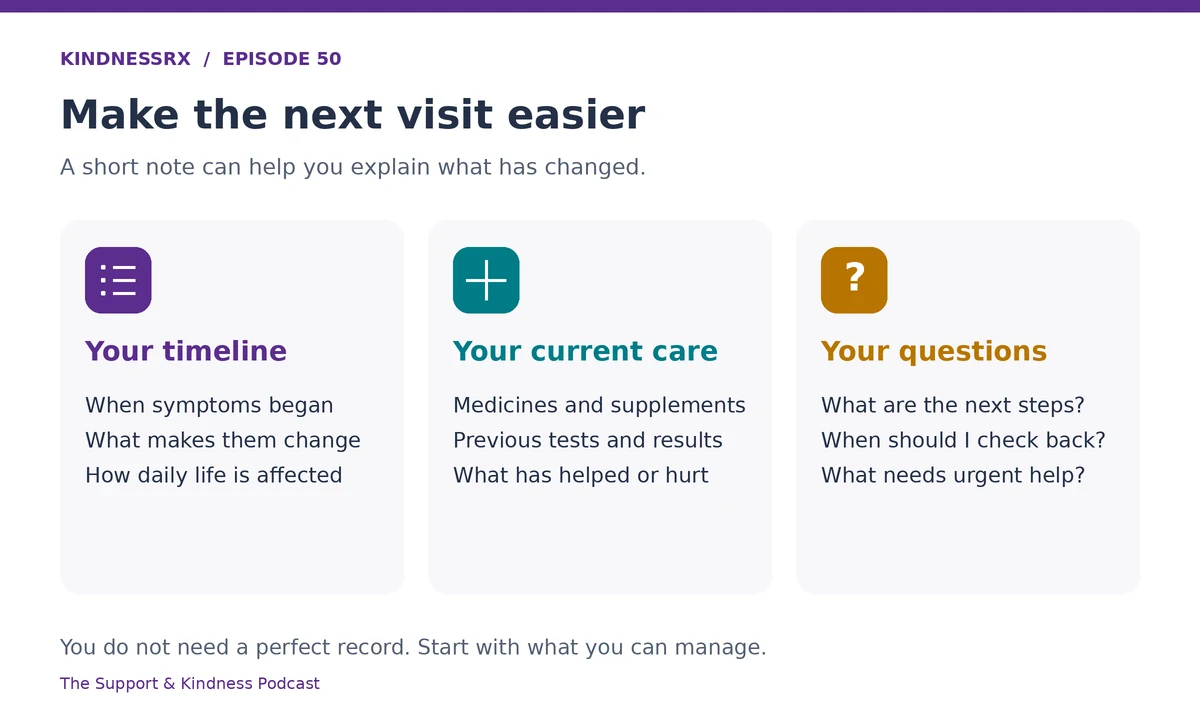
The episode’s practical challenge is a one-page Medical Limbo Map. Think of it as a conversation aid, not a self-diagnosis or a test you have to pass. You do not need a perfect medical history. Start with what is most important for the next appointment.
- Your main concerns: the symptoms disrupting your life most, when they began, and whether they come and go.
- Daily impact: what has become harder, such as standing, reading, sleeping, working, or preparing food.
- Changes you have noticed: patterns or recent changes in symptoms, medicines, supplements, or routines. Separate observations from guesses about causes.
- Your current list: medicines, vitamins, supplements, and relevant previous results or reports.
- What is pending: referrals, tests, appointments, and who is expected to follow up.
- Your three questions: what you most need to understand before leaving.
An example of a useful detail is “I have stopped cooking most evenings because standing is difficult,” rather than only “I feel worse.” Another is “This happens three afternoons a week and lasts about an hour.” Use your own experience, not wording you think will sound more serious.
Keep the note manageable. A timeline with a few clear dates may be easier to discuss than pages of daily entries. Bring longer records if needed, but put the main points first. If writing is difficult, ask a trusted person to help organize what you want to say. You remain the person whose experience is being described.
Leave the appointment with a follow-up plan
Being clear is not the same as being rude. You can respect a clinician’s expertise and still ask questions. You can also say when an explanation has not made sense to you.
The Agency for Healthcare Research and Quality’s questions for your clinician is a useful starting point for conversations about tests, treatment options, risks, and results. Adapt the questions to your situation rather than trying to cover everything at once.
- “What are we trying to learn from this test?”
- “What can we do about the symptoms while the cause is still unclear?”
- “When should the results arrive, and who will explain them?”
- “If I do not hear anything, whom should I contact?”
- “Which changes mean I should seek help sooner or get urgent care?”
- “Would a referral or another opinion be useful, and what would we want it to answer?”
Before leaving, try summarizing the plan in your own words: “So I will do this next, and your office will contact me about that result. Have I understood?” If useful, ask for written instructions. If you want a companion present, agree beforehand whether their job is to take notes, help remember questions, or simply be there.
A second opinion can be worth discussing when concerns remain unresolved. It is not a guarantee of a different answer. Ask about referrals, records, cost, and insurance requirements before booking. An organized transfer of information may make the next consultation more useful than starting the story from scratch.
Emotional support belongs alongside medical care
Waiting can put pressure on relationships and your sense of yourself. Talking about that strain does not mean dismissing physical symptoms. The panel discusses support as another part of getting through a difficult period, not a replacement for medical assessment.
You might want someone to listen without suggesting a diagnosis. You might need help getting to an appointment, sorting paperwork, or remembering a question. You might want an evening when the conversation is not about health at all. Those are different needs, and it helps to say which one matters today.
It is reasonable to put limits around updates. For example: “I will let you know when I hear something. For now, I would rather talk about something else.” You do not owe everyone a detailed account of each test. Choose who gets personal information and how much you want to share.
If uncertainty is affecting your mood or ability to cope, discuss support with a qualified professional. You do not have to choose between addressing emotional distress and continuing appropriate physical care. A peer group can offer connection and shared experience, but it cannot diagnose symptoms or replace treatment.
How to support someone without a diagnosis
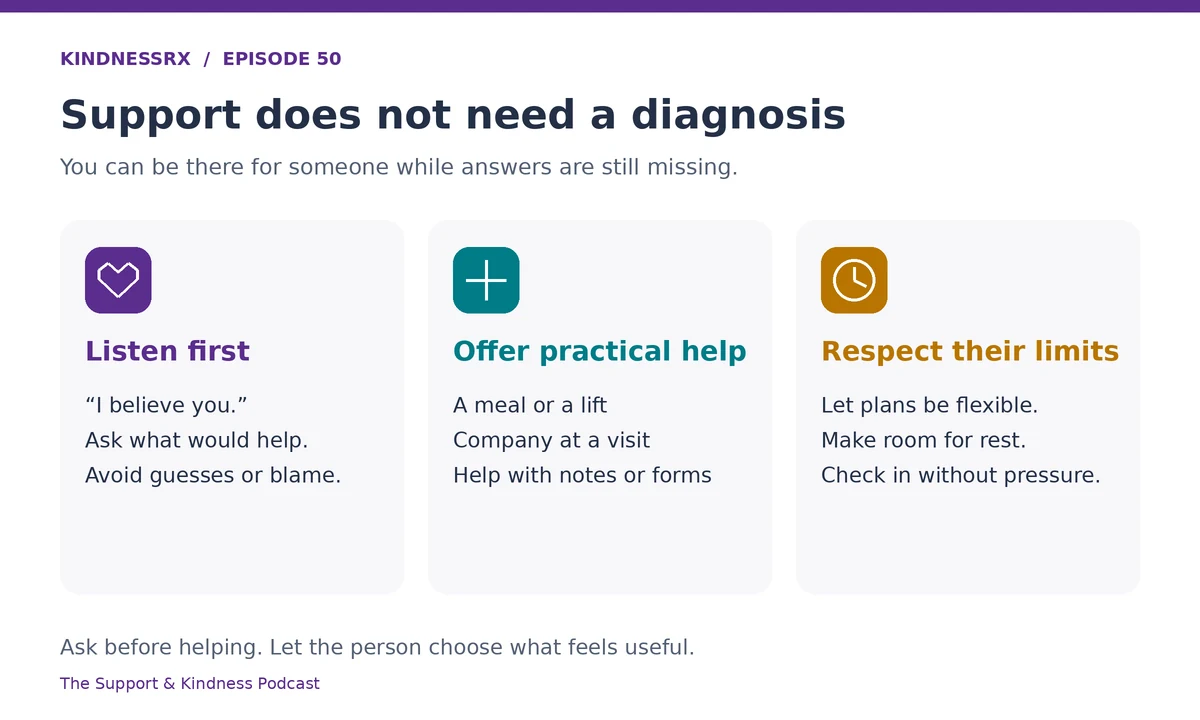
Start by listening. You do not need a convincing explanation before taking someone’s experience seriously. Ask what would be helpful instead of deciding for them.
- Listen without blame. Try “Would you like to talk, or would you prefer some distraction?” Avoid turning symptoms into a debate.
- Offer something specific. “Can I bring dinner on Tuesday?” is easier to answer than “Let me know if you need anything.”
- Respect limits. A cancelled plan is not an invitation to interrogate someone. Offer a lower-pressure alternative and accept a no.
- Ask before sharing. Do not forward someone’s health details, contact their clinician, or post their story without permission.
Do not make the person responsible for easing everybody else’s worry. Support can be ordinary: a lift, a quiet visit, a message that does not require a reply. It can also mean staying in touch after the first round of tests, when the novelty has worn off but the uncertainty has not.
Further reading, a TED talk, and useful resources
These resources extend the episode. They are not a diagnosis checklist. External resources open in a new tab.
- Understanding test results: MedlinePlus’s lab-results guide explains reference ranges and why results need clinical context.
- Planning a conversation: AHRQ’s ten questions to ask can help you prepare for a visit.
- Rare-disease information: NIH’s Genetic and Rare Diseases Information Center (GARD) offers information and resource navigation. It does not diagnose you.
- Specialist research evaluation: the NIH Undiagnosed Diseases Program considers selected cases through clinician referral. It is a research program, not routine clinical care, an automatic referral destination, or a promise of a diagnosis. Treatment is generally not provided.
- A related personal perspective: Jennifer Brea’s TED talk, “What happens when you have a disease doctors can’t diagnose”, recorded at TEDSummit in 2016, shares her experience with ME/CFS and being medically misunderstood. This is further viewing selected for this article, not a claim that the talk was mentioned on air or a source of current treatment advice.
- Continue the podcast conversation: Episode 6: Medical Gaslighting explores the experience of not feeling heard in healthcare.
One manageable step today
You do not need to build the perfect medical history tonight. Write down the three things you most want your next appointment to address. Put the note somewhere you can find it. If you are supporting someone else, offer one practical thing and let them decide whether it helps.
That will not remove the uncertainty. It may make the next conversation a little easier. You deserve a respectful conversation and support while the questions are still open.
Visit KindnessRX support groups for current meeting details, or explore the KindnessRX resource library. For new, worsening, or urgent symptoms, seek appropriate clinical care rather than waiting for a podcast or peer-support meeting.
Research and resource links reviewed November 14, 2026. This companion offers lived-experience support and general education, not diagnosis or individual medical advice.