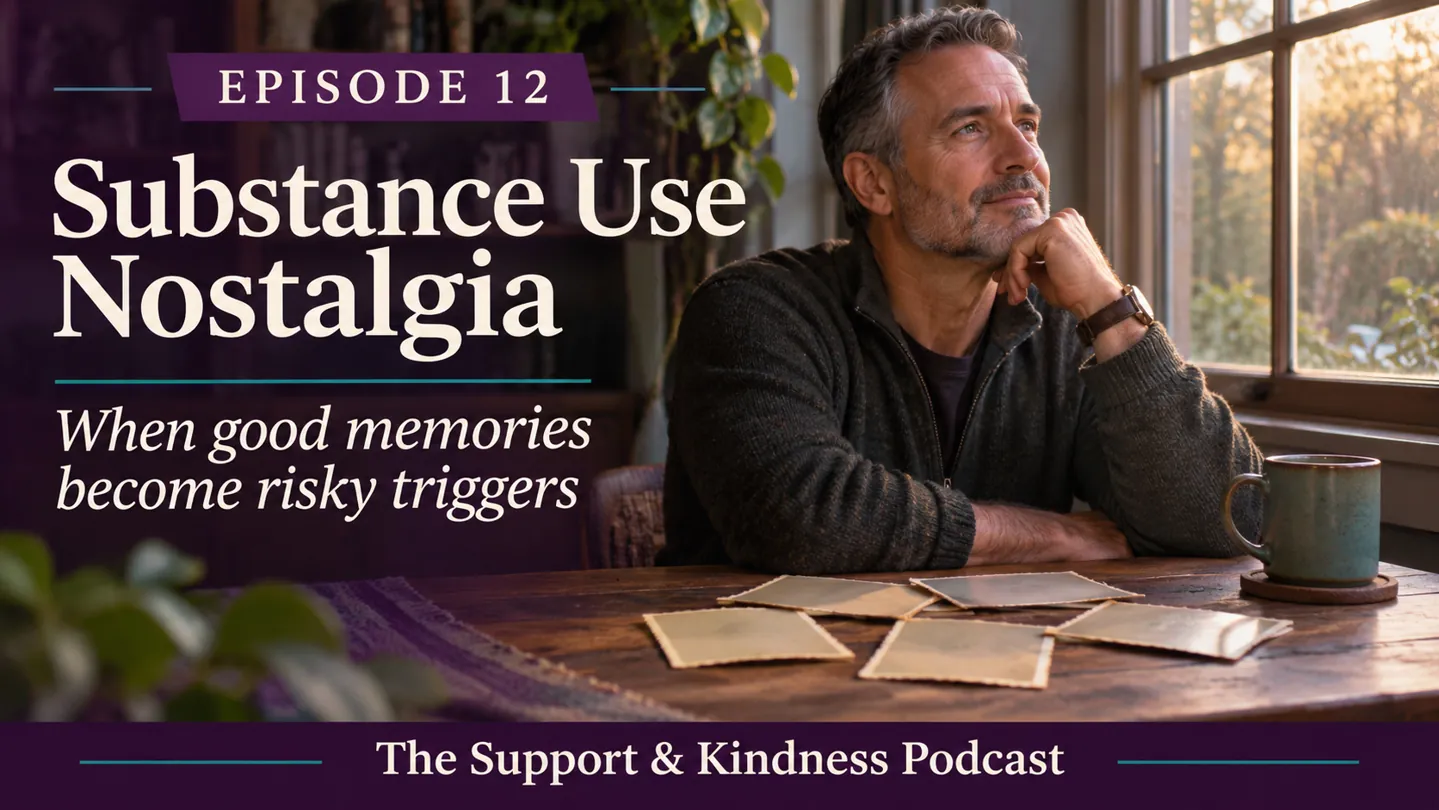
Episode 12: Substance Use Nostalgia and Recovery
You hear an old song. For a moment, you are back with your friends. You remember the laughs, the music, and the feeling that you belonged.
Then another thought slips in. Maybe drinking or using was not all that bad. Maybe you could have that feeling again.
That pull is what we mean by substance use nostalgia. It is a longing for parts of the past linked to alcohol or other drugs. The memory may hold real joy. It may also leave out the harm that came with it.
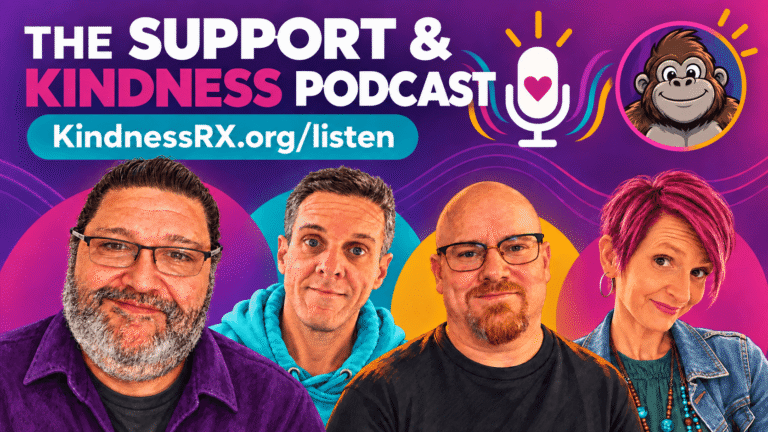
In Episode 12 of The Support and Kindness Podcast, Greg Shaw joins Rich, Liam, Derek, and Jay for an honest talk about that pull. They share what can stir it up, how they respond, and why having a craving does not erase the work of recovery.
This companion article builds on their lived experience with research, support links, and small steps you can try. Their stories are personal experiences, not promises about how recovery will feel for everyone.
Content note: This article and episode discuss substance use, cravings, injury, and return to use. They offer peer support and general information, not therapy or medical care.

Listen to Episode 12
Open the episode on Spotify, or browse The Support and Kindness Podcast.
What is substance use nostalgia?
Substance use nostalgia is the warm pull of memories tied to drinking or using drugs. It can bring back a person, a place, a song, or a sense of freedom. It can also make the past seem safer than it was.
You might miss being young. You might miss your old band, your social life, or a time before illness changed your world. Those feelings deserve care. They do not mean that returning to use would bring back the life you miss.
Rich talks about remembering the fun while leaving out the pain. Liam adds an important layer. He did have good times playing music with people he liked. He also knows he was using substances to cover deep pain. Both things can be true.
Recovery does not ask you to say that every past moment was awful. It asks you to hold the whole picture. The laughter can sit beside the lost time. The friendship can sit beside the injury. The good memory does not cancel the cost.
A useful question is: What am I missing, and is substance use the only way to meet that need?
If you miss connection, you may need company. If you miss music, you may need a safer way to make or hear it. If you miss relief, you may need more help with pain, stress, or grief. Naming the need gives you more options.
What does research say about addiction-related nostalgia?
Researchers use the term addiction-related nostalgia for longing tied to an addictive behavior. A 2024 paper by Mackenzie Dowson and Michael J. A. Wohl explored it in two groups: 301 people recovering from gambling problems and 604 people recovering from alcohol use disorder.
In both studies, more addiction-related nostalgia was linked with more mixed feelings about recovery. The authors also examined how nostalgia and optimism related to those feelings. Read the study abstract in PubMed.
That finding fits the tension the hosts describe. A person can want recovery and still miss parts of their old life. But the research does not prove that nostalgia causes a return to use. It does not tell us that each nostalgic memory is dangerous. It also does not give us a rate for how common this experience is across all people in recovery.
The practical lesson is modest but useful. If warm memories are making you question a recovery plan that matters to you, take that change seriously. Talk it through before you feel pushed into a choice.
Cues and cravings matter, but they do not predict your future
A 2022 review in JAMA Psychiatry brought together 237 studies involving 51,788 participants. It found an association between drug-related cues or craving and later substance use or relapse. Read the research review.
The studies covered different substances, settings, and ways of measuring craving. A pooled finding cannot tell you the chance that one song or one hard day will lead to use. Research like this supports planning for cues. It does not make a craving a verdict.
You can notice a cue, feel an urge, and seek support. Those are moments when care and a plan can matter.
Who can be affected?
The episode includes people at different stages of recovery. Rich describes how his relationship with old memories changed over many years. Jay says reminders still appear after years away from alcohol. Their accounts show why support should fit the person rather than a fixed recovery timetable.
For wider context, NIAAA reports that 27.9 million people in the United States aged 12 or older had alcohol use disorder in 2024. That was 9.7% of that age group. The reported rates were 11.8% among males and 7.6% among females. See NIAAA’s age and demographic data.
These figures describe alcohol use disorder. They do not measure substance use nostalgia. They also do not cover every drug use disorder or show who will have a craving. Their value here is to remind us that alcohol problems affect many lives and many kinds of families.
You do not have to match the hosts’ backgrounds to find this topic useful. A reminder may matter because of what it means in your own life. Someone newly in recovery may need very firm limits. Someone with many years of recovery may still choose those same limits. Neither person owes anyone a test of their willpower.
Triggers can come from inside or outside
Greg describes two broad kinds of triggers in the opening. Some come from feelings and physical needs. Others come from the world around you.
| Type of reminder | What it might look like | A possible first step |
|---|---|---|
| Feelings | Loneliness, grief, anger, anxiety | Name the feeling and contact someone safe |
| Physical needs | Hunger or tiredness | Check food, rest, and your care plan |
| People and places | Old hangouts or friends who still use | Leave, change the plan, or bring support |
| Music and media | A song, film, photo, or online discussion | Pause it and notice what it brings up |
| Objects and routines | An item tied to past use | Change the space where practical |
| Positive events | A party, celebration, or feeling overconfident | Plan support and an exit in advance |
These are examples, not a checklist for diagnosis. A thing that feels harmless to one person may feel loaded to another. You are allowed to respond to what you notice in yourself.
Rich: a conversation can change direction
Rich tells a story about joining an online group to look at artwork connected with his past. The talk moved from art into praise of drug experiences. He left.
That is a useful boundary lesson. You can enter a space for one reason and find that it becomes something else. Leaving does not require an argument. You do not have to prove that other people are wrong before you protect your own recovery.
The same can apply to a group chat, a social feed, or a reunion. You can mute a topic, step outside, or stop replying. A boundary can be quiet and still count.
Greg: change the space when you can
Greg explains that an everyday household product linked with his past inhalant use could bring back a strong response. He chose a battery-powered tool for the same household task instead.
The lesson is about making the task safer for him. It is not a suggestion that everyone has the same triggers. If an object in your home repeatedly stirs up urges, consider whether someone you trust can help you change or remove it safely.
You do not need to keep a trigger nearby to prove that you are doing well.
A craving plan: Recognize, Remind, Remove
Greg’s three R’s offer a short plan to remember in a hard moment. They are a peer coping reminder from this episode, rather than a complete treatment program.
1. Recognize
Name what is happening. You might say to yourself, “This is a craving,” or “That memory is pulling me toward using.”
You do not have to solve your whole history. Start by noticing the moment you are in. If a number helps, rate the urge from zero to ten. If numbers feel like more work, use plain words such as mild, strong, or hard to manage.
2. Remind
Remind yourself that you do not have to act on the urge. Bring back the rest of the story. What did use cost you? What are you trying to protect now?
Keep this kind. The point is not to punish yourself with painful memories. It is to make room for facts that the warm memory has left out. A short note in your phone may help when it is hard to think clearly.
3. Remove
If possible, step away from the trigger. Close the page. Leave the room. Ask someone to walk with you. Change the music. Contact a trusted person or use your recovery plan.
Sometimes you cannot leave at once. In that case, move toward support in the ways you can. You might text a friend, find a quieter spot, or ask for help getting home. A plan should work with your mobility, money, health, and transport needs.
Use HALT to check basic needs
HALT stands for Hungry, Angry, Lonely, Tired. Greg brings it into the episode as a quick way to pause and check in.
It is a reminder, not a test you pass or fail. Food will not solve every craving. Rest will not fix every source of pain. Still, a basic need may be one part of what is making the moment harder.
Ask yourself four short questions. Have I eaten? Am I angry or wound up? Do I need company? Am I worn out?
Choose one small response that fits your health needs. Have a meal or snack if that is right for you. Tell someone you are having a rough day. Sit somewhere calmer. Make time to rest. If your needs feel out of reach, ask for help with the practical barrier too.
People dealing with chronic pain, disability, brain injury, or poor sleep may need a plan with fewer steps. A saved message, a large-print card, or a reminder beside the phone can make it easier to use. You do not have to remember a long list under stress.
 |
What does it mean to ride out an urge?
Greg compares a craving to a wave. The image can help you see a feeling as something that changes, rather than an order you must obey.
Some recovery approaches call this urge surfing. The aim is to notice the urge and your response while making space before acting. It is not a promise that every urge will disappear within a set number of minutes.
You might feel your feet on the floor, look around the room, and name a few things you can see. You might take slow breaths if that feels comfortable. If focusing inward makes distress worse, use an outward task or contact someone instead.
Support still matters. You do not have to sit alone with a craving to do this correctly. If urges are growing, happening often, or becoming hard to manage, bring that information to a qualified care provider.
For another practical resource, see NIAAA’s guide to handling alcohol cravings.
The SMART Recovery Urge Log offers a way to record triggers and responses. You can note what happened, what you felt, what you tried, and what helped. Treat the notes as information for your next plan, not a score for your worth.
Keep the music, with a plan that fits today
Liam shares a hard question. How can he return to music without putting his sobriety at risk? Music holds real joy for him. It also brings familiar faces and memories of using.
The article cannot decide when a return is right for him or anyone else. But his question points to a useful planning process. What part of the activity do you want back? What part feels risky? Who can help you think it through?
You might start with music at home, a daytime rehearsal, or a setting with fewer reminders. You might go with someone who knows your plan. You might arrange your own way home and agree that you can leave early without explaining yourself.
There is no prize for doing the hardest version first. You can keep loving something while taking time to work out how it fits your life now.
Positive nostalgia can hold a different story
Jay brings his ten-year recovery coin into the discussion. For him, it holds memories of people who cared about him in Alcoholics Anonymous and Narcotics Anonymous. The object points toward support and what he has built.
That is his personal example of positive nostalgia. It does not mean that a coin or a happy memory prevents relapse. It shows that the past contains more than using days.
You may have a photo of a sober outing, a kind note, a small piece of art, or a memory of waking with a clear head. You may be at the start and have very few of those memories yet. That is okay. A small good moment today can become a memory you draw on later.
How friends and family can help
If someone says they miss their old life, try to hear the need beneath the words. They may miss feeling included, wanted, young, or free. You can listen without agreeing that drinking or using is the answer.
Ask what would help right now. A phone call may help more than advice. A quieter place may help more than a debate. If you are planning a gathering, offer choices and make leaving easy.
Avoid testing their recovery or surprising them with old using stories. Ask before showing photos or playing a song you know is tied to that time. A person does not need to give a full account of their past to have a boundary respected.
You can care about someone and still need your own limits. Peer and family support can help you work through those needs. For ongoing concerns, seek guidance from a qualified professional rather than trying to manage another person’s recovery alone.
If you have returned to use
A return to use calls for support and a review of what is needed next. It does not make you less worthy of care. Contact your treatment provider, recovery support person, or a service that can help you find care.
Do not assume that a previous amount is safe after time away from a substance. Seek urgent help if there may be overdose, severe intoxication, or another medical emergency. Call 911 in the United States for immediate danger.
Alcohol withdrawal can be dangerous. If you drink heavily or regularly and may be physically dependent, get medical advice before suddenly stopping. Severe confusion, seizures, or other serious symptoms need emergency care. NIAAA explains alcohol treatment and the need for medical support.
This week’s companion challenge: make a small plan
This is an added exercise for the article, inspired by the episode. It is not a challenge read out in the recording.
Choose one option. Keep it small enough to do without overwhelming yourself.
Option one: write a craving card. Add the three R’s, one safe person to contact, and one place you can go or activity you can use when an urge shows up. Keep it somewhere easy to find.
Option two: make one new memory. Choose something that fits your energy and budget. Listen to music with a trusted friend. Share a meal. Sit outside. Make something simple. Notice one detail you would like to remember.
If you want to reflect afterwards, ask: What did I need? What helped? What could make the next time easier? You can keep those answers private.
Questions people ask about substance use nostalgia
Does missing parts of using mean I want to give up recovery?
Not necessarily. A memory can contain real feelings without being a plan. If you notice it changing your choices or making use feel more appealing, reach out and talk it through.
Will cravings stop after a certain number of years?
There is no timetable that fits everyone. Rich and Jay describe changes over time, while also showing that old reminders can still appear. Your experience may differ. Ongoing or stronger cravings are worth discussing with a care provider.
Do I have to avoid every old friend or favorite song?
Your plan should fit your needs and risks. Some boundaries may be temporary. Others may remain useful. Work with trusted support rather than testing yourself to meet someone else’s idea of progress.
Can peer groups replace treatment?
Peer support can offer connection and shared experience. It does not replace medical assessment, therapy, or prescribed treatment. Different forms of support can work alongside each other.
Support, further reading, and links mentioned
The recording mentions SMART Recovery, urge logs, AA, NA, SAMHSA recovery resources, FindTreatment.gov, 988, and the nostalgia research. Here are direct places to start:
- SMART Recovery tools and the Urge Log.
- Alcoholics Anonymous and Narcotics Anonymous.
- SAMHSA recovery resources.
- FindTreatment.gov for U.S. treatment services.
- 988 Suicide & Crisis Lifeline. In the United States, call or text 988 for crisis support. Call 911 for an immediate medical emergency.
- The Long Shadow of Addiction-Related Nostalgia, Dowson and Wohl, 2024.
- Association of Drug Cues and Craving With Drug Use and Relapse, JAMA Psychiatry, 2022.
- NIAAA alcohol use disorder facts and demographics.
Further viewing
An added resource beyond the recording is Judson Brewer’s TED talk, A simple way to break a bad habit. It offers an introduction to habit loops, attention, and curiosity. Watch it as further context, rather than a complete treatment plan or proof that one method works for everyone.
Keep the conversation going with KindnessRX
For more conversations about asking for help and finding connection, browse the podcast, including Episode 9, Asking for Help, and Episode 5, What Do You Do When You Have Nobody to Talk To.
You can also see KindnessRX’s online support groups or visit KindnessRX. These peer spaces offer connection around mental health, chronic pain, and brain injury. They are not addiction treatment or emergency services.
The past may come back through a song, a face, or a quiet moment. You can meet it with honesty and care. You can remember what mattered, name what hurt, and ask for help with the life you are building now.
Images are illustrative artwork and do not depict the hosts or group participants.