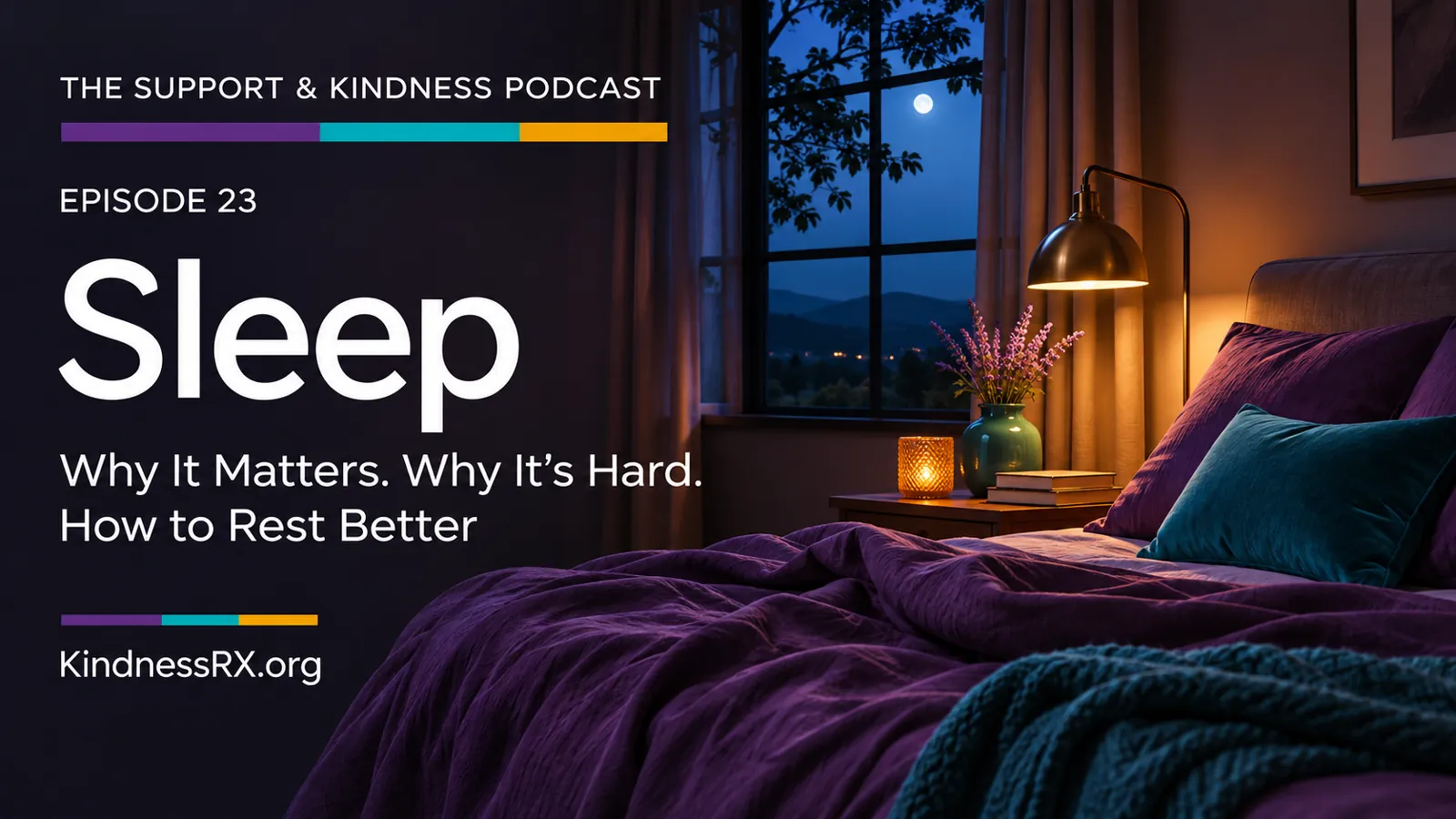
Episode 23: Sleep, Why It Matters, Why It’s Hard, and How to Rest Better
You can be worn out all day and still lie awake at night. You can sleep for hours and wake up feeling as if you barely rested. And when someone says, “Just go to bed earlier,” it can feel as though they have missed the whole point.
Sleep can be hard when you live with pain, anxiety, brain injury, trauma, or a sleep disorder. It can also be hard when your work, housing, caring duties, or money worries leave little room for rest.
In Episode 23 of The Support and Kindness Podcast, Greg Shaw is joined by Rich, Jay, Derek, and Sarah. They talk about the science of sleep and the very human struggle of trying to get enough of it.
This companion article builds on that conversation. It adds research, practical ideas, and a few useful details that broad sleep tips can miss. The aim is to help you understand your sleep and find a kind next step.
The main point: better sleep often starts with steady habits, but ongoing sleep problems may need proper treatment. Struggling to sleep does not mean you lack effort or care.
Listen to Episode 23
You can also visit our listening page to find more episodes.
This is education and peer support, not personal medical advice. Ask a healthcare professional about sleep problems that persist, affect your daily life, or make you unsafe.
What the team shares about sleep
Greg describes living with several conditions that affect his rest. These include ADHD, PTSD, pain, narcolepsy, and sleep apnea. He talks about a cool room, less light, and familiar evening cues. His account shows why one sleep tip is rarely enough when several health issues overlap.
Rich talks about the search for a pillow that does not hurt his head after traumatic brain injuries. He has tried many options. A steady bedtime routine helps him fall asleep, but comfort is still a real problem.
Jay describes anxiety and a past pattern of staying awake for very long periods. He also shares a useful truth: a bad morning does not have to decide how the whole day goes. Later, he talks about warm baths, regular sleep times, and less screen use in bed.
Derek says his sleep changes with his activity, food, plans, and stage of life. He has learned to pay attention to his body. Sarah talks about heavy sleepiness, prescribed nighttime medicines, and no longer remembering her dreams.
These are personal experiences. They give the topic a human face. They are not diagnoses for listeners or proof that the same approach will work for everyone.
What happens while you sleep?
Sleep is an active process. Your brain and body move through different stages that support memory, learning, immune function, and other parts of health. The National Heart, Lung, and Blood Institute explains these stages in its guide to sleep.
Non-REM sleep includes three stages. The first is the light drift into sleep. The second brings slower heart rate and lower body temperature. The third is deep sleep. REM sleep brings a different pattern of brain activity and often vivid dreams.
We move through these stages more than once each night. Their length changes across the night and from person to person. A sleep cycle is not a fixed timer that everyone can plan around.
That matters if an app promises the perfect wake-up time based on exact 90-minute blocks. Real sleep is more varied. Giving yourself enough time to sleep is more useful than trying to land on a perfect minute.
Dreams also need a little care when we discuss them. Sarah wonders whether her lack of dream recall means she is missing REM sleep. Not remembering dreams does not prove that REM sleep is absent. Dreams can occur in more than one sleep stage, and remembering them depends on several factors. A change in dream recall alone cannot diagnose a sleep problem.
How much sleep do adults need?
The CDC’s sleep guide lists different needs by age. Adults ages 18 to 60 generally need at least seven hours a night. Adults ages 61 to 64 are advised to get seven to nine hours. For adults 65 and older, the range is seven to eight hours.
These are guides, not a scorecard. Your health and circumstances matter. A clinician can help if you regularly need much more sleep, cannot sleep enough, or remain very sleepy despite enough time in bed.
Hours are only one part of the picture. It also matters whether sleep is broken, whether you feel restored, and whether you can stay awake safely during the day.
Try asking a broader question than “Did I get eight hours?” Ask, “How is my sleep affecting my life?” That can open a more useful conversation with your care team.
Sleep problems are common, but they do not affect everyone equally
A CDC National Center for Health Statistics report published in April 2026 used the 2024 National Health Interview Survey. It found that 30.5% of U.S. adults reported sleeping less than seven hours in a 24-hour period.
The report also found differences by age and race. Short sleep was reported by 34.5% of adults ages 50 to 64. The figure was 40.2% among Black non-Hispanic adults. Trouble staying asleep most days or every day was reported by 21.4% of women and 14.6% of men.
These survey findings describe groups. They do not explain why an individual sleeps poorly. They also do not mean that short sleep is an inborn trait of any group.
Work hours, neighborhood noise, stress, caring roles, discrimination, access to care, and health can shape the chance to sleep. A calm bedroom routine cannot remove all those barriers.
The survey measures self-reported sleep. It is not a count of diagnosed sleep disorders. Keeping those ideas separate helps us use the figures fairly.
Why sleep and mental health can affect each other
Most of us know how much harder life can feel after a poor night. Small problems may feel huge. Patience may run thin. It may be harder to focus, cope with pain, or manage worry.
Anxiety, depression, and trauma can also make sleep harder. A quiet room may leave more space for racing thoughts. Nightmares can make bedtime feel unsafe. Worry about tomorrow can turn into worry about sleep itself.
This creates a painful loop. You want to sleep. You watch the clock. Each passing hour feels like proof that tomorrow will be awful. The pressure to sleep can leave you even more alert.
A kinder response is to reduce the struggle where you can. You might write down tomorrow’s concerns before bed. You might choose a quiet activity that feels safe. You might talk to your clinician about nightmares, mood, or insomnia.
Our conversations on anxiety with no apparent cause in Episode 20 and why intrusive memories show up at 3 a.m. explore some of the distress that can follow us into the night.
Sleep care and mental health care can work together. You do not have to decide which problem “counts” before asking for help. And improving sleep should not be sold as a cure for every mental health condition.
Your body clock and the problem of social jet lag
Your body has a daily timing system, often called the circadian rhythm. Light helps set that clock. Sleep pressure also builds while you are awake. These systems work together to affect when you feel sleepy and alert.
In the episode, Greg talks about social jet lag. This is the gap between your natural timing and the schedule you follow. It often shows up when workdays and days off have very different sleep times.
A regular waking time can help create a steadier rhythm. Daylight during your waking day may help too. A comfortable place near a window can be useful when going outside is difficult.
The aim is a routine you can live with. Shift workers, parents, carers, and people with fluctuating illness may need a different plan. If your body clock seems far out of step with daily life, ask about a sleep assessment rather than forcing a sudden change on your own.
A bedroom that supports your body
Rich’s pillow search is a reminder that comfort is not a small detail. We explore the wider effects of pain in Episode 14: Understanding Chronic Pain, Beyond Hurt. Pain can interrupt sleep even when the room is quiet and the phone is off.
Start with the thing that bothers you most. Is it pressure on your head? Heat? Light? A stiff neck? Noise? Needing to get up for the bathroom?
You do not have to buy a whole new bedroom. You might adjust bedding, block a small light, move a noisy device, or ask a therapist about positioning. A cool room can feel good, but there is no single temperature that suits every body.
Think about safety as well as comfort. Keep a clear path to the bathroom. Place needed mobility aids within reach. Use enough light to move safely. A fall is a much bigger problem than an imperfectly dark room.
White noise and pets also deserve a personal approach. The episode raises concerns about both. A sound machine is not a proven cure, but it is not fair to say every sound machine harms everyone’s sleep. Volume, sound type, and personal response matter. Pets may interrupt some people and comfort others. Notice your own pattern instead of treating either choice as a moral rule.

Screens, caffeine, food, and a gentler wind-down
Evening light can affect the body clock. Phones can also keep us awake through the content we consume. A tense message, upsetting news story, or endless video feed may matter as much as the glow of the screen.
A digital sunset can be simple. Dim the screen. Silence alerts. Stop an upsetting task. Put the phone farther from the pillow. If you rely on it for care, communication, or accessibility, keep the features you need.
Caffeine can affect sleep for hours. Check coffee, tea, energy drinks, and some medicines. Rather than changing everything at once, notice when you use caffeine and how your nights feel. A pharmacist can help identify sources you may overlook.
Alcohol may make you feel sleepy at first, but it can disrupt sleep later. It is not a good sleep treatment. Large late meals can also be uncomfortable, especially with reflux.
Jay finds a warm bath helpful. A warm wash or shower may feel calming too, if it is safe and accessible. Avoid water that is too hot, especially if you have dizziness or reduced sensation. Warm milk is an optional comfort ritual, not a reliable insomnia treatment. Choose what fits your diet and health needs.
Movement can support sleep, but exercise timing is personal. Gentle evening movement is not automatically harmful. Notice whether a particular activity leaves you settled or wide awake.
When healthy habits are not enough: CBT-I
You may have tried the dark room, the quiet routine, and the caffeine changes. You may still be awake.
That does not mean you have failed. Sleep hygiene is useful, but it is not the same as treatment for chronic insomnia.
The National Heart, Lung, and Blood Institute describes cognitive behavioral therapy for insomnia, usually called CBT-I, as a treatment that helps change thoughts and habits that interfere with sleep. It commonly includes several parts, tailored to the person.
One part works on the link between bed and wakefulness. Another helps with fears and beliefs about sleep. A clinician may also adjust the time spent in bed. This is a structured treatment, not simply being told to relax.
Ask your primary care clinician or sleep service how to find CBT-I. Some services offer remote or digital options. Check what support is included and whether the program fits your health needs.
Avoid starting an aggressive sleep restriction plan on your own. Marked daytime sleepiness, fall risk, bipolar disorder, seizure conditions, and other health issues can affect how treatment should be delivered. Your plan should support your safety as well as your sleep.
The American Academy of Sleep Medicine clinical guideline recommends multicomponent CBT-I and advises against sleep hygiene alone as treatment for chronic insomnia. It also addresses safety adaptations.
Sleep advice needs to fit disability and chronic illness
“Get out of bed if you cannot sleep” is common insomnia advice. But what if you cannot safely get up? What if bed is also where you manage pain, recover from illness, or spend much of your day?
Tell your clinician. Ask for an adapted plan. You may be able to use a different position, a quiet activity, or a change of lighting to mark rest time and sleep time. The right approach depends on what your body can safely do.
You also do not need to stare at a clock to enforce a strict 20-minute rule. That can add pressure. The larger aim is to reduce long periods of frustrated wakefulness in bed, using an approach that is safe for you.
Naps need the same care. Some people with insomnia benefit from changing daytime naps. But people with narcolepsy may have planned naps as part of treatment. Do not remove prescribed rest because a general sleep checklist says naps are bad.
If you use CPAP, continue it as prescribed. Ask your sleep team about discomfort, leaks, or trouble tolerating it. A good bedtime routine does not replace treatment for sleep apnea.
For more on brain injury, the MSKTC guide to sleep after TBI explains how injury, pain, mood, and medicines may affect sleep.
When to speak to a healthcare professional
Ask for help when sleep problems keep coming back, distress you, or affect daytime function. You do not have to wait until you are completely worn down.
Mention loud snoring, witnessed breathing pauses, waking gasping, strong urges to move your legs at night, sudden sleep episodes, or unusual movements during sleep. These details can help guide an assessment.
Sarah’s comments also raise a useful topic: medicine review. Some medicines can change alertness, sleep, or dreams. Tell your prescriber about heavy daytime sleepiness or a change after starting a medicine. Do not stop, combine, or change prescribed doses on your own.
If you are too sleepy to drive safely, do not drive. Arrange another way to travel. If you have severe breathing trouble or another emergency symptom, seek urgent help.
A sleep study may be useful for some conditions. It is not needed for every person with insomnia. A clinician can explain which assessment fits your symptoms.
A simple sleep diary to take to an appointment
A short diary can help you describe patterns without needing perfect recall. For a week or two, note your rough bedtime, waking time, naps, caffeine, and how you felt during the day.
Add a brief note about pain, nightmares, breathing concerns, or medicine changes. Keep it simple enough to use on a difficult day.
You do not need a wearable device. Consumer sleep scores are estimates. They cannot diagnose insomnia, apnea, narcolepsy, or a lack of REM sleep.
If tracking makes you more anxious, tell your clinician and scale it back. The diary should help you understand your needs, not become another nightly test.
This week’s kindness challenge: choose one
This challenge extends the episode’s message of self-kindness. Pick the option that fits your energy.
Option one: make one small change for three nights. Choose a softer light, fewer alerts, a calmer last activity, or a more comfortable pillow setup. Notice whether it helps. There is no pass or fail.
Option two: ask for one piece of support. Write down your main sleep concern. Share it with your clinician, pharmacist, or a trusted person who can help you seek care. Asking counts, even if the appointment takes time.
You can also bring the emotional side of sleep struggles to our free KindnessRX peer support groups. Peer support offers connection and encouragement. It does not replace sleep or mental health treatment.
Common questions about better sleep
Does falling asleep quickly mean my sleep is healthy?
Not always. Think about your full pattern, including breathing, how rested you feel, and daytime sleepiness. Very strong sleepiness deserves attention, even if bedtime seems easy.
Does not remembering dreams mean I am not getting REM sleep?
No. Dream recall does not measure sleep stages. Share concerns with your clinician, especially if you also have daytime symptoms or medicine changes.
Should everyone stop taking naps?
No. The right advice depends on your health and treatment. Planned naps can be part of narcolepsy care. Ask before changing a prescribed plan.
What if I cannot afford sleep products?
You do not need expensive equipment to begin. Small changes to light, noise, routines, and comfort may help. Ongoing symptoms deserve care regardless of what products you can buy.
Can peer support help with sleep?
It can help you feel less alone and give you space to talk about pain, stress, or frustration. It cannot diagnose a sleep disorder or replace treatment.
Further reading, resources, and a TED talk
The episode and its script point listeners toward sleep education and KindnessRX support. These are useful places to continue:
- CDC: About Sleep. Sleep needs by age and practical healthy habits.
- NHLBI: Insomnia Treatment. CBT-I, other treatment options, and questions to discuss with a clinician.
- NHLBI: Sleep Phases and Stages. Sleep stages, body clocks, and the brain.
- CDC: Short Sleep Duration and Sleep Difficulties Among Adults, United States, 2024. The source for the survey figures discussed above.
- Sleep Foundation: Sleep Hygiene. A plain-language guide linked in the episode script. This is a secondary education resource.
- Matt Walker: Sleep Is Your Superpower, TED. An optional introduction to sleep science. Use the clinical resources above for treatment guidance.
- KindnessRX peer support groups. Find current group details and sign-up information.
- More from The Support and Kindness Podcast. Explore related conversations about mental health, pain, and life with health challenges.
You do not have to fix your whole sleep life tonight. Start with what is within reach. Seek help for what needs more support. Your need for rest deserves care, patience, and kindness.