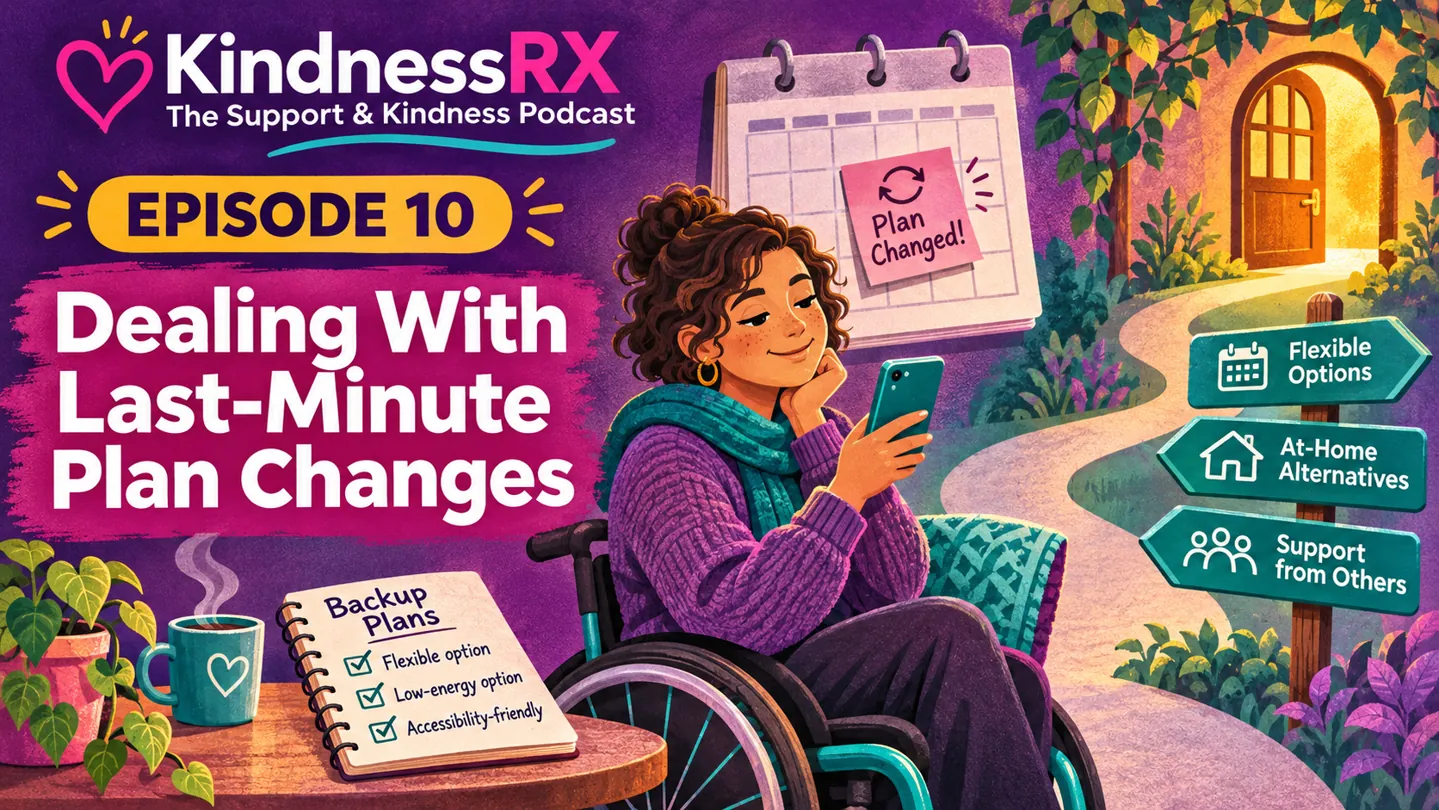
Episode 10: Dealing With Last-Minute Plan Changes
A ride changes. A place closes early. Someone calls to say they cannot make it. The plan you spent all morning getting ready for has gone.
For some people, that is a small bump in the day. For others, it can feel like the floor has moved.
In Episode 10 of The Support & Kindness Podcast, Greg Shaw, Rich, and Jay talk about dealing with last-minute plan changes. They share what helps when plans fall through, how to speak up about what you need, and why a calm face does not always show what is going on inside.
This companion goes beyond the conversation. You will find added research, practical words to use, a small backup plan, and ways to support someone whose day has changed. The research and exercises below are extra reading, not claims that the hosts discussed every source on air.
The main point: When plans change, check what you need, say what has changed, and choose one next step. You can feel upset and still take care of yourself.
Content note: This episode includes anxiety, agoraphobia, medical treatment experiences, and medication changes. It shares personal experiences and peer support. It does not offer medical advice.
Listen to Episode 10
Listen to Episode 10: Dealing With Last-Minute Plan Changes.
Looking for more conversations like this? Browse The Support & Kindness Podcast. For a related read, visit our Episode 3 companion about guilt after cancelling plans.
Why last-minute plan changes can feel so hard
A change of plans is rarely just a change of plans.
You may have arranged a ride. You may have rested the day before. You may have moved an appointment, saved money, or used most of your energy to get dressed and leave home.
Then someone says, “We will have to do it another time.”
They may mean well. You may still feel a real loss.
There is the thing you hoped to do. There is also the work you put into being able to do it. When both disappear at once, frustration makes sense.
Greg talks about this in the episode. He had planned to return to Pathway Clubhouse after a treatment appointment. He had arranged transport. Then he found out the clubhouse was closing early for staff training.
The next question was not just what to do with a free afternoon. He needed to know how he would get home.
That matters. A person with their own car may have several choices. A person using a wheelchair and a booked ride may have far fewer. The same change can land very differently.
Before judging your reaction, ask what the change has actually cost you. Time? Energy? Access? Money? A chance to see people? Knowing that can help you explain what you need.
A calm face can hide a loud alarm
Greg describes seeming to handle the change well while feeling alarmed inside. Other people could not see the full stress of it.
This happens in all kinds of settings. Someone may be polite on the phone while trying not to cry. They may agree to a new time while wondering how they will pay for a second ride. They may go quiet because they need a moment to think.
A quiet response does not prove that a change is easy.
If you are helping someone, ask a concrete question: “Does this affect your ride home?” That may be more useful than telling them to relax.
If you are the person who feels overwhelmed, you do not have to give a long account of your health. A short sentence is enough: “I need a minute. This changes my transport.”
That gives the other person something clear to respond to. It also gives you permission to pause.
What the research adds about anxiety
Anxiety is common, but a stressful reaction to a changed plan does not by itself mean you have an anxiety disorder.
A CDC report using 2022 National Health Interview Survey data found that 18.2% of U.S. adults had mild, moderate, or severe anxiety symptoms in the previous two weeks. This was a symptom measure, not a count of diagnosed anxiety disorders. Symptoms were more common among younger adults, women, people with lower family income, and adults in rural areas.
Those figures help put anxiety in context. They do not tell us how many people struggle with last-minute changes. They also do not tell us why any one person is upset.
Someone may fear being stranded because it has happened before. Someone else may be worried about missing a medical appointment. Another person may feel rejected when a friend cancels.
The useful question is not, “Who is reacting correctly?” It is, “What is making this hard, and what would help?”
Disability and transport change the picture
Greg’s story brings access into a conversation that can too easily become advice to “go with the flow.”
The Bureau of Transportation Statistics report on travel patterns and disability uses the 2022 National Household Travel Survey. It estimates that 18.6 million people age five and older had disabilities that limited travel.
Among adults ages 18 to 64, 40.2% of those with travel-limiting disabilities reported no trips on their survey day, compared with 21.2% of those without travel-limiting disabilities.
These are travel figures. They do not show that anxiety caused people to stay home. They do show why getting out and about cannot be treated as a simple matter of willpower.
A backup plan has to fit real access needs. An ordinary rideshare may not take a person’s mobility equipment. A new venue may have steps. A later finish may fall outside an aide’s hours.
If you change a plan, check the parts that affect access. Ask about the entrance, seating, bathroom, ride, cost, and finish time. A kind invitation works best when people can actually use it.
A small laboratory study adds a useful piece of context. In a 2016 experiment involving 45 participants, stress responses tracked uncertainty during a task involving possible electric shocks. That is a very different setting from a cancelled visit. It supports studying uncertainty as part of stress, rather than proving how any one person will respond to a changed plan.

Practical help with transport can matter as much as emotional support.
Five steps when a plan suddenly falls through
The steps below build on the episode. They are a practical guide, not a clinical treatment or a test you have to pass.
1. Check the immediate need
Start with what has to happen first.
Do you have a safe place to wait? Is your ride still coming? Does someone need to know you will be late? Are you following any care instructions from a treatment you have just had?
If a practical problem needs attention, deal with that first. You do not need to become calm before asking for help.
Try: “My destination has closed. I need to find out how to change my return trip.”
2. Name the feeling
Greg describes using an “I” statement to make sense of his reaction.
You might say, “I am frustrated because I put a lot into this.” Or, “I feel worried because I do not know how I will get home.”
The point is to be honest without making yourself the problem.
You do not have to talk yourself out of being disappointed. Naming it can help you see what the feeling is connected to. Then you can decide what needs care.
3. Separate what you know from what you fear
In Greg’s story, the driver was able to help. Before that happened, he had imagined a much harder response.
A simple check can help: What do I know? What am I afraid might happen? What can I ask?
You might know that a venue is closed. You might fear that the ride company will refuse to help. The next step is to ask what options are available.
This does not mean every fear is false. Some systems are hard to use. It means giving yourself a chance to get the facts before making the whole day depend on the worst outcome.
4. Give yourself a little room
If it helps, let your shoulders drop or loosen your jaw. Sit somewhere that feels steady. Look around and name a few things you can see.
Greg mentions breathing in for four seconds, holding for four, and breathing out for six. That is a personal coping suggestion from the episode. You do not need to force that count or hold your breath.
The NHS guide to breathing for stress advises gentle, comfortable breathing without forcing it. Stop an exercise that makes you feel worse. If breath focus does not help, choose another way to pause.
There is also research on breathing practice. A 2023 randomized study compared daily five-minute breathing exercises with mindfulness over one month. It found improvements in mood and anxiety, with greater gains in positive mood for an exhale-focused practice called cyclic sighing than for mindfulness. The study did not test the episode’s exact four-four-six pattern, so it should not be used to claim that this count is proven.
5. Choose one next step
You do not need a complete new plan right away.
Make one call. Send one text. Ask one person for help. Confirm one detail.
In the episode, Greg was able to go home and rest. That became a useful outcome. You may find a useful outcome too. You may also simply have a disappointing afternoon. Both can be true.
Clear words make a hard moment easier
Rich returns to communication throughout the episode. He points out that sharing practical details can reduce confusion for everyone involved.
People cannot plan around a limit they do not know about. They also do not need your full medical history to understand a clear request.
Here are some words you can borrow. These examples were written for this companion.
| Situation | Words you could use |
|---|---|
| The meeting runs late | “My ride leaves at two. I need to finish by then.” |
| You need time to adjust | “That is a big change for me. Let me check a few things before I answer.” |
| Your health changes | “I am not well enough to come today. I still want to see you. Can we try a short call instead?” |
| A venue changes | “Can you confirm there is a step-free entrance and an accessible bathroom?” |
| You cannot afford another trip | “I cannot pay for a second ride this week. Could we keep this online?” |
| You need a clear answer | “Please let me know by noon. After that, I need to keep my current ride.” |
A useful message often has three parts: what changed, what you need, and what you can offer.
For example: “My appointment ran late. I cannot reach you by one. I can join by phone at one-thirty, or we can choose another day.”
It is clear. It leaves room for the other person to respond. It does not require you to make promises you cannot keep.
When you are the person who needs to cancel
Having a valid reason does not mean a change has no effect on someone else. You can care about that effect without blaming yourself for being ill or disabled.
Tell the person as soon as you reasonably can. Say clearly whether the plan is cancelled or delayed. If there is a realistic alternative, offer it.
“I cannot make today. I know you arranged time for this, and I am sorry for the short notice. Would a ten-minute call on Thursday work?”
If you do not know when you will be well enough, say that. It is kinder than picking a date you already doubt you can manage.
You can also agree on a plan ahead of time: “My symptoms change quickly. Could we check in that morning before either of us leaves?”
That does not remove all disappointment. It gives both people a shared way to handle uncertainty.
When someone keeps cancelling on you
Rich raises a fair concern. Repeated cancellations can affect trust. Jay also talks about the value of showing up for friends, while placing health first.
There is room for both care and limits here.
Repeated cancellations may come from changing symptoms, transport problems, caring duties, money worries, or poor communication. You may not know the reason. A pattern is a reason to talk, rather than proof that someone does not care.
Try asking, “Is there a way we could make our plans easier to keep?”
Maybe a short visit works better than a long day out. Maybe you can meet online. Maybe a flexible window is more realistic than a fixed start time.
You can also name the effect on you: “When plans change after I have booked a ride, I lose money. I need us to confirm before I book next time.”
Kindness does not require endless waiting. A boundary can protect the friendship by making the plan more honest.
A shorter visit or time together at home can keep a connection going.
You can move the date and keep the meaning
Rich shares a family example about travel near his brother’s birthday. Several things made that date difficult, including a medication change and travel concerns at the time.
Once the family spoke openly, they found that they were all trying to make a difficult date work. The birthday mattered. Meeting on that exact date was creating stress.
That is a useful question for holidays, reunions, meals, and celebrations: What are we trying to protect?
If the answer is time together, a different date may serve that goal better.
A birthday call now and a visit later can still be loving. A quiet meal can still mark an important day. Someone joining by video is still part of the gathering.
The travel discussion in this archived episode describes the circumstances at the time of recording. It should not be used as a current airport or flight update. Medication and travel decisions belong with the person’s own care team.
Staying home, avoidance, and agoraphobia
The conversation touches on agoraphobia. This needs a little care when we expand it into a health article.
Cancelling plans or spending time at home does not by itself mean someone has agoraphobia. It is also not sound to say that frequent cancellations alone cause it.
The NHS explains agoraphobia as fear of situations where escape may feel difficult or help may not be available. It can involve public transport, busy places, or leaving home. Diagnosis needs proper assessment.
Someone may be home because the building has steps, the lift is broken, their symptoms have flared, or no suitable transport is available. These are access and health problems. They should not be treated as a lack of courage.
If fear is making your life smaller, speak with a qualified clinician about support. If access is the barrier, ask for practical changes. Sometimes both need attention.
A friend can help by asking, “What is getting in the way?” Then listen to the answer.
For another conversation about choosing where to put your energy, listen to Episode 38: What You Can Actually Control.
Make a small backup plan before you need one
A backup plan should reduce work. It should not become another large task.
Choose one coming activity and write down a few details. Keep them somewhere easy to find.
- The plan: Where am I going, and when?
- The check: Who can confirm that the place is open and the time is right?
- The ride: Who do I contact if the destination or finish time changes?
- The alternative: Could we shorten it, join online, choose another day, or go home?
- The limit: What would make this too much for my health, energy, or budget?
A backup may be as simple as agreeing to text before leaving. Or asking the venue to call if it closes early.
For booked transport, check the provider’s current rules. Greg’s driver helped in his situation. That does not promise that every service can change a trip in the same way.
Support that sounds like support
Jay talks about the value of friendship and the group chats the hosts share. Being able to speak with people who understand can make a hard day feel less lonely.
Support does not always need a clever answer.
“That sounds like a lot after all the work you put in” can be a good start.
“Do you want help making a call?” offers something practical.
“Would you like company while you wait?” gives the person a choice.
Try not to rush straight to a bright side. A cancelled plan may create rest, as it did for Greg. It may also cost someone a rare chance to connect. Let the person tell you what it means to them.
The National Institute of Mental Health’s self-care guidance includes setting priorities and staying connected with people who can offer emotional and practical support. The right support will look different from person to person.
This week’s kindness challenge: make one plan easier
This challenge is extra companion material, created to build on the conversation.
Choose one option. Keep it small.
Option one: Give yourself a backup. Pick one plan this week. Write down who to contact if it changes and one realistic alternative. You can stop there.
Option two: Offer someone else some room. When making a plan, ask, “What would make this easier for you?” Listen without asking them to prove their need.
At the end of the week, notice what helped. Did a clear finish time reduce stress? Did a same-day check save a wasted trip? Did a short call keep you connected?
The challenge is to make life a little kinder, including for yourself. There is no score to keep.
Questions people often ask
Why do I get upset when plans change?
A changed plan can mean lost effort, uncertainty, disappointment, or an access problem. Look at what the plan meant to you and what the change affects. A strong reaction alone does not tell you whether you have a mental health condition.
How can I calm down when a plan is cancelled?
Check your immediate needs first. Name the feeling, confirm the facts, and choose one small action. Gentle breathing or a quiet pause may help some people. You do not have to feel calm before asking for practical support.
Is it wrong to cancel because of my health?
Your health needs care. Communicate as early as you can, and be honest about what is possible. If you want to stay connected, suggest an option that fits your current capacity. You do not owe a detailed medical explanation.
What if my friend thinks I do not care?
Tell them that the relationship matters. Explain the practical limit you want them to understand. Ask what effect the changes have had on them too. Then look for a way of meeting that both of you can manage.
Should I push myself to go out anyway?
That depends on your health, access needs, and the reason you are staying home. This article cannot make that call for you. If anxiety or panic is restricting your life, ask a qualified professional for an individual plan.
Resources mentioned in the episode
The recording refers to KindnessRX, Pathway Clubhouse, and COTA Mainstream. The hosts discuss personal experiences with these services. Check each provider directly for current access, eligibility, hours, and trip rules.
- KindnessRX: Podcast, community, and ways to connect.
- KindnessRX support groups: Find current group details and sign-up information.
COTA Mainstream: Official information about Central Ohio paratransit.
Pathway Clubhouse, Columbus: Official local clubhouse information. Contact the provider about membership and current opening hours.
The old invitation to a movie “tomorrow” belongs to the original recording. For current activities, use the present KindnessRX links rather than that archived invitation.
Added research, a TED talk, and further reading
- NHS: Change and uncertainty. Practical guidance for handling uncertainty.
- de Berker and colleagues, 2016. The uncertainty laboratory study.
- Balban and colleagues, 2023. The breathing trial discussed above.
These resources were added for this companion. They were not all mentioned on air.
- CDC: Symptoms of Anxiety and Depression Among Adults, United States, 2019 and 2022. Read the survey methods and demographic breakdowns behind the anxiety figures.
- Bureau of Transportation Statistics: Travel Patterns of American Adults With Disabilities. Explore the differences in travel reported in the national survey.
- NHS: Breathing exercises for stress. A gentle guide that does not require forcing the breath.
- NHS: Agoraphobia overview. Learn what the condition involves and how to seek assessment.
- NIMH: Caring for Your Mental Health. Further guidance on self-care and finding help.
- Susan David: The gift and power of emotional courage, TEDWomen 2017. A related talk about making room for difficult feelings. It offers broader reflection, rather than a treatment for anxiety or a study of cancelled plans.
Keep the conversation going
What is the hardest part of a last-minute change for you? Is it the lost time, the worry, the ride, or the feeling that your effort did not count?
Share what helps, if you feel comfortable. Someone else may need that idea today.
You can join our free online support groups or find another episode of The Support & Kindness Podcast. Check the current group page for times and registration.
Plans will change. Clear words, practical help, and a little room for each other can make those moments easier to bear.
If you are in the United States and need urgent emotional support, call or text 988 or visit 988lifeline.org. For immediate danger or a medical emergency, call 911.