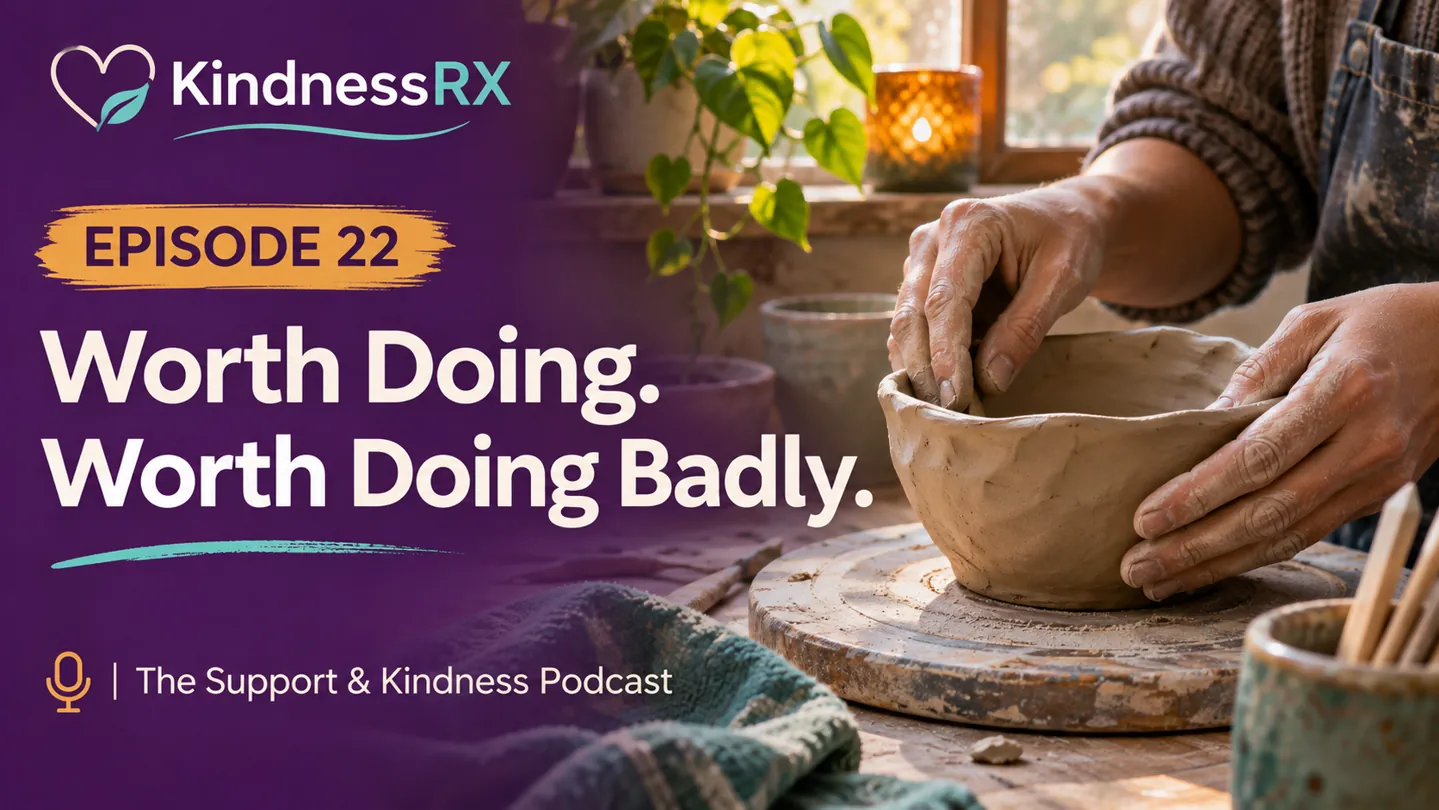
Episode 22: If It Is Worth Doing, It Is Worth Doing Badly
Overcoming perfectionism, making room for small steps, and learning to begin with kindness.
You have been meaning to send that message. Start that hobby. Sort that pile of papers. Yet each time you think about it, the job gets bigger.
The message needs the right words. The hobby needs the right tools. The papers need a whole free afternoon. So you wait.
Episode 22 of The Support & Kindness Podcast asks a useful question: What if a first attempt could be awkward, small, or unfinished and still have value?
Greg Shaw joins Rich, Jay, Derek, and Sam to explore a line linked to G. K. Chesterton: “If a thing is worth doing, it is worth doing badly.” Their conversation brings that idea into real life through coaching, planning, gardening, friendship, and the rough early days of the podcast itself.
Overcoming perfectionism can begin with choosing one safe, useful step and allowing it to be imperfect. Your worth does not depend on finishing the whole task. You can ask for help, change the plan, or rest.
Listen to Episode 22
Open the Episode 22 page or browse more episodes.
This article is a companion to the conversation. The research, examples, and reader challenges below add context. They are not claims that the panel discussed every study or used every exercise.
What does “worth doing badly” mean?
It means giving yourself room to learn. You can write a rough first draft. You can ask a clumsy but honest question. You can enjoy drawing even if your picture looks nothing like the scene in front of you.
The phrase appears in Chesterton’s What’s Wrong with the World, published in 1910. The Society of G. K. Chesterton explains its context: he was defending ordinary people taking part in meaningful life and hobbies, even when they lacked expert skill.
Today, many people use it as permission to start before they feel ready. That is a helpful reading, with a clear boundary. A rough sketch and an unsafe repair are different things. Medication instructions, food safety, driving, and skilled care still need the right standards. Ask a qualified person when a mistake could cause harm.
For a low-risk task, though, “good enough for this first step” can be a fair goal.
A birthday message does not need to be a poem. A short check-in can still tell someone they matter. A hobby does not have to become a business. You are allowed to take part because you enjoy it.
Greg: The podcast exists because he began
Greg uses the show itself as an example. He recalls rough audio, stumbling over words, and finding his rhythm through practice. If he had waited to make a perfect podcast, this conversation might never have happened.
That example makes the idea less abstract. A first attempt creates something you can learn from. An imagined perfect version cannot give you that feedback.
Three useful points from Greg’s part of the episode are:
- Start with curiosity. Ask what you might learn rather than how you can avoid every mistake.
- Choose a process you can try. A small writing session is more within your control than writing a bestseller.
- Notice the courage involved. Beginning can take effort even when the result looks simple to someone else.
Greg also suggests keeping notes or photos of early work. This can help you see change that is hard to notice day by day. Use this gently. A record should help you learn, rather than become another scorecard to punish yourself with.
Rich: Confidence needs chances to grow
Rich draws on coaching young football players. Different children needed different kinds of support. A skilled player might need help leading. Another might need to hear that they belonged on the field at all.
He describes giving children repeated chances to try, make mistakes, and try again. Belief from a coach and teammates helped create space for their own belief to grow.
“Just strive to get better. Strive to improve,” Rich says.
Three lessons stand out:
- Support should fit the person. The same speech will not help everyone.
- Practice includes mistakes. One poor attempt is not a final verdict on your ability.
- Belonging can come before confidence. You do not have to feel skilled to deserve a place to learn.
Later, Rich talks about cherishing small moments with family. It adds another layer to the episode. Life is not only a list of skills to master. Time with people can matter even when the day, the room, or the conversation is far from perfect.
Jay: Make a plan you can change
Jay’s starting point is simple: make a plan. Some people do best with a written list. Others hold a small plan in their head.
He also makes room for what happens when the day does not go as planned. An unfinished task does not need to become a reason to attack yourself.
Three takeaways from Jay are:
- Give the task a starting point. A basic plan can make the next action clearer.
- Let the plan change. You can move a task or reduce its size when needed.
- Include kindness. How you treat yourself and other people matters alongside what you get done.
A plan can be just one line: “After lunch, I will find the form.” You do not need to solve the entire week first.
Keep an eye on planning that turns into another delay. If you have rewritten a list five times, the next useful step may be opening the document, putting one item away, or asking someone to sit with you while you begin.
Derek: Reduce the hurdles
Derek describes overthinking a task until his mind feels worn out. His response is to step back, breathe, and ask what result he wants. Then he looks for a way to get there with fewer extra hurdles.
“And if it doesn’t work, then the next time I’ll try something slightly different,” he says.
His gardening example also makes room for uncertainty. Weather and growing conditions do not follow our plans. You learn by seeing what happens and changing what you can.
Three ideas from Derek are:
- Pause when thinking becomes a loop. More thought is not always giving you more useful information.
- Remove extra steps. The task may be hard enough without added rules.
- Treat an attempt as information. A result can guide the next choice without becoming a judgment on you.
This is a useful way to review a difficult day. Instead of “Why am I so bad at this?” try “What made this harder?” Perhaps the supplies were out of reach. Perhaps the room was too loud. Perhaps your body needed rest.

Sam: Give yourself and other people grace
Sam compares getting off track to a slot car flying out of its groove. He talks about a small number of people who have stayed around and helped him find his way back.
In “What’s on Your Heart?”, he brings the conversation to empathy and grace. His comments about having been homeless give that point real weight. We rarely know the full story of the person in front of us.
Three takeaways from Sam are:
- Getting off track is part of his experience. It does not mean the possibility of returning has gone.
- A few trusted people can matter. Support does not have to mean a large social circle.
- Grace belongs in both directions. Other people need room to be human, and so do you.
Overcoming perfectionism can feel like a private job. Sam’s part of the conversation reminds us that help is part of the picture. You can ask for company, a reminder, practical help, or a patient listener.
What research can add to this conversation
High standards and harsh self-judgment are not the same thing. Caring about your work can be useful. Feeling that every mistake proves you are a failure can make daily life much harder.
Research on perfectionism often separates personal demands from the sense that other people expect perfection. This matters because “I want to learn this well” feels different from “People will reject me unless I get this right.”
A 2026 meta-analysis of college student samples brought together 307 samples with 82,939 students from the United States, Canada, and the United Kingdom. It found rising trends in several aspects of perfectionism. These are trends within college samples, not a count of how many people in the general population have a disorder. The findings cannot tell us the experience of every age group or community.
Self-kindness may also support effort. In four experiments on self-compassion and motivation, researchers found that responding with compassion after a setback could increase motivation to improve. This supports trying a kinder response to mistakes. It does not prove a lasting cure for perfectionism or mean every person will respond in the same way.
There is also evidence for structured help with taking action. A Cochrane review of behavioral activation for adult depression included 53 studies, 5,495 people, and 14 countries. Behavioral activation helps people plan meaningful activities with support. Much of the evidence was of low to moderate certainty, with important gaps in longer-term findings. A home challenge is not the same as this therapy, but the review shows why supported, planned action deserves attention.
What about a missed day? In Lally and colleagues’ habit study, 96 volunteers took part in a 12-week study of everyday behaviors. Missing one opportunity did not materially disrupt the habit-building process. That does not make every routine easy. It does challenge the idea that one missed attempt means you must start your whole life over.
The panel’s advice is peer support, not treatment. If fear of mistakes, repeated checking, or avoidance is taking over daily life, a mental health professional can help you explore what is happening. You do not need to reach a crisis to ask.
When low energy changes what is possible
For someone living with chronic pain, depression, brain injury, fatigue, or another health condition, a task may be difficult for reasons that have little to do with perfectionism.
A shower may involve standing, balance, pain, and recovery time. A phone call may demand memory and focus. A form may be hard to read when your brain is tired. Calling these barriers laziness adds shame without making the task easier.
Before shrinking a task, ask what support it needs.
Could you sit down? Use a voice note? Ask someone to read the letter with you? Move supplies closer? Choose a calmer time? Stop for today?
A smaller task can be useful. So can an accommodation. So can rest. Small steps are options, not a demand to keep doing more.
| A large demand | A smaller option, if it fits today |
|---|---|
| Clean the whole room | Put one item where it belongs |
| Write the full article | Save a rough title or one sentence |
| Catch up with everyone | Send one short message |
| Complete every form | Find one document or ask for help |
| Start a whole new routine | Choose one cue and one easy action |
| Make a perfect meal | Use a safe, manageable food option |
These examples are suggestions, not a care plan. Follow advice that fits your health needs. If activity worsens symptoms, do not use this article as a reason to push through them.
For more on how time, energy, and access shape daily tasks, read Episode 51: The Cost of Survival.
Try a kinder first-attempt plan
Pick one low-risk task you want to approach. Then give yourself five short answers.
1. What matters about this?
Keep the answer close to real life. “I want my friend to know I care” may be more useful than “I need to be better at relationships.”
2. What is the smallest useful action?
Choose something you can see or describe. “Open the email” is clearer than “Get organized.” A useful step may also be asking for help.
3. What is good enough for this attempt?
Set the limit before you start. A message may need to be kind and clear. It does not need to explain your whole life. A practice drawing may need ten minutes of attention. It does not need to be shown to anyone.
4. What might make this easier?
Think about tools, access, company, timing, and breaks. Needing support is information about the task, not evidence against you.
5. What will I learn afterward?
Ask what helped and what got in the way. Keep the review brief. You are collecting useful clues, not building a case against yourself.
If your first answer is “I cannot do this today,” that is useful information too. You can adjust the goal, protect your energy, or return with support.
How to respond when the inner critic speaks
The voice may sound familiar: “Everyone else can do this.” “That barely counts.” “You should have started years ago.”
You do not have to win a long argument with it. Try a reply that is both kind and true.
- “This is difficult for me today.”
- “One attempt can teach me something.”
- “I can care about the result without insulting myself.”
- “I am allowed to need help.”
- “Stopping now does not erase what I did.”
Kindness does not mean pretending a mistake had no effect. If you hurt someone, you can listen, take responsibility, and make a repair. You can do that without deciding you are beyond hope.
That balance runs through this episode. Make room for imperfect action. Keep caring about people. Learn what you can. Try a different approach when needed.
For related conversations, explore Episode 11: What Does Recovery Look Like? and Episode 15: Forgiveness and Mental Health.
Explore more practical ideas on building habits and resilience.
Two weekly challenges to choose from
These are companion exercises inspired by Episode 22.
Choice 1: The small beginning.
Choose one safe task you have delayed because you want to do it well. Define a small first attempt. Try it for a brief period that suits your energy, then stop and notice one thing you learned. You may keep it private.
Choice 2: The kind return.
Choose something you stopped doing. Ask what made it hard. Change one part of the setup, reduce the task, or ask someone for support. Returning may mean one small attempt. It may mean making a plan for another day.
There is no catch-up rule. You do not have to repeat a challenge every day to make it count.
Questions about overcoming perfectionism
Does doing something badly mean I should stop caring?
You can care deeply and still allow a first attempt to be rough. The aim is to make learning possible. Tasks that affect safety or someone else’s wellbeing may need expert help or a proper check.
What if I am still scared to start?
Make the action smaller or safer. Practice privately. Ask for company. If fear keeps blocking daily life, speak with a mental health professional. A slogan alone may not address what you need.
Is every unfinished task caused by perfectionism?
No. Pain, fatigue, lack of money, access barriers, stress, attention difficulties, and many other factors can affect a task. Ask what is getting in the way before judging yourself.
Can rest count as a sensible choice?
Yes. Rest may protect your health or make a later decision easier. You do not have to turn rest into another way to earn productivity. You are allowed to rest because you need it.
How can I help someone who feels stuck?
Ask what would help. Offer a clear option, such as company for a phone call or help finding one document. Let the person choose. Praise and pressure can feel similar when someone is already overwhelmed.
Watch, read, and find support
These resources add to the discussion. They are not all mentioned in the recording.
- Tim Urban: Inside the mind of a master procrastinator. A TED talk that uses humor to explore delay and the things we keep putting off. It is a personal explanation, not a diagnostic test.
- Thomas Curran: Our dangerous obsession with perfectionism is getting worse. A TED talk about the pressures behind perfectionism.
- The Chesterton Society: A Thing Worth Doing. Background on the phrase and its meaning.
- Perfectionism trends in college students, 2026 meta-analysis. Read the study abstract and its population limits.
- Self-compassion increases self-improvement motivation. Four experiments on responses to setbacks.
- Cochrane: Behavioral activation for depression in adults. Evidence summary with limits and uncertainty.
- Lally and colleagues: How are habits formed?. Research on repetition, daily context, and habit formation.
- KindnessRX: Building Habits & Resilience. More ways to connect small actions with care and support.
- Episode 51: The Cost of Survival. A related conversation about disability, energy, access, and the hidden cost of everyday life.
- KindnessRX support groups. Find current details for peer support and connection.
- Listen to more episodes. Explore more of The Support & Kindness Podcast.
What worthy thing would you like to begin, return to, or ask for help with? You can share your thoughts at info@kindnessrx.org.
This podcast and article offer education and peer support. They do not replace medical care or mental health treatment. In the United States, call or text 988 for crisis support, or visit 988lifeline.org.