Episode 47: Understanding Fibromyalgia
What fibromyalgia actually is, and why “it’s all in your head” gets it exactly wrong
Based on Episode 47 of The Support and Kindness Podcast, featuring Linda Fraas.
Medical note: This article shares health education and lived experience. It does not replace medical advice, diagnosis, or treatment. Talk with a qualified health care professional about your symptoms, medicines, exercise, diet, and other care choices.
Fibromyalgia was not an abstract topic for this episode. One co-host lives with chronic pain. Another had spent weeks in an intensive pain-rehabilitation program alongside his child. Guest Linda Fraas has lived with fibromyalgia since 2000.
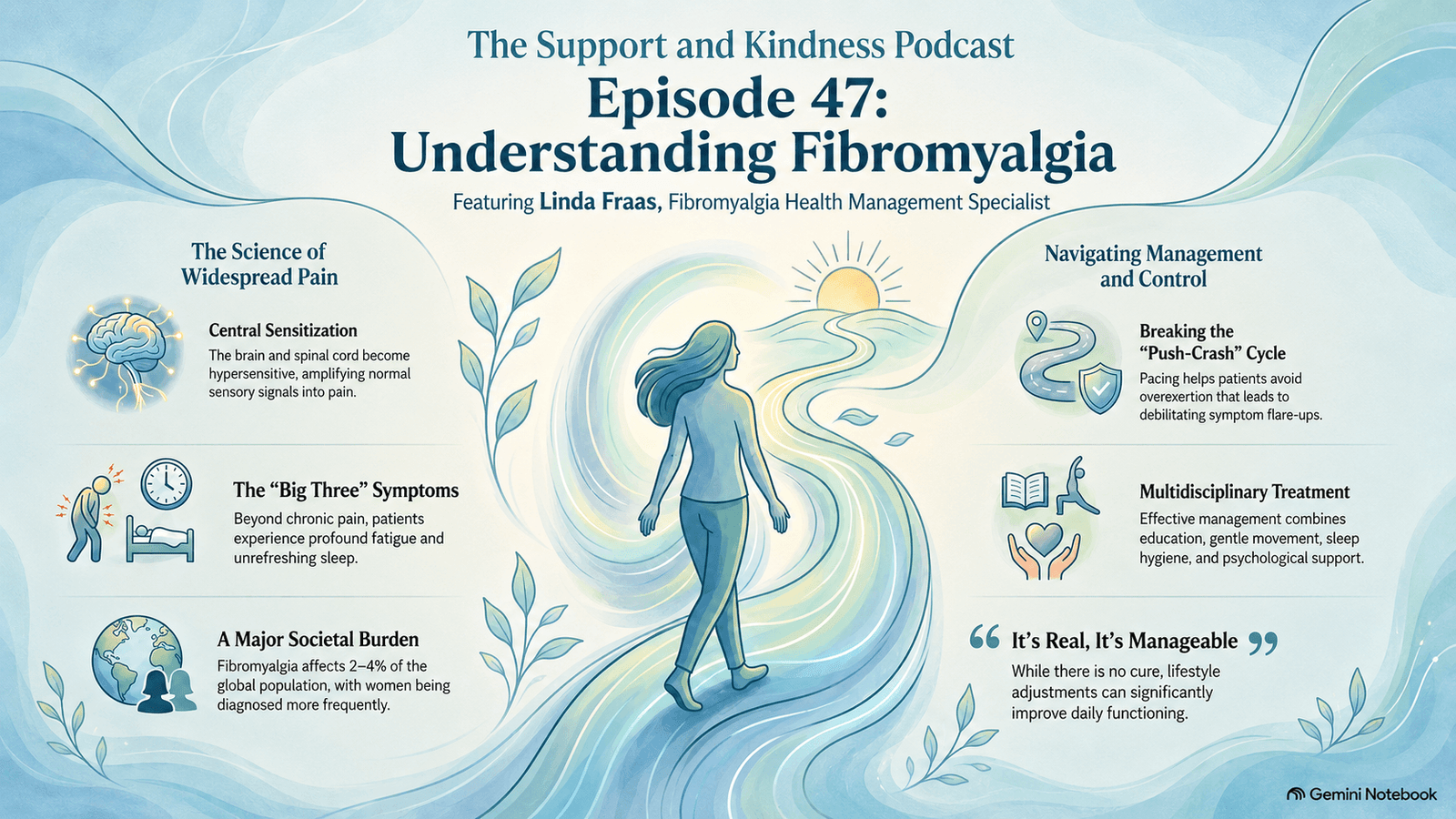
Understanding Fibromyalgia: Real Pain, Invisible Symptoms, and Practical Support
At first, Linda was a patient whose symptoms seemed impossible to explain. Later, after about 30 years as an occupational therapist, she became a Certified Fibromyalgia Health Management Specialist and Integrative Nutrition Health Coach. Her clinical background and lived experience shaped a conversation that was honest, practical, and deeply personal.
Fibromyalgia is often treated as vague, emotional, or imagined. It is none of those things.
According to the CDC, fibromyalgia affects about 4 million U.S. adults—roughly 2% of the adult population. It can affect people of all ages, including children. It causes real, widespread pain and can affect sleep, energy, thinking, movement, and daily life.
The difficulty is that fibromyalgia is often invisible.
“A person may look perfectly healthy on the outside while experiencing a nightmare on the inside.”
—Linda Fraas, Episode 47, around 16:00
What Fibromyalgia Actually Is
Fibromyalgia Involves Changes in Pain Processing
Fibromyalgia is a recognized condition involving how the nervous system processes pain and other sensory signals. It is not a disease diagnosed through one simple blood test or scan. Instead, clinicians consider a person’s symptom pattern, medical history, and other possible causes of pain and fatigue. People with fibromyalgia frequently see several doctors before they’re diagnosed (EULAR).
Linda explains it with a helpful comparison: imagine the nervous system as a car alarm.
For most people, a real bump may set off the alarm, while a leaf landing on the car does nothing. With fibromyalgia, Linda says, the nervous system can act like a car whose alarm goes off loudly when a leaf falls on it.
The pain “volume knob” is turned up too high.
That is not weakness, exaggeration, or a failure to cope. It is a plain-language way of describing abnormal pain processing. Research, including brain-imaging studies, has found differences in pain signaling among people with fibromyalgia. The pain is real, even when other people cannot see its cause.
Central Sensitization and Chronic Pain
In his TED talk, “The Mystery of Chronic Pain”, Stanford anesthesiologist Dr. Elliot Krane describes how pain can sometimes continue after an injury has healed. The nervous system may become more sensitive and continue amplifying danger signals.
This is often called central sensitization.
It does not mean pain is imagined. It means the nervous system has become unusually reactive. The encouraging part is that the nervous system can change over time. Supportive care, regular gentle movement, better sleep, stress-management tools, and appropriate medical treatment may help reduce symptoms and improve daily function.
There is currently no cure for fibromyalgia, but there are many ways to manage it.
Fibromyalgia Symptoms Go Beyond Pain
Widespread Pain Is Only One Part of Fibromyalgia
When people hear “fibromyalgia,” they often think only of pain. Pain is a major symptom, but it is not the full picture.
Fibromyalgia may also involve:
- Poor or unrefreshing sleep
- Severe fatigue
- Muscle stiffness
- Headaches
- Digestive symptoms
- Greater sensitivity to noise, light, temperature, touch, or smell
- Trouble concentrating, remembering, or finding words
- Mood changes, anxiety, or depression
Symptoms can vary from person to person and from day to day.
Fibro Fog and Cognitive Changes
Many people with fibromyalgia experience what is commonly called fibro fog. It can include difficulty concentrating, memory slips, slowed thinking, and trouble finding the right word.
Linda describes it this way:
“You can’t see where you’re going, you can’t hear anything. It’s just a loud noise inside that cloud.”
Fibro fog is especially frustrating because it can affect work, conversations, appointments, and everyday tasks that once felt automatic.
Fibromyalgia Fatigue Is Not Ordinary Tiredness
Fatigue from fibromyalgia is not always fixed by a nap or one good night of sleep. A shower, a trip to the grocery store, or preparing a meal may use a large share of a person’s available energy.
Sleep problems and fatigue can become a difficult cycle:
- Pain interrupts sleep.
- Poor sleep makes pain, fatigue, and concentration worse.
- Worse symptoms make daily activity harder.
- Stress and overexertion can make sleep even more difficult.
Breaking even one part of that cycle can matter.
Why Fibromyalgia Can Be Hard to Diagnose
There Is No Single Fibromyalgia Test
Fibromyalgia does not have one blood test, scan, or lab result that confirms the diagnosis. A health care professional usually considers:
- Widespread pain
- The severity and duration of symptoms
- Sleep, fatigue, and cognitive concerns
- Other health conditions that may cause similar symptoms
Modern fibromyalgia diagnosis is based on widespread pain and symptom severity lasting at least three months. It does not rely only on the older tender-point exam that many people still associate with fibromyalgia.
No single test does not mean the condition is not real. It means diagnosis requires a clinician who listens carefully and looks at the full pattern of symptoms.
Fibromyalgia Is Too Often Dismissed
For many people, the hardest part is not only the physical symptoms. It is not being believed.
Linda has been told that her symptoms were imaginary. A physical therapist once told her he did not believe fibromyalgia was real. She also saw her own mother labeled and heavily medicated decades ago for symptoms Linda now suspects may have been related to fibromyalgia.
Over time, repeated dismissal can cause people to doubt themselves, stop asking for help, or avoid medical care altogether.
“Simply having someone say, ‘I believe you, and I understand that this is affecting your life,’ can make an enormous difference.”
—Linda Fraas, Episode 47
Fibromyalgia Can Affect Anyone
Fibromyalgia is diagnosed more often in women. The CDC reports that women are about twice as likely as men to receive a fibromyalgia diagnosis.
But men and children can have fibromyalgia too. Some researchers believe men may be underdiagnosed because outdated assumptions make clinicians less likely to consider the condition.
Fibromyalgia is not caused by laziness, inactivity, weakness, or poor character. It is not a personal failure.
How to Advocate for Yourself With Fibromyalgia
Bring Clear Information to Medical Appointments
If you are seeking answers for chronic pain, fatigue, poor sleep, or fibro fog, it can help to track your symptoms before an appointment.
Consider noting:
- Where your pain occurs and how long it lasts
- Sleep quality
- Energy level
- Headaches, digestive issues, or sensitivity to light and sound
- Activity levels and symptom flares
- Medicines, supplements, and other treatments you have tried
Specific examples can help a provider understand how symptoms affect your life.
Seek Another Opinion if You Are Dismissed
A clinician may not have the right expertise, enough time, or a full understanding of fibromyalgia. If someone brushes off your symptoms, you are allowed to seek another opinion.
You know your body. Persistent symptoms deserve thoughtful care.
Fibromyalgia Pacing: Breaking the Push-Crash Cycle
What Is the Push-Crash Cycle?
Linda describes a familiar experience for many people with fibromyalgia: waking up on a rare good day and trying to do everything at once.
You shop, do laundry, clean the bathroom, catch up on errands, and try to make the most of feeling better. Then, the next day, you may feel as though you have been hit by a baseball bat and cannot get out of bed.
This is often called the push-crash cycle.
It can happen because of hope, guilt, pressure, or the understandable wish to feel “normal” again. It is not a lack of discipline.
Pacing Helps Protect Energy
The answer is not to stop doing everything you enjoy. It is to spread activity out in a way your body can better tolerate.
Linda calls this pacing or energy conservation.
“Not conserving your electricity, but conserving your body’s energy.”
Pacing may mean:
- Breaking larger tasks into smaller steps
- Resting before you are fully exhausted
- Sitting while preparing food or folding laundry
- Doing one errand instead of five
- Asking someone else to take one part of a task
- Planning recovery time before and after a demanding event
Pacing cannot prevent every flare. Fibromyalgia can still be unpredictable. But it may help you take part in work, family life, and meaningful activities without consistently paying for it afterward.
“You cannot help somebody else if you don’t help yourself.”
—Linda Fraas, Episode 47, around 10:09
Fibromyalgia Treatment and Self-Management
Gentle Movement Is One of the Best-Supported Tools
Movement can be intimidating when movement hurts. However, gentle, regular exercise has some of the strongest evidence for helping manage fibromyalgia symptoms.
The European Alliance of Associations for Rheumatology, known as EULAR, reviewed more than 100 studies for its fibromyalgia guidelines. Exercise was the only therapy rated “strong for.”
A Cochrane review of 13 trials involving 839 people found that aerobic exercise can improve quality of life and may help pain, stiffness, and physical function.
The important part is to start carefully.
Start Low and Go Slow
For some people, a few minutes of gentle range-of-motion work is enough to begin. Linda even suggests “snow angels in the bed” in the morning as a small way to get moving.
Activities that may help include:
- Short walks
- Gentle cycling
- Swimming or water aerobics
- Yoga
- Tai chi
- Stretching
- Light strength work, when tolerated
More is not always better. Pain is not a test of character. A sustainable routine matters more than an occasional intense workout.
Protect Sleep as Part of Fibromyalgia Care
Sleep affects nearly every fibromyalgia symptom. A consistent bedtime and wake time may be more helpful than trying to “catch up” with long weekend sleep.
Small sleep-supportive habits may include:
- Keeping a regular sleep schedule
- Creating a darker, quieter sleep space
- Limiting stimulating activities close to bedtime
- Discussing ongoing sleep problems with a health care professional
- Building gentle wind-down routines, such as stretching or slow breathing
Stress Reduction Is Not “Fluff”
Stress can worsen pain sensitivity, sleep problems, muscle tension, and fatigue. Practices such as slow breathing, meditation, gentle stretching, counseling, or relaxation exercises do not suggest the pain is emotional or imagined.
They are tools that may help calm an over-sensitive nervous system.
Cognitive behavioral therapy, or CBT, is included in fibromyalgia treatment guidance because chronic illness affects thoughts, emotions, behavior, sleep, and physical symptoms. It is one option among many—not a statement that pain is “all in your head.”
Fibromyalgia Diet: Avoid the Myth of One Perfect Food Plan
There Is No Proven Universal Fibromyalgia Diet
Some people notice that certain foods affect their symptoms. Others do not. Tracking personal patterns can be useful, but there is no one “fibromyalgia diet” proven to work for everyone.
A 2024 review in Nutrients found that evidence for restrictive diets in fibromyalgia remains limited and warned that overly restrictive eating can cause harm.
A safer approach is to make gradual changes:
- Track food, sleep, activity, stress, and symptoms.
- Change one thing at a time.
- Notice patterns without blaming yourself.
- Discuss major dietary changes with a doctor or registered dietitian.
Nutritious food and adequate hydration support overall health, but they are not a cure for fibromyalgia.
Before cutting out major food groups or starting supplements, review the evidence and safety information available through the National Center for Complementary and Integrative Health.
The Emotional Impact of Fibromyalgia
Grief, Guilt, and Isolation Are Common
Fibromyalgia can change how a person works, parents, socializes, travels, exercises, and plans for the future. It can bring grief for the life someone expected to have.
People may feel guilty when they cancel plans or ask for help. They may stop accepting invitations because they fear being viewed as lazy, dramatic, or unreliable.
Anxiety and depression can occur alongside fibromyalgia. That does not make the physical pain less real. It means the whole person deserves care and support.
Acceptance Is Not Giving Up
Linda offers an important distinction:
“Acceptance is not surrender. It’s learning where you are today while you’re believing that tomorrow can be better.”
—Linda Fraas, Episode 47, around 1:02:49
A diagnosis may change how life gets done. It does not erase a person’s humor, values, skills, relationships, love, or purpose.
“Fibromyalgia may change the way you do things, but it does not have to erase who you are.”
—Linda Fraas, Episode 47, around 1:12:13
How to Support Someone With Fibromyalgia
Believe Them First
You do not need perfect words. Start with belief.
Simple phrases can matter greatly:
- “I believe you.”
- “That sounds hard.”
- “I’m sorry you’re dealing with this.”
- “What would feel helpful today?”
Offer Practical, Specific Help
Instead of saying, “Let me know if you need anything,” offer one clear task:
- “Can I carry the groceries?”
- “I can make dinner tonight.”
- “I’ll handle cleanup.”
- “Would it help if I drove you to your appointment?”
- “I can pick up your prescription.”
Stay Flexible Without Taking It Personally
A changed plan is not a rejection. Symptoms can change quickly, and a person may need to cancel at the last minute.
Keep inviting them. Make room for “no” without guilt. Avoid comparing their pain to someone else’s experience, and resist the urge to immediately solve the problem.
Listening is often more helpful than advice.
What You Can Do This Week for Fibromyalgia
Small, Consistent Actions Can Matter
Try one or two of these practical steps this week:
- Pace activity before you crash. Rest on good days, not only bad ones.
- Keep a consistent sleep and wake schedule.
- Move gently for a few minutes each day.
- Track sleep, pain, fatigue, activity, and possible triggers.
- Ask for help clearly and specifically.
- Say “no” without guilt when your body needs rest.
- Tell someone with chronic pain: “I believe you.”
This Week’s Fibromyalgia Challenge: Listen, Pace, and Support
For the next seven days, take one quiet minute each day to check in with your body.
Ask yourself:
- What is my energy level right now?
- What is my body telling me?
- What is one thing I can adjust, simplify, share, or postpone?
Then choose one small, compassionate action. You might take a short rest, drink water, move gently, ask for help, postpone a task, or say no without guilt.
This is not about doing more or forcing yourself through pain. It is about noticing what you need and responding with kindness before your body forces you to stop.
If you do not live with chronic pain, support someone who does. Ask:
“What would feel helpful today?”
Then listen without judging, questioning, comparing, or rushing to solve the problem.
At the end of the week, reflect:
- Did listening earlier help you make a healthier choice?
- Did pacing protect your energy?
- Did someone feel more supported because you took the time?
Honoring your limits is not giving up. Believing someone’s experience is a powerful act of kindness.
Frequently Asked Questions About Fibromyalgia
Is Fibromyalgia a Real Medical Condition?
Yes. Fibromyalgia is a recognized condition involving how the nervous system processes pain. The CDC estimates that it affects about 4 million U.S. adults. There is no single lab test for it, but no test does not mean the condition is not real.
Why Can Someone With Fibromyalgia Seem Fine One Day and Be Unable to Get Out of Bed the Next?
Symptoms can fluctuate. One reason is the push-crash cycle: doing too much on a good day can lead to a flare and days of recovery. Pacing can help reduce this pattern, although it cannot prevent every flare.
What Is Fibro Fog?
Fibro fog refers to the cognitive effects of fibromyalgia, including trouble concentrating, memory slips, slowed thinking, and difficulty finding words. It may be worse after poor sleep or during a flare.
What Helps Fibromyalgia if There Is No Cure?
There is no magic fix, but symptoms can often be managed. The best-supported approach includes gentle, regular exercise, pacing, sleep support, stress reduction, appropriate medicines when needed, and care from health professionals who understand fibromyalgia.
How Can I Help a Loved One With Fibromyalgia?
Believe them. Ask what would help today. Offer specific practical support. Stay flexible when plans change, avoid comparisons, and listen without trying to fix everything.
Watch Next: Understanding Chronic Pain
For a clear explanation of how the nervous system can amplify pain, watch Dr. Elliot Krane’s eight-minute TED talk:
“The Mystery of Chronic Pain” by Elliot Krane
His feather demonstration—showing how an ordinary touch can be experienced as severe pain—offers a memorable explanation of chronic pain sensitivity.
Listen to the Full Fibromyalgia Episode
This article only covers part of the conversation. Listen to the full Episode 47 of The Support and Kindness Podcast for Linda Fraas’s story of losing and rebuilding her life, her 2015 retirement from occupational therapy, and the panel’s personal connections to fibromyalgia.
Listen to Episode 47 of The Support and Kindness Podcast
Free Weekly Support Groups for Chronic Pain
If you are living with fibromyalgia or another chronic-pain condition, you do not have to face it alone.
KindnessRX hosts free peer-led support groups each week. There are no paywalls, insurance requirements, or gatekeeping—just real conversations with people who understand.
Weekly Support Group Schedule
- Brain Injury Support: Mondays, 1:00–2:00 PM ET
- Chronic Pain Support: Tuesdays, 12:00–1:00 PM ET
- Mental Health Support: Wednesdays, 7:30–8:30 PM ET
Sign up or RSVP for KindnessRX support groups
If you need immediate emotional support in the United States, call or text 988 to reach the free, confidential Suicide & Crisis Lifeline, available 24 hours a day, seven days a week.
About KindnessRX
KindnessRX is a peer-support community built on a simple idea: no one should have to face mental-health struggles or chronic illness alone.
Through The Support and Kindness Podcast and free weekly support groups, KindnessRX creates space for honest conversation, practical help, and human connection.
To learn more about Linda Fraas, her coaching resources, and her complimentary 3-Day Pain Reset booklet, visit Torchlight Vitality.
Because you deserve a little kindness today.
Fibromyalgia Resources and Further Reading
Trusted Fibromyalgia Medical Information
- CDC: Fibromyalgia. Prevalence, symptoms, risk factors, and self-management basics.
- NIAMS (NIH): Fibromyalgia symptoms, causes and risk factors. The federal research institute’s plain-language overview.
- NIAMS: Diagnosis, treatment, and steps to take. What evidence-based care actually looks like.
- MedlinePlus: Fibromyalgia. The NIH consumer health library, with links to current clinical trials.
- Mayo Clinic: Fibromyalgia. Symptoms, causes, and treatment, clearly explained.
- Cleveland Clinic: Fibromyalgia. A thorough, regularly updated patient guide.
- Office on Women’s Health: Fibromyalgia. A helpful overview, including why the condition is diagnosed more often in women.
Fibromyalgia Diet, Supplements, and Complementary Care
- NCCIH (NIH): Fibromyalgia in depth. What the evidence says about supplements, mind-body practices, and safety.
- Almirall et al. (2024), Nutrients: Restrictive diets in fibromyalgia. A careful review of the dietary evidence and its limits.
Fibromyalgia Research and Clinical Guidelines
- EULAR revised recommendations for the management of fibromyalgia (Macfarlane et al., 2017). Across 100+ reviews, exercise was the only “strong for” recommendation.
- Cochrane: Aerobic exercise for adults with fibromyalgia (2017). 13 trials, 839 people; moderate-quality evidence for improved quality of life.
- Wolfe et al. (2016): Revisions to the fibromyalgia diagnostic criteria. How modern diagnosis works, beyond tender points.
- Walitt et al. (2015), PLoS One: Fibromyalgia in the 2012 National Health Interview Survey. The U.S. prevalence data behind the “4 million” figure.
Support and Crisis Resources
- Torchlight Vitality: Linda Fraas
- National Fibromyalgia Association
- 988 Suicide & Crisis Lifeline
- KindnessRX Free Peer Support Groups
Watch
- Elliot Krane, “The mystery of chronic pain” (TED). An 8-minute look at how pain can become a disease of its own.
Sources and further reading
- Fibromyalgia. Centers for Disease Control and Prevention (CDC)
- Fibromyalgia symptoms, causes and risk factors. NIAMS, NIH
- Fibromyalgia: diagnosis, treatment, and steps to take. NIAMS, NIH
- Fibromyalgia in depth. NCCIH, NIH
- EULAR revised recommendations for the management of fibromyalgia. Macfarlane et al., Ann. Rheum. Dis., 2017
- Aerobic exercise for adults with fibromyalgia. Cochrane Database of Systematic Reviews, 2017
- 2016 revisions to the fibromyalgia diagnostic criteria. Wolfe et al., Semin. Arthritis Rheum., 2016
- Restrictive diets in patients with fibromyalgia. Almirall et al., Nutrients, 2024
- Prevalence of fibromyalgia in the 2012 NHIS. Walitt et al., PLoS One, 2015
- The mystery of chronic pain. Elliot Krane, TED
- Linda Fraas, Torchlight Vitality
- 988 Suicide and Crisis Lifeline
Take care of yourself, and do one small kind thing for yourself and one small kind thing for someone else.