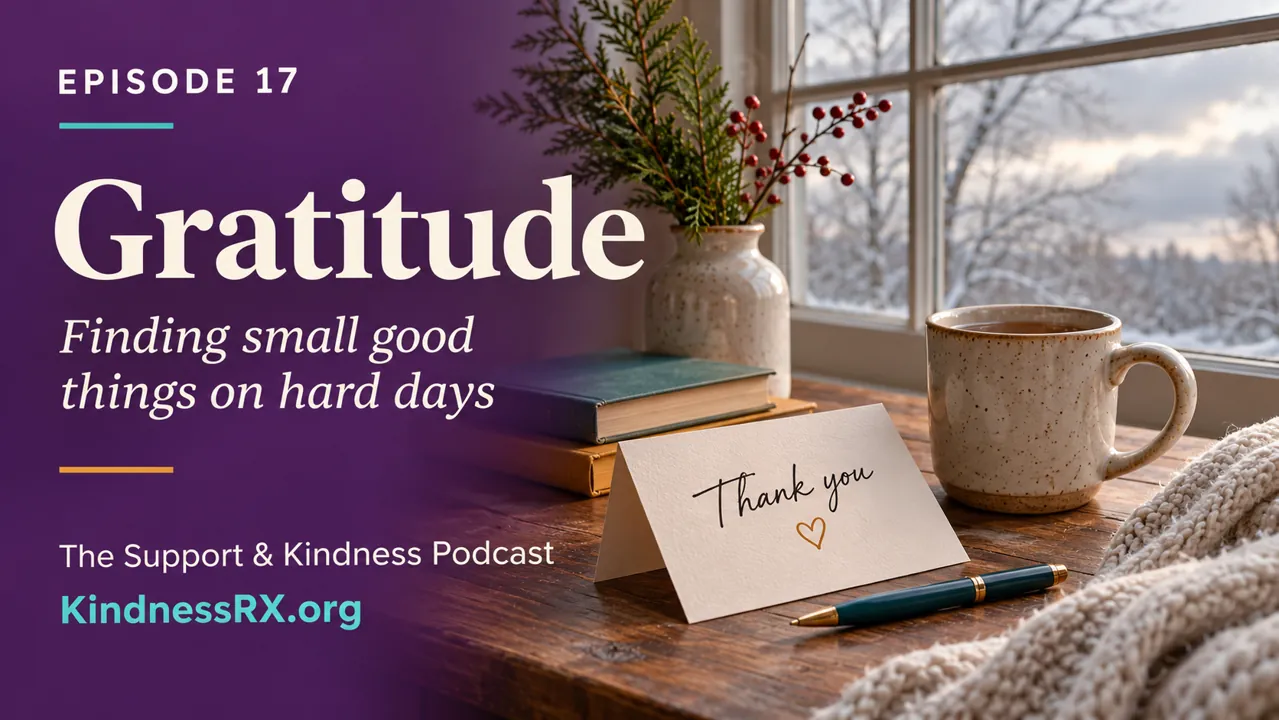
Episode 17: Gratitude on Hard Days
From the podcast archive, originally released December 28, 2025. Original recording, with expanded companion research checked November 14, 2026.
The Support & Kindness Podcast | Greg Shaw with Rich, Jay, and Derek
Some days, the last thing you want to hear is, “Be grateful.”
You are tired. Something hurts. Someone you miss is far away. There are bills to pay, calls to make, and things you cannot fix today. Being told to count your blessings can feel like being told to stop talking about your pain.
That is a poor place to start a conversation about gratitude.
In Episode 17, Rich, Jay, Derek, and I talk about the small things we value, the people who help us, and what it means to notice something good when life still feels hard. There is laughter. There is love for family. There is also a heavy heart.
Practicing gratitude on hard days means making room for something you appreciate while being honest about what hurts. Both can be true. You can need help and value the help you receive. You can miss someone and be glad for the time you had together.
This companion article builds on that conversation. It adds research, useful links, and a gentle challenge you can adapt to your own life.
Content note: The episode and article discuss grief, family distance, recovery, depression, and difficult holidays. This is peer support and education. It does not replace medical care, therapy, or crisis support.
Listen to Episode 17: Gratitude
Listen to Episode 17: Gratitude above, or explore The Support & Kindness Podcast. The recording features Greg Shaw, Rich, Jay, and Derek.
What does gratitude mean in everyday life?
Gratitude is noticing and valuing something that matters to you. It may be something another person did. It may be a moment of comfort, a place to rest, or a part of life you had stopped seeing.
It can be as plain as this:
- Someone stayed on the phone while you were upset.
- Your shower was warm.
- A friend remembered your appointment.
- You saw a little light through the clouds.
- You got through a hard hour.
There is no need to turn any of those moments into a grand life lesson.
In the episode, Rich talks about thanking people whose work may go unnoticed. Derek describes warm showers, human connection, and light coming through clouds. Jay thinks about the people who care for us, including people in recovery groups. I speak about having a home, access to care, and the people who make our podcast and support groups possible.
Those are different ways of paying attention. None requires a perfect day.
Gratitude, relief, and obligation are different feelings
You might feel grateful when someone helps you. You might also feel relief, sadness, or worry about needing help again.
You do not have to repay a kindness at once to make your thanks real. Receiving help does not make you less worthy. A sincere thank-you can stand on its own.
And gratitude does not create a debt that gives someone control over you. You can appreciate a kind act and still say no to a request. You can value support and still need a boundary.
What does research say about gratitude?
There is research behind gratitude exercises. The findings are encouraging, though more modest than many headlines suggest.
A 2025 review in PNAS combined 145 papers involving 24,804 participants in 28 countries. Gratitude exercises produced a small average improvement in well-being. The reported effect size was 0.19. That is a research measure, not a claim that people became 19% happier. Results varied across countries and studies. [1]
The useful message is simple: a gratitude practice may offer a small lift. It will not have the same effect for everyone.
An earlier review of 64 randomized trials also found benefits across mental-health outcomes. Study methods and results varied. That supports trying gratitude as one possible source of support, while keeping the rest of your care in place. [2]
Who took part in the research?
This question matters, especially for our community.
Across the samples in the 2025 review, the average age was about 29.5, and the average share of women was 65.3%. Those details remind us to be careful when applying the findings to people of different ages, backgrounds, and health needs. A broad result does not tell us exactly how an older person with chronic pain or a brain injury will respond. [1]
People also express thanks in different ways. A quiet act of care may mean more in one family than a public speech. Someone else may value a direct message. Choose a form that feels natural and respectful.
The research mentioned in the recording
In the opening, I mention a study in which appreciation led to more calls by fundraisers. The original Grant and Gino paper gives that story useful context. [3]
In one small field experiment involving 41 university fundraisers, the group thanked by a director increased its average weekly calls from about 41 to 63. The control group changed little. Feeling valued helped explain the result. This was a particular workplace study. It does not mean saying thank you increases everyone’s output by 50%.
The episode also refers to Robert Emmons and Michael McCullough. Their 2003 research compared gratitude lists with other kinds of reflection. Across three experiments, positive emotion was the most consistent benefit. One sample included people with neuromuscular disease. That did not show that gratitude reversed their illness. [4]
What we should avoid claiming
Gratitude is sometimes sold as a quick way to change brain chemicals, heal disease, or guarantee a longer life. That goes beyond what these studies can establish.
Even newer findings call for care. A small September 2026 trial involving 41 Turkish university students found an immediate mood benefit after gratitude writing, but no detectable difference between groups in heart rate. This is added reading for the article, rather than something discussed in the recording. [5]
A moment of appreciation may help you feel a little steadier. It is still worth checking a worrying symptom, taking prescribed medicine, and asking for skilled help when you need it.
Gratitude on hard days: leave room for the whole truth

A useful gratitude practice starts with honesty.
“Today was painful, and I appreciated that call.”
“I am worried about money, and that meal helped.”
“I miss my family, and I am glad someone made time for me.”
These are examples you can adapt. They leave the hard part in the picture.
In the episode, I speak about the weight of the holidays and being far from family. Being grateful for friends and our support groups does not erase that distance. It gives me something real to hold alongside it.
That is a more useful question than demanding a silver lining: Is there one thing I can appreciate without denying what I feel?
When “be grateful” closes the conversation
Imagine telling someone that you are in pain and hearing, “At least you have a roof over your head.”
You may value your home very much. You may also need someone to hear that you are hurting.
If you are supporting a friend, begin with what they have told you. You might say, “That sounds rough. Would you like me to listen?” Let them decide whether a gratitude exercise would help.
For more on the words we use when someone is hurting, see Toxic Positivity: What to Say Instead.
The same care applies to yourself. If you cannot find a good thing today, you have not failed a test. You can rest. You can reach out. You can try another day.
Gratitude does not require unsafe contact
There is no rule that says you must thank someone who harmed you, forgive before you are ready, or reopen a relationship that feels unsafe.
A gratitude letter can stay private. It can be addressed to a safe person, a group, or no one at all. You can appreciate one part of your past while keeping a firm boundary in the present.
What the panel’s stories bring to the topic
Rich: notice the person doing the work
Rich describes the pleasure of showing appreciation to someone who does not expect it. A support worker or customer-service employee may hear complaints all day. A clear, kind thank-you can help them know their effort was seen.
You do not need polished words. Name the act and its effect:
“Thank you for explaining that again. I was confused, and your patience helped.”
That tells the person what mattered. If you want to pass praise to a supervisor, ask for the right way to do so. Respect the worker’s time and privacy.
Jay: value the people who welcome you back
Jay talks about finding care in recovery groups. His example is a room where people want someone to return, even when that person feels low or alone.
That sense of welcome is part of what he values. For readers, the practical question may be: Where do I feel heard? Who can I contact when I am struggling?
Jay shares his experience of Alcoholics Anonymous. If that interests you, AA’s official website has information about its program and meetings. Different people need different kinds of recovery support. A gratitude practice should never be a reason to delay addiction care.
Derek: let ordinary things count
Derek’s examples are small and vivid: a warm shower, people holding hands, sunlight through a cloudy sky.
There is a useful idea here. Appreciation does not always need a major event. You can notice comfort or beauty without comparing your life with someone else’s.
If you cannot get outdoors, perhaps there is something to notice from a window. If a shower takes too much energy, perhaps it is a clean shirt or a warm cloth. Your version can fit the day you actually have.
Greg: receiving support counts too
I talk about having an apartment, access to health care, and people who show up. I also talk about family distance and a heavy heart.
It can be hard to receive help without feeling guilty. Yet care is not reserved for people who need the least. Needing company, help with a task, or a place to speak does not make you a burden.
Sometimes the thing to appreciate is that you did not have to manage one part of the day alone.
Living with pain, fatigue, grief, or recovery
If you live with chronic pain or fatigue, advice can quickly become another job. Keep this practice small enough that it does not use up the energy you need for food, care, or rest.
A voice note may be easier than a journal. One word may be enough. You might notice that someone brought a drink, that a task waited until tomorrow, or that a cushion made sitting more comfortable.
You do not have to be thankful for your illness. You can value care while wanting better treatment. Our article on Episode 48: Invisible Illness makes room for the things others cannot see.
With grief, appreciation may bring tears. Remembering a kind person can make you miss them more. You do not have to turn that feeling into a cheerful ending.
Our conversation on grief for the life you thought you would have explores another kind of loss that can sit beside appreciation.
You might write, “I am glad we had that afternoon together, and I wish we had more time.” You can also choose something in the present if memories feel too raw.
For recovery, gratitude may be one part of a larger support plan. It can sit alongside meetings, counseling, medication when prescribed, and other care. It cannot tell you whether a treatment is working or replace help with withdrawal or a crisis.
This week’s challenge: Three Good Things, your way
The episode’s challenge is to notice three things that went well and think about why. Try it for seven days if it feels useful. This is an invitation, not a streak to protect.
- Choose a time that suits you. Bedtime is optional.
- Name up to three things that went well or brought some comfort.
- Add a short reason each one mattered or happened.
- Leave room for how the rest of the day felt.
Here is an example:
| What I noticed | Why it mattered |
|---|---|
| A friend checked in. | I felt remembered. |
| I had something easy to eat. | It made a tiring evening simpler. |
| I paused before one more task. | I listened to my need for rest. |
If three feels too much, name one. If writing hurts, say it aloud, record a short note, or ask someone you trust to help. If reminders stress you out, skip the reminder.
On a day when nothing comes, you can stop. Please do not invent a happy answer to satisfy the exercise.
At the end of the week, ask: Did this help me notice anything? Did it feel kind, neutral, or like pressure? Keep what helps. Change or drop what does not.
A second option: send one specific thank-you
Choose a safe person who made life a little easier. Tell them what they did and why it mattered.
“Thanks for checking whether I got home. It helped me feel cared for.”
A message is enough. There is no need to buy a gift or share their response online. Their kindness can remain private.
Questions people ask about gratitude
Can I feel grateful and depressed at the same time?
Yes. Appreciating someone or something does not cancel depression. You deserve care even when your life contains good things. For a fuller conversation, see Episode 52: When Depression Doesn’t Lift.
What if a gratitude list makes me feel worse?
Stop or make it smaller. Notice whether the exercise brings up shame, grief, or pressure. You can discuss that with a trusted supporter or therapist. A practice that helps someone else does not have to suit you.
Do I need to do it every day?
The episode invites a one-week trial. You do not owe anyone a daily record. Choose a pace you can manage, then see whether it helps.
Is gratitude religious?
It can be part of a person’s faith, but you do not need a religious belief to appreciate care, comfort, or a moment in nature. Use words that fit your own life.
Should I make my children or group members share?
Offer a choice. Some people like a round of thanks. Others feel put on the spot. Let people pass, keep their answer private, or share something else about their day.
Watch, read, and find support
The recording mentions Grateful.org, David Steindl-Rast, Emmons and McCullough, Harvard Health, and AA. These links give you places to explore:
- David Steindl-Rast: Want to be happy? Be grateful. The TED talk offers a reflective approach to noticing life. It is a personal and spiritual perspective, rather than clinical proof.
- Louie Schwartzberg: Nature. Beauty. Gratitude.. Added viewing with nature imagery and reflections on appreciation.
- Three Good Things and Gratitude Letter. Step-by-step practice guides from Greater Good in Action.
- Grateful Living. Practices and reflections from the organization discussed in the episode.
- Harvard Health: Giving thanks can make you happier. A readable introduction to gratitude research.
- Alcoholics Anonymous. Official program and meeting information.
If you would like a place to talk, explore KindnessRX’s free online peer-support groups. There are groups for brain injury, chronic pain, and mental health. Check the current details on the website. You can listen quietly and share at your own pace.
If you are in the US and need crisis support, call or text 988, or visit 988lifeline.org. Call 911 for immediate danger or a medical emergency. Outside the US, use your local emergency or crisis service.
You do not need a perfect gratitude list to belong here. If you want to try this week’s challenge, begin with one honest thing. If what you need today is help, that is a good thing to ask for.
Research and references
- Choi and colleagues (2025). A meta-analysis of the effectiveness of gratitude interventions on well-being across cultures. PNAS.
- Diniz and colleagues (2023). The effects of gratitude interventions: a systematic review and meta-analysis. Einstein.
- Grant and Gino (2010). A little thanks goes a long way: Explaining why gratitude expressions motivate prosocial behavior. Journal of Personality and Social Psychology.
- Emmons and McCullough (2003). Counting blessings versus burdens. Journal of Personality and Social Psychology.
- Suru (2026). The immediate effects of a brief gratitude intervention on positive affect, negative affect, and heart rate. Frontiers in Psychology.
Research checked November 14, 2026. Added research and practical examples are distinguished from the panel’s recorded experiences.