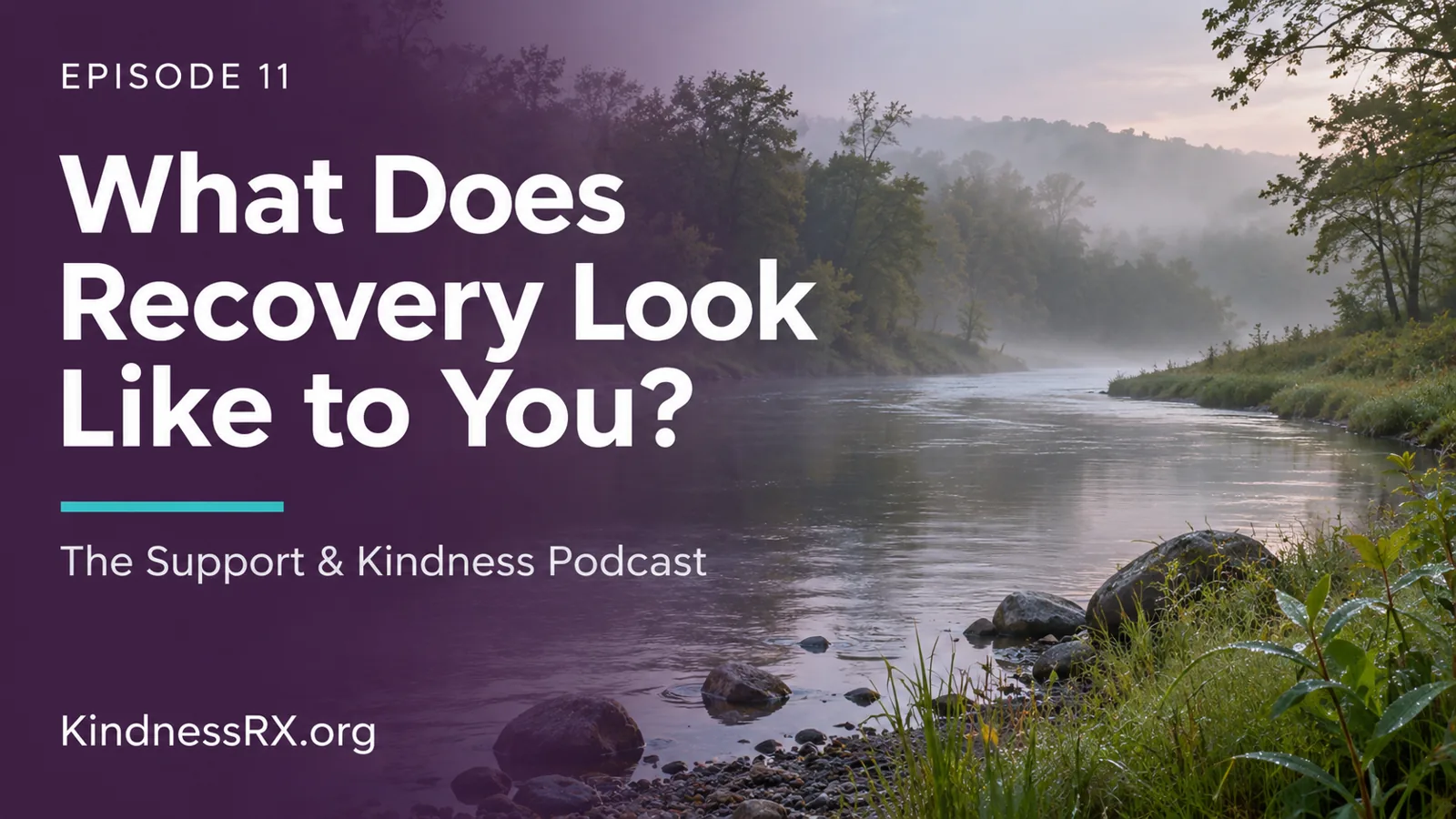
Episode 11: What Does Recovery Look Like to You?
Recovery can mean better health, more choice, stronger support, or finding ways to live well with lasting symptoms. Your next step does not have to look like anyone else’s.
Content note: This episode discusses addiction, brain injury, childhood harm, hospital care, and suicidal thoughts without graphic detail.
What does recovery look like to you?
It sounds like a simple question. Then you stop and think about it.
Is it a sober day? Less pain? Getting through a hard morning? Asking for help before things reach a crisis? Finding a new way to do something you once did without thinking?
In Episode 11 of The Support & Kindness Podcast, Greg, Rich, and Jay explore those questions through their own lives. Jay talks about addiction, treatment, and the brain injury that changed his plans. Rich talks about physical rehab. Greg shares a family story about change, care, and hope.
The episode was recorded in November 2025. The research and practical ideas below are new companion material. They add context to the conversation rather than report things the hosts said on air.
Listen to Episode 11
Open Episode 11 on Spotify, or find more episodes on our listening page.
What recovery can mean
Greg offers an image that runs through this episode:
“Recovery is not a straight line or a checklist, it’s more of a winding river.”
A river can move slowly. It can bend. It can pass through rough water. That image leaves room for a life that does not follow a neat chart.
It also leaves room for different goals. Someone might want to stop using alcohol. Someone else might want enough strength to make a meal. Another person might want a safe home, steady care, and fewer days spent feeling alone.
The SAMHSA recovery framework includes health, a stable home, meaningful activity, and community. Those areas help explain why recovery can be much wider than a symptom score.
That does not make medical goals unimportant. It means a person has a life beyond those goals.
You can still need medicine. You can still need a walking aid, therapy, or help at home. You can still have symptoms and be building a life with more choice and connection.
Jay’s story: support can matter before change makes sense
Jay describes having his first drink at about nine. He talks about years of trouble and more than 30 stays in treatment programs of different lengths.
He does not offer one neat reason why things changed. He says he cannot fully explain what finally clicked.
That honesty matters. We often look back at a person’s recovery and try to turn it into a recipe. Do these three things. Have this one thought. Find this one moment.
Jay’s account is more human than that.
He remembers leaving treatment and putting off drinking for a week. Then two weeks. Then a month. At the time of recording, he said he was nearing 11 years of sobriety.
This is his experience, not a plan for someone else to copy. Someone who drinks heavily over time should seek medical advice before stopping. Alcohol withdrawal can be dangerous. The National Institute on Alcohol Abuse and Alcoholism explains why treatment may include medical care. A clinician can help assess what support is needed.
Jay also speaks warmly about Alcoholics Anonymous:
“But I found a lot of friendship in that room, a lot of support, a lot of wisdom.”
Research offers context for that experience. A 2020 Cochrane review found that structured AA/Twelve-Step Facilitation interventions improved continuous abstinence at 12 months compared with other established approaches. That finding concerns studied interventions and a specific outcome. It does not make AA the only useful path or guarantee a result for any person.
The help he received was not wasted because change took time. Nor does his story mean everyone needs the same number of treatment attempts or the same kind of group.
Alcoholics Anonymous, Narcotics Anonymous, and SMART Recovery offer different forms of mutual support. People can explore what fits their needs, beliefs, and access. Peer support can sit alongside professional treatment and prescribed medicine.
What can we learn without turning a story into a rule?
Perhaps the useful question is this: what makes the next safe step feel possible?
It may be a call to a treatment provider. It may be asking someone to come to an appointment. It may be trying a different group after the first one did not feel right.
A step can be small and still deserve care. Small does not mean doing it alone.

Connection can be part of a recovery plan. AI-generated image, not an actual group photo.
Rich’s story: recovery happens in ordinary moments
Rich focuses on physical injury. He remembers knee injuries and the slow work of rehab.
Progress was often measured in small changes. A little more movement. A little more weight through the joint. Another goal set with a therapist.
Those moments may look modest from the outside. To the person doing the work, they can mean a great deal.
Rich also describes the community around rehab. Seeing the same patients and therapists created trust and a sense of shared effort.
That part of the story is easy to miss. A treatment plan happens within a person’s week. Transport, fatigue, cost, pain, and the feeling of being understood can all shape what is possible.
The World Health Organization’s rehabilitation overview describes rehabilitation in terms of helping people function in daily life. Its global estimate is that about 2.4 billion people live with a condition that could benefit from rehabilitation.
That figure is not a count of people who need the same treatment. It covers many conditions and levels of need.
For one person, rehab might support a return to sport. For another, the goal may be safer transfers, communication, or getting dressed with less help. A useful goal belongs to the person living with it.
Progress is not always doing more
Sometimes progress means doing a task with less strain. Sometimes it means learning to stop before a crash. Sometimes it means using a tool that saves energy.
Rest and adaptation can be part of a care plan. They do not need to be treated as an embarrassing pause in the story.
If you are coping with injury and a changed routine, our brain injury support group page is one place to explore peer connection.
When injury changes the future you expected
Jay’s story joins physical recovery with loss.
Before his brain injury, skateboarding was a large part of his life and plans. He describes having sponsors and hoping for a future in the sport. Hearing that he could no longer skateboard changed much more than a hobby.
It changed the future he had pictured.
There can be grief in that. You may miss an activity, a role, a job, or a version of yourself. You may feel grateful to be alive and angry about what happened. Both feelings can exist on the same day.
Rich brings the discussion back to mental health:
“There’s a mental health side of recovery to injury or to addiction that can’t be ignored.”
This is a useful point to bring to a care team. You can ask about mood, sleep, fear, grief, and relationships as well as physical symptoms.
You do not have to wait until distress becomes a crisis before raising it. Nor do you have to force a positive meaning onto an injury before you can receive support.
Greg’s family story: hope with room for boundaries
Greg describes difficult childhood experiences involving his stepmother. He also describes seeing her change after she received help, became sober, and took medication.
His account holds pain and love together. He does not erase what happened. He describes a relationship that changed over time.
That is his story. Other people may have very different experiences.
Someone’s recovery does not erase the harm they caused. A family member can hope they get well while keeping firm boundaries. Contact, trust, and reconciliation are separate choices.
Jay raises forgiveness, including forgiveness of yourself. Some people find that word helpful. Others do not. You do not have to forgive someone who harmed you to deserve care or move forward.
A more useful starting point may be simple: what would help me feel safer today?
That might involve a trusted person, a counselor, space from a relationship, or a clear limit. Kindness can include a boundary.
What research adds to this conversation
The hosts share lived experience. Research can help us see a wider picture, but it cannot tell us exactly how any one person’s life will unfold.
SAMHSA’s 2024 National Survey on Drug Use and Health offers a hopeful picture. Among US adults who said they had ever had an alcohol or drug problem, 74.3%, about 23.5 million people, considered themselves recovered or in recovery. Among those reporting a past mental health problem, 66.9%, about 45 million, said the same. These populations overlap and should not be added together.
The report also shows age differences within those groups:
| Self-reported past problem | Ages 18–25 identifying as recovered or in recovery | Ages 26+ identifying as recovered or in recovery |
|---|---|---|
| Alcohol or drugs | 67.5% | 75.0% |
| Mental health | 63.4% | 67.7% |
These are 2024 survey findings, not a forecast for an individual. The questions did not define “problem” or “recovery” for respondents, as explained in the survey’s companion report.
Survey findings need care too. A recovery percentage depends on who was asked, what they were asked, and how recovery was defined.
A survey asking people whether they consider themselves in recovery is measuring their own report. It is not the same as a clinical assessment or a treatment success rate. It does not mean everyone followed the same path.
Age differences also need context. This table cannot tell us why those differences exist. It does not follow the same people over time. A lower reported rate in a younger group does not mean that young people lack willpower.
Care is shaped by access. Money, housing, transport, discrimination, disability, and local services can affect what help a person can reach.
For a household under financial pressure, our Episode 51: The Cost of Survival companion article explores the strain of meeting basic needs. Recovery plans make more sense when they include those practical parts of life.
A setback deserves support, not shame
The episode makes room for setbacks. That can help people speak honestly about a hard day or a return of symptoms.
It is still important to tell different situations apart.
A painful day after injury is not the same event as returning to substance use. New or worsening symptoms can need assessment. A return to opioid use after a break can bring overdose risk because tolerance may have fallen.
NIDA’s treatment and recovery guidance explains that a return to use can mean treatment needs to be reviewed or adjusted. It should not be treated as proof that a person is beyond help.
If substance use has returned, contact a treatment provider promptly. Ask about overdose prevention and naloxone where opioids may be involved. If someone is unresponsive or may be overdosing, call emergency services.
There is room for compassion and urgent action at the same time.
Build a recovery plan around your real life
This section adds practical ideas beyond the episode. Use what fits and leave what does not. Clinical goals and changes to treatment belong in a discussion with your care team.
1. Name one thing you want more of
Try an everyday answer. More sleep. More safety. More time with someone you trust. More confidence asking a question at an appointment.
You do not need a grand goal to begin a useful conversation.
2. Choose a step that fits today’s capacity
A step might be sending one message or writing down one question. It might be asking for help to book care.
If the step feels too much, make it smaller or bring someone in. Difficulty taking action is information about the support you may need.
3. Notice what helps
You might keep a short note: what was hard, what helped, and what you need next.
Keep it brief enough to use. A voice note, a tick on a calendar, or a sentence on paper can work. Tracking should serve you rather than become another test to fail.
4. Make room for bad days
What can wait? Who can you contact? What care instructions should stay close at hand?
A hard-day plan can reduce the number of choices you need to make when you are tired or overwhelmed. Our Episode 2 article on what to do when you feel overwhelmed offers another place to start.
5. Let support be specific
“Let me know if you need anything” can be hard to answer.
It may be easier to ask, “Could you help me make this call?” or “Could you check in after my appointment?” A supporter can also offer a clear choice without pressure.
What could one manageable next step look like this week?
A small recovery challenge for this week
This is a new challenge for the companion article, not a segment from the recording.
Finish this sentence:
“This week, recovery could look like…”
Choose one safe, manageable answer. It could be asking a question about care, trying a support meeting, resting as advised, or telling someone how you have been feeling.
Then add two lines:
- The support I need is…
- If this is too much, a smaller step is…
There is no perfect answer. You can change it during the week. You can also ask someone to help you choose.
TED talks and further viewing
These talks are extra reading and viewing for this companion. They were not discussed in the recording.
Guy Winch: Why We All Need to Practice Emotional First Aid makes the case for tending to emotional pain as well as physical health. It is a useful starting point for reflecting on Rich’s call to include mental health in recovery care.
Eleanor Longden: The Voices in My Head offers a personal account of distress, understanding, and recovery. The talk includes distressing material about psychosis, trauma, and self-harm. Her experience is not a promise about another person’s outcome or a reason to change prescribed treatment.
Questions people ask about recovery
Can I be in recovery and still have symptoms?
Yes. Recovery can involve building a meaningful life while symptoms or disability remain. The goals depend on your condition, needs, and choices. Discuss changes in symptoms with a qualified professional.
Does recovery mean stopping medication?
No. Prescribed medication can be part of recovery. Do not stop or change it because you feel you should prove you are doing well. Discuss questions and side effects with the prescriber.
What if a support group does not feel right?
You can try another group, format, or type of support. Ask about access needs and ground rules. A poor fit in one setting does not mean support cannot help you.
How can I support someone without taking over?
Ask what would help. Listen to their answer. Offer specific practical support and respect limits. If there is an immediate safety concern, seek urgent help.
Support and resources
The recording mentions KindnessRX, SAMHSA, 988, and Find a Helpline. These direct links help you reach those services:
- KindnessRX support groups: explore our free, online peer-led groups. Check the page for current details. Groups do not provide emergency care.
- 988 Suicide & Crisis Lifeline: in the United States, call or text 988, or use online chat for crisis support.
- SAMHSA National Helpline: call 1-800-662-HELP (4357) for treatment information and referrals.
- Find a Helpline: find support by country and concern.
- FindTreatment.gov: search for mental health and substance use treatment in the United States.
- NAMI: mental health information, support, and education.
This article is for education and peer reflection. It does not replace medical care. If there is immediate danger or a medical emergency, call local emergency services.
Greg’s message near the end of the episode is worth keeping close:
“You are worth the effort. You are worth the help.”
What does recovery look like in your life right now? You are welcome to share what feels comfortable. You do not have to share private health details to belong here.
Research and further reading
These sources expand on the recording and identify where the added figures and clinical context come from.
- SAMHSA, 2024 NSDUH: National findings and age comparisons, recovery section and Table A.72B.
- SAMHSA: 2024 survey companion report and interpretation notes.
- SAMHSA: About recovery and its supporting dimensions.
- Kelly, Humphreys, and Ferri, 2020: Cochrane review of AA and other 12-step programs for alcohol use disorder.
- WHO, 2024: Rehabilitation fact sheet.
- NIAAA: Understanding alcohol use disorder, treatment, and withdrawal.
- NIDA: Treatment and recovery, including recurrence and overdose risks.