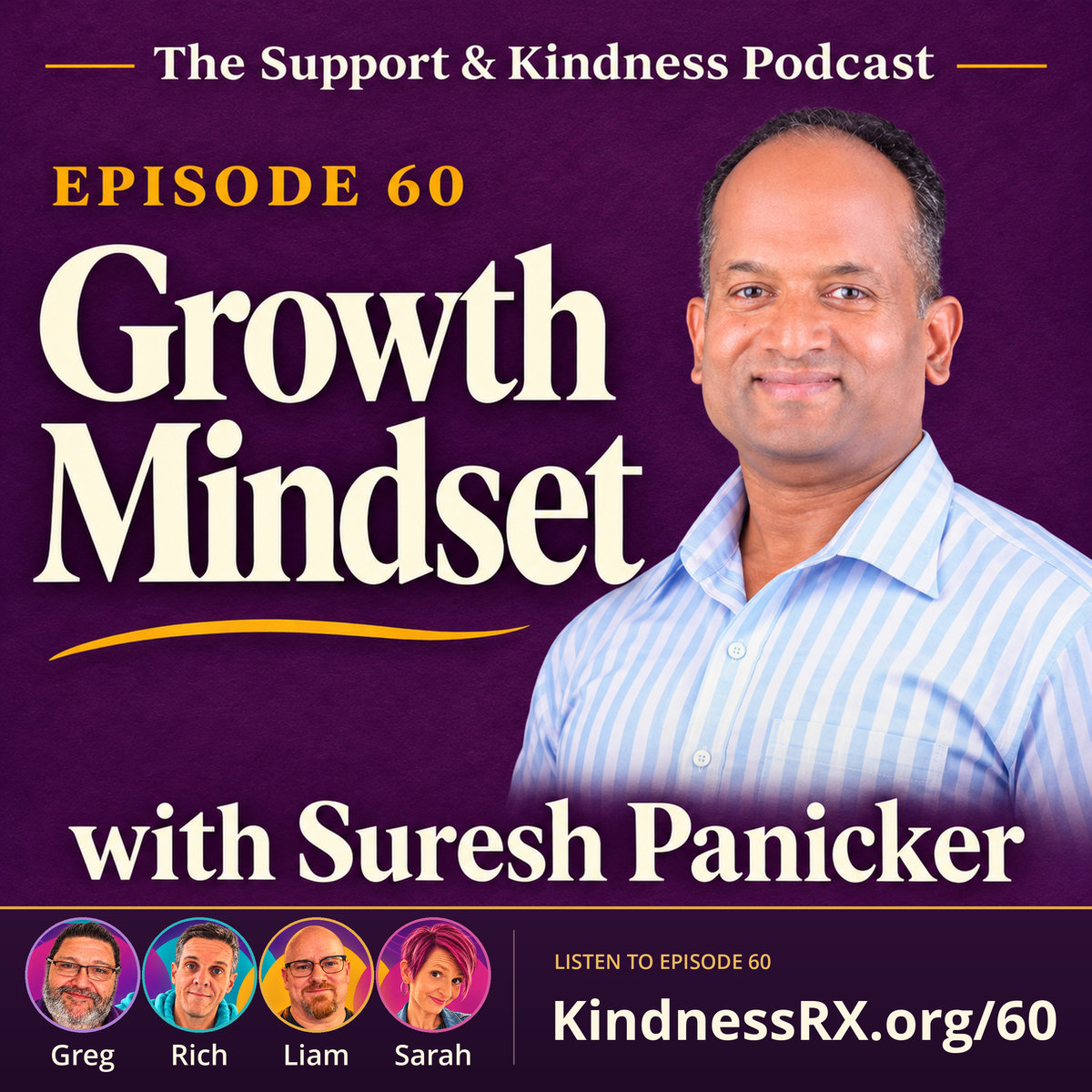
Episode 60: Growth Mindset for the Weeks That Go Wrong
Episode 60 of The Support and Kindness Podcast: Growth Mindset with Suresh Panicker.

By Greg Shaw | The Support and Kindness Podcast
Say you’ve picked Monday to start looking after yourself a little better. Then you sleep badly. Your pain is worse. An appointment gets moved. By lunchtime you’ve scrapped the plan, and that little voice pipes up. “Well, there I go again.”
Hang on a minute. What happened to the bit about the rough night and the appointment? How did a difficult morning turn into a verdict on you?
That’s where Rich, Liam, Sarah and I began our conversation with Suresh Panicker. Suresh served in the Indian Army, worked in international business and now runs Omni Wellness in Sweden. He created the FLOW Method. One question he uses with people he coaches is simple enough to ask over a cup of tea. What gives you energy, and what drains it?

Listen to Episode 60 with Suresh Panicker
Where a growth mindset fits
Psychologist Carol Dweck studied how people think about learning. A growth mindset leaves room for an ability to develop with practice, useful feedback and a different way of doing things. Think about learning to use a new phone. Someone can tell you to keep trying, or they can sit next to you and show you where the button is. Those are two quite different offers of help.
For someone living with pain, brain injury or fatigue, the part worth borrowing is that willingness to try another approach. Symptoms deserve care. You can be curious about what helps on a hard day and still need treatment, rest, accessible transport or a hand from somebody else.
Read Stanford’s explanation of growth mindset and learning
What if getting to the gym is the hard part
Rich asked Suresh how he’d adapt his approach for someone with limited mobility, little money or no way to get to a gym. It was the “getting there” bit that struck me. Anyone can hand you an exercise plan. Who’s helping you get down the stairs, pay for the ride or save enough energy to get home?
Rich mentioned a World Health Organization estimate. In 2022, about 31% of adults worldwide fell below recommended activity levels. That figure covers people with very different lives. It tells us little about the person sitting in front of us. What do they enjoy? What is within reach? What has their care team said is suitable?
Suresh suggested looking at what was available where you already live. For one person that might mean doing something from a chair. For another it might mean writing a question for their next appointment. If activity makes your symptoms worse, tell your healthcare team what happens and ask about an approach that fits your condition.
See CDC guidance for adults with chronic conditions or disabilities
What one missed day can tell you
Liam asked what you say to someone who misses a day and decides they’ve ruined the whole week. A study he brought to the table gives us a little breathing room. University College London researchers enrolled 96 volunteers. Each chose one eating, drinking or activity habit to repeat in the same situation for 12 weeks. Missing one opportunity made little difference to how the habit developed.
That study looked at ordinary daily habits. Think of leaving your notebook by the kettle. If you missed it on Tuesday, you can still use it on Wednesday. And if the notebook sits there untouched for a fortnight, perhaps a voice note would suit you better. That’s something you can actually change.
Read the original habit study by Phillippa Lally and colleagues
Support you can actually feel
Sarah asked what helpful accountability sounds like after a rough week. She also brought up loneliness. In its 2025 report, the WHO Commission on Social Connection estimated that about one in six people worldwide experienced loneliness. Suresh talked about how you can have a long list of contacts and still struggle to find one person you can tell the truth to.
If somebody you care about has stopped checking in, you could ask, “Would you like me to listen, or is there one thing I can help with?” Then give them time to answer. They might want company while they make a phone call. They might want to talk about the football. Let them tell you.
Read the WHO Commission’s plain-language report on social connection
The coach Rich still is
During What’s on Your Heart?, Rich told us that health problems had taken him away from coaching after a 20-year career. He missed it. As he listened to Suresh, he realised he still gets to do some of that work. Paid or unpaid, on a pitch or chatting with a friend, he can listen and help somebody find their next step.
“I do it as a parent. I do it as a friend. I do it as a podcast participant,” he said. A new training schedule wouldn’t have answered what Rich was asking himself. He wanted to know what he still had to give.
Liam talked about sharing a meal with family members who see politics differently. He got to enjoy being an uncle and spending time with the children. Sarah shared some promising news about a job interview. Our group chat had already been cheering her on. If you’ve ever waited to hear back about a job, you’ll know what it means when someone remembers to ask.
Suresh was looking forward to a boxing federation meeting where people of different ages could speak with coaches. I found myself thinking about who watches the way we handle a hard day. Sometimes it’s someone younger. Sometimes the person learning from us is our own self tomorrow.
Choose a challenge for this week
These are the two choices we offered on the show. Pick whichever sounds useful. You can make it smaller or leave it for another week.
One Small Experiment
Pick one thing you’d like to make a little easier. Tie one small action to a moment you’ll recognise. After my morning drink, I’ll write down one thing I need today. Your version could be putting a notebook by the door so you remember a question for your next appointment. Try it up to three times this week if that feels manageable. Afterwards, ask, “Did this help? Was it too much? What would make it easier next time?”

Change the Question
Once this week, catch yourself having a go at yourself. When you hear “I never stick with anything,” try asking, “What got in the way this time?” Then ask what support or change would help. If the reminder went off while you were on the bus, perhaps you need it at a different time. You can keep the answer to yourself or ask somebody you trust to help you think it through.
When I asked Suresh how to make either challenge fit a difficult week, he said, “Be kind to yourself.” And if all you got from today was a bit of company, I’m glad you spent the time with us.
Find Suresh and the KindnessRX community
Suresh told us his book, Resilient by Design, had launched on Amazon India on November 5. He gave us his coaching website for the book and updates on international and audio editions.
Visit Suresh’s FLOW Method website
Listen to more episodes of The Support and Kindness Podcast
Join our free online peer support groups for brain injury, chronic pain and mental health
The podcast and our groups share lived experience and peer support. Speak with your healthcare team for advice about your own care.