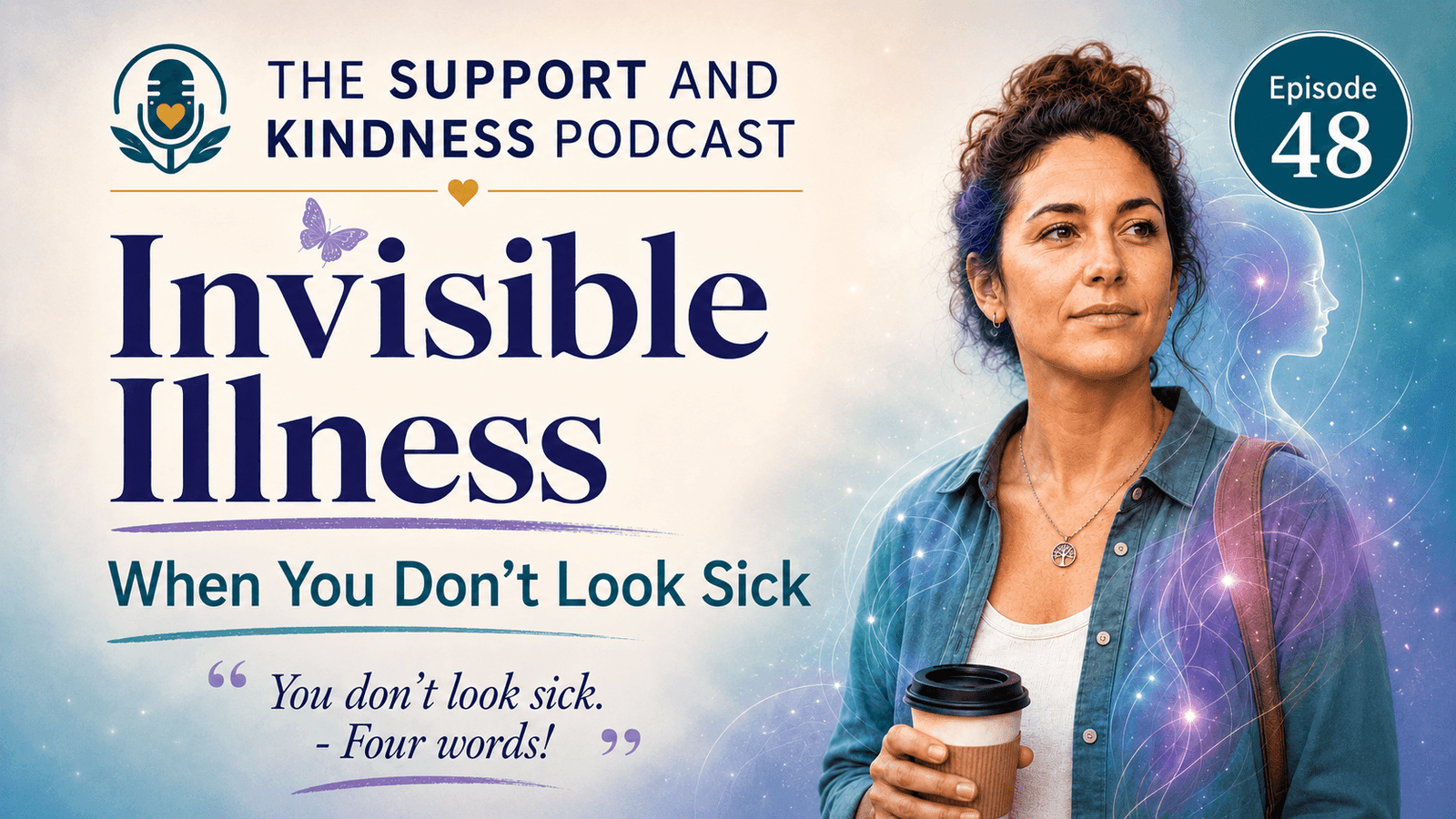
Episode 48: Invisible illness, when you don’t look sick
What invisible illness actually is, and why it affects more people than you think
“You don’t look sick.” Four words. Usually meant kindly. And if you live with an invisible illness, they can land like a door quietly closing. Because what is sick supposed to look like?
- A wheelchair?
- A cast?
- An oxygen mask?
If someone is smiling, working, or picking up groceries, does that mean they are well?
Invisible illness is not a single diagnosis.
There is no official medical category by that name. It is a broad term for conditions where the struggle does not show on the outside: pain, fatigue, dizziness, brain fog, nausea, mood episodes. And it is far more common than most people realize.
The CDC reports that three in four American adults live with at least one chronic condition, and more than half have two or more. Not all of those are invisible, but a great many are. In 2023, 24.3% of adults reported chronic pain, and 8.5% said that pain regularly limited their daily life or work. You cannot look at someone and measure that.
This is not a fringe issue.
The U.S. Department of Health and Human Services made invisible illness a formal focus area for its 2026 TOPx challenge, calling it “intentionally broad and inclusive” and listing autoimmune conditions, ME/CFS, Long COVID, mental health conditions, and Lyme disease among the examples.
Harvard Health estimates that invisible conditions affect roughly 10% of the 61 million Americans living with a disability. And a 2021 paper in the AMA Journal of Ethics noted that only a small fraction of people with disabilities use visible supports like a cane or wheelchair, meaning most do not appear disabled at all.
On this episode, Rich, Liam, and I sat down and talked about what that reality feels like from the inside. Not as experts. As people who have been there.
The words that wound, and simple swaps that land as care
Rich named exactly why the phrase “you don’t look sick” cuts so deep. It is not only the words. It is what sits underneath them.
- “The reason that phrase really hurts is the dismissal, the doubt, and the isolation. It makes you feel like your pain or struggle isn’t real.”
// Rich
Most people who say it mean well. But “you were fine yesterday,” “at least it’s not something worse,” “have you tried yoga?” and “everyone gets tired” all whisper the same quiet thing: I am not sure I believe you.
The good news is that warmth survives a small edit.
- Instead of “you don’t look sick,” try “how are you feeling today?”
- Instead of “have you tried yoga?” try “is there anything that makes things easier for you?”
- Instead of “everyone gets tired,” try “that sounds exhausting.”
And maybe the most powerful one of all, the one Rich singled out:
- “Do you want suggestions, or would it help more if I just listened?”
That last one hands control back to the person who is hurting. And most of the time, that is what they needed. I connected this to something we have covered on the show before: medical gaslighting. When a provider says “everyone gets tired” instead of ordering a test or referring you on, hope leaks out of the room. If a doctor had simply said “that sounds exhausting,” I would have felt validated even without new answers. Being heard is its own kind of care.
“But you were fine yesterday”: spoon theory and the battery that won’t hold a charge
One of the hardest things for well-meaning people to grasp is that bodies fluctuate. A person can have a good morning and a brutal afternoon. They can manage a trip to the store and then have nothing left to cook dinner. Other people see the event, not the days of recovery that follow.
Liam put the timeline plainly:
- “It’s not only week to week. It’s day to day, it’s hour to hour, it’s even minute to minute. It fluctuates so much.”
// Liam
Two images do the explaining better than any lecture. The first is spoon theory, created by Christine Miserandino, who lives with lupus. Imagine waking up with a fixed number of spoons, each one a unit of energy. A shower costs a spoon. Breakfast, another. The commute, two. Healthy people never count. When you are ill, you ration all day, and by mid-afternoon you have run out.
The second image is the drained battery: a phone that looks perfectly normal but will not hold a charge, no matter how good the screen looks. Rich mentioned his family had used the spoon language for fifteen years before he ever heard it called a theory. That tells you how true it rings.
Invisible illness at work: your rights, minus the medical memoir
Work adds its own complications.
Some people need flexible scheduling, more frequent breaks, an occasional remote day, adjusted lighting for migraines, or a chair where everyone else stands. None of that says anything about intelligence, commitment, or worth. And the stakes are real: Census Bureau data from 2021 found that about 82% of working-age people without a disability were employed, compared with roughly 54% of people with a disability.
Here is the part worth memorizing.
Under the Americans with Disabilities Act, qualified employees at workplaces with 15 or more people can request reasonable accommodations. And you do not have to reveal your specific diagnosis, only how your condition limits a major life activity like working, concentrating, or sleeping.
Rich laid out a practical playbook on the episode:
identify what you need, get a supporting letter from your doctor, keep the HR conversation brief and solutions-focused, and document everything afterward with a follow-up email.
In the UK, similar protections exist as reasonable adjustments under the Equality Act 2010. (This is general information, not legal advice.)
Why people stay silent at work, and what that costs
Even with legal protections in place, many people choose not to disclose. A 2017 study by the Centre for Talent Innovation (now CoQual) found that only 3.2% of white-collar employees disclosed a disability to their employer, even though the study estimated the actual rate was 30%. That gap is enormous. The main reasons were fear of being seen as incapable, getting passed over for promotion, or being treated differently by coworkers.
But silence has its own cost.
That same study found that employees who did feel comfortable disclosing were more than twice as likely to feel regularly happy or content at work. Hiding a condition all day, every day, takes energy that many people with invisible illness cannot spare.
A 2026 study in the Journal of Business and Psychology on employees with invisible disabilities found that the disclosure decision is shaped by something specific to disability: the fear that others will view you as less productive, not just different. That pressure to perform as if nothing is wrong is its own kind of exhaustion.
The parking lot, the cane, and the snap judgment
Then there is the world outside the office. The accessible parking spot. The wheelchair user who stands up. The cane that appears one day and not the next. Suddenly strangers appoint themselves investigators.
But mobility is not all-or-nothing. Being able to stand does not mean you will not fall twenty feet later. Being able to walk does not mean walking is safe. The panel was honest that most of us would not confront a stranger who muttered “they don’t look disabled.” But we would want that person to hold one more possibility open.
And there is a flip side worth naming: compassion is not pity. People with invisible illness still have talents, humor, ambitions, and bad jokes. Often the kinder question is not “are you sure you can do that?” It is “what would help you do that?”
Sick before the paperwork: why so many go undiagnosed
One thread from the episode deserves more room. Some people are genuinely ill before medicine has named what they have. And that gap between symptoms and a diagnosis can stretch for years.
Take ME/CFS (myalgic encephalomyelitis / chronic fatigue syndrome). The CDC estimates that as many as 3.3 million Americans have it, and the vast majority are undiagnosed. Autoimmune disease tells a similar story: the NIH counts at least 80 distinct conditions affecting an estimated 5 to 8% of the population, roughly 80% of them women, many of which take years and multiple doctors to pin down.
Medical gaslighting makes the wait worse.
A 2024 study in Healthcare on Lyme disease patients found that even with a recognized, reportable condition, patients routinely described being dismissed by providers who insisted their symptoms were psychological. A 2019 qualitative analysis in Health Care for Women International documented how women with chronic illness experienced repeated dismissal in clinical settings, leading to delayed care and eroded trust.
The term “medical gaslighting” entered the American Journal of Medicine as a named concept in 2024. It is no longer an informal complaint. It is a recognized pattern. The lesson is not that everyone is secretly sick. It is that a person can need compassion long before they have paperwork proving why. Belief should not be contingent on a diagnosis code.
What the government just recognized about invisible illness
In 2026, the U.S. Department of Health and Human Services launched a $2 million national challenge called the TOPx HHS Tech Sprint for AI and Invisible Illness, in partnership with the NIH and the LymeX Innovation Accelerator. The challenge focuses on three areas: Lyme Innovation, Invisible Illness, and Cost of Illness.
What is worth noting is the framing.
The challenge description asks: “How might we use the U.S. open data and AI to turn fragmented signals into trusted insights, so people living with Lyme disease, Long COVID, and other complex, chronic conditions are believed earlier, diagnosed faster, and supported better?”
“Believed earlier.” That language matters. It tells you that the gap between a patient’s experience and the system’s willingness to listen has gotten wide enough for the federal government to build a program around it. That is validation on a scale most people with invisible illness have never seen. It does not fix the problem. But it names it. And naming things is often where change starts.
What to say instead: a pocket guide
If you take one practical thing from this episode, let it be these swaps:
- Instead of “you don’t look sick” try “how are you feeling today?”
- Instead of “have you tried [remedy]?” try “is there anything that makes things easier for you?”
- Instead of “everyone gets tired” try “that sounds exhausting.”
- Instead of “at least it’s not something worse” try “I’m sorry you’re dealing with that.”
- When in doubt try “do you want suggestions, or would it help more if I just listened?”
None of these cost anything. All of them say: I see you. I believe you. I am here.
Questions people ask about invisible illness
Is it real if there is no diagnosis yet?
Yes. Many serious conditions go unnamed for years. The CDC estimates the vast majority of ME/CFS cases are undiagnosed. A missing label does not make the symptoms less real, and no one owes you their medical history to be believed.
How do I respond to “but you were fine yesterday”?
You can gently explain that symptoms fluctuate, sometimes hour to hour, and that a good day often gets “paid for” later. Spoon theory is a quick way to say it. And you are allowed to keep the explanation short. You do not owe a full account.
Do I have to tell my employer my diagnosis to get accommodations?
No. Under the ADA, you disclose the functional limits (what tasks are hard, what change would help), not your private diagnosis. It applies to employers with 15 or more employees. There is a back-and-forth “interactive process” to land on something that works. You do not have to hand over your medical file.
Someone is in an accessible spot but looks fine. Should I say something?
Many disabilities are invisible, and a valid permit is enough. The kinder move is to assume you are missing information rather than assuming the worst. Catch your own snap judgment before it forms.
What is the single kindest thing to say?
“Do you want suggestions, or would it help more if I just listened?” It hands control back to the person who is hurting, and that is usually what they needed most.
Watch next
If this episode resonated, TED Fellow Jennifer Brea’s talk “What happens when you have a disease doctors can’t diagnose” is a moving companion piece. Brea was a PhD student at Harvard when she became progressively ill with ME/CFS. Her doctors insisted it was psychological. She started filming herself and other patients, and that footage became the Sundance-premiering documentary Unrest. The talk has been viewed over 2 million times. It is a firsthand account of being disbelieved by the medical system and choosing to be seen anyway.
Listen to the full episode
This is just the surface. The full conversation, including Rich’s unforgettable neighbor who is certain he has cured everybody’s seizures, the three-word memory test that “proves” you are fine, and each host’s “what’s on your heart” moment, is on The Support and Kindness Podcast.
Listen on Spotify | Watch on YouTube
You are not alone
If what we talked about sounds familiar, if you are carrying more than people can see, you do not have to carry it alone. KindnessRX runs free, peer-led support groups every week:
- Brain Injury on Mondays at 1:00 PM ET
- Chronic Pain on Tuesdays at 12:00 PM ET
- Mental Health on Wednesdays at 7:30 PM ET
They are safe, confidential, online video spaces. No experts, no fees, just real people showing up for each other.
You can sign up or RSVP at kindnessrx.org/groups.
About KindnessRX
KindnessRX is a peer-led wellness community for people living with chronic pain, brain injury, and mental-health challenges. Built on honesty, kindness, and zero judgment. Learn more at kindnessrx.org.
Sources and further reading
CDC: Chronic pain in U.S. adults, 2023 (NCHS Data Brief 518)
CDC: Clinical overview of ME/CFS
NIH Office of Research on Women’s Health: Autoimmune disease
U.S. Census Bureau: Disability, employment, and benefit receipt: 2021
EEOC: Disability discrimination and accommodations
GOV.UK: Disabled people’s employment rights (Equality Act 2010)
Christine Miserandino: The spoon theory
Jennifer Brea (TED): What happens when you have a disease doctors can’t diagnose
Harvard Health: Invisible illness, more than meets the eye
HHS: Invisible Illness, TOPx HHS 2026 focus area
NIH: TOPx HHS Tech Sprint for AI and Invisible Illness
Fagen (2024): Medical gaslighting and Lyme disease, the patient experience (Healthcare)
Centre for Talent Innovation / CoQual (2017): Disabilities and inclusion study
Journal of Business and Psychology (2026): Not an ideal worker, not a disabled worker
McManimen et al. (2019): Dismissing chronic illness, Health Care for Women International