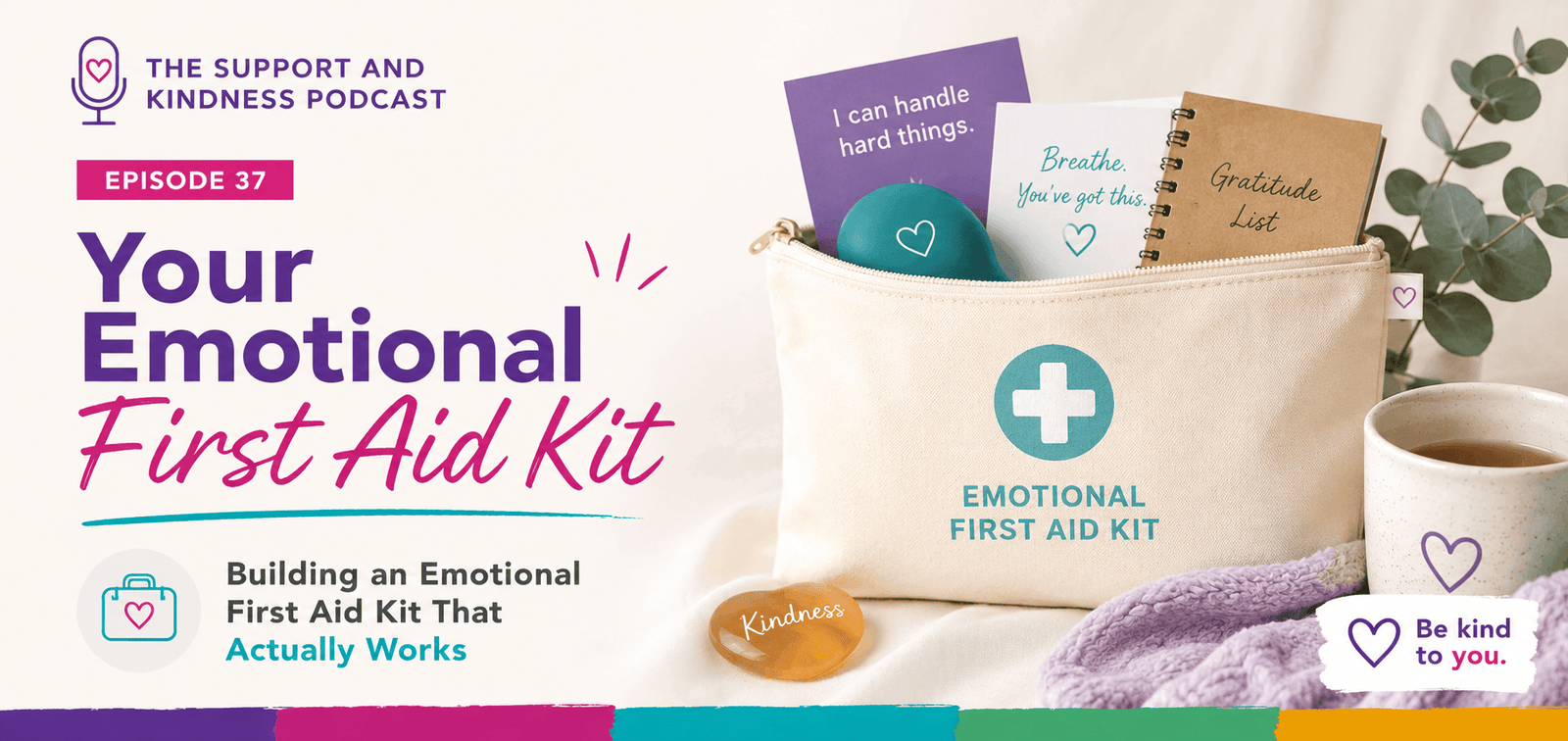
Episode 37: Your Emotional First Aid Kit
Building an Emotional First Aid Kit That Actually Works
It’s three in the morning. Your chest is tight, your thoughts are looping, and you’ve already googled half a dozen symptoms you don’t really have. You know what you’d do if you’d cut your finger — reach for the cabinet, find the gauze, clean the wound, wrap it up. The script is automatic. But for this? For the way your heart feels right now? Nobody handed you that script.
That gap — between the physical wound we know how to treat and the emotional one we freeze in front of — is the gap an emotional first aid kit is built to close. It isn’t therapy. It isn’t a diagnosis. It’s the thing you reach for in the moment, while the bigger questions wait for daylight.
Why So Many of Us Don’t Have One
The numbers are uncomfortable. According to Johns Hopkins Medicine, nearly one in ten US adults experiences a mental health crisis in any given year — close to 30 million people. For young adults between 18 and 29, the rate climbs to about one in seven. A 2022 Mental Health America survey found that 56% of adults living with mental illness received no treatment at all. None. And roughly 8 in 10 workers won’t reach out for mental health support when they need it.
The reasons are real. Stigma. Cost. Long waitlists. Cultural histories that taught whole communities to be suspicious of clinicians. And the cruelest one of all: when you’re in the middle of a crisis, your brain is flooded. You can’t think clearly enough to make a plan. The moment you most need a plan is the moment you’re least equipped to build one.
This is exactly why the emotional first aid kit has to exist before the moment arrives. The framework the panel keeps returning to is Psychological First Aid — an evidence-informed model originally developed by trauma researchers and now used as the standard of care after disasters. It’s built on a simple, generous premise: humans are resilient, and the job of an early intervention is to reduce distress, stabilize, foster connection, and help a person regain a sense of control. Your personal kit is the household version of that idea.
What Actually Goes In It
Here is where the conversation on the podcast went somewhere I didn’t expect. Liam, with the kind of grin you can hear on a microphone, suggested we drop the “emotional first aid kit” framing entirely and call it an emotional utility belt instead of an emotional first aid kit. “Like Batman has,” he said. “You could have your little grappling hook, which might be your frozen water bottle. You could have your countdowns with your senses. You can be quick on the draw, you don’t waste any time.”
It sounds playful — and that’s the point. The kit only works if you can reach for it without thinking. The Batman bit isn’t a gimmick; it’s a usability principle. A tool you have to hunt for during a panic attack is a tool that doesn’t get used.
With that frame, the panel mapped out what people actually keep on hand. Rich keeps Bodhi balls — small Chinese meditation balls with chimes inside — and rotates them in his palm to come back to the present. Liam keeps a frozen bottle of water in the freezer; pulled out and pressed to the back of the neck, it forces his senses to recalibrate. He also keeps a stuffed animal he calls his sobriety sidekick (named Claire), which is small enough to grab from anywhere — even from the fetal position, he pointed out, with the kind of dark honesty that earns trust on a mental health podcast.
Derek leans on music — not single songs but full albums, the kind that take you through a whole emotional arc. Sarah keeps a wider toolkit: jewelry-making (beading, she said, is unreasonably cathartic), naps, coloring, a funny movie or action movie to disappear into, and what she lovingly called rage cleaning. Greg admitted on air that he doesn’t have a kit yet either, which is half the reason this episode exists.
If you want a starter shelf, the panel’s combined list looks something like this:
- Grounding tools: a frozen water bottle, ice, the 5-4-3-2-1 senses method, simple counting.
- Tactile comfort: a stuffed animal you can squeeze, a soft blanket, scented lotion, a fidget object, Bodhi balls.
- Audio anchors: a playlist of grounding songs, a full album that mirrors the emotional journey you need, a comfort show or favorite scene.
- People: the names and numbers of two or three humans you can text or call without explaining yourself first.
- Movement: a walk, a few stretches, dancing in the kitchen to a song that makes you feel alive.
- Outlets: a notebook for brain-dumping without judgment, a coloring book, beading, or — yes — angry cleaning.
Sarah’s Counting Story, and Why It Matters
One of the most quietly powerful moments in the episode came when Sarah described what grounding actually did for her. After a spinal cord injury, she began experiencing episodes of autonomic dysreflexia — and then, layered on top, PTSD-style panic attacks that mimicked the same symptoms. Her blood pressure would spike, she’d think she was dying, and she’d end up in the ER. Someone on a mental health line taught her two techniques: count your fingers; name five things you can see, four you can hear, three you can smell.
“That was so helpful for me,” she said, “because it made me concentrate on something else. I don’t know how I would have gotten through all of that if it would not have been for those techniques.” Later in the freeform section, she added the simplest version of all: “When your body goes into fight or flight, just start counting. Any number. Pick a number. I made my daughter count with me, and it just kept me in the moment.”
This is an emotional first aid kit at its purest. Not expensive. Not complicated. A trained brain, a number to start at, and a body that gradually remembers how to settle.
When the Kit Isn’t Enough
The panel was clear-eyed on the limit of all of this. An emotional first aid kit isn’t a substitute for professional care; it’s a bridge. Rich put it cleanly: “It is, as I said before, a tool for the here and now, but not for the long-term mental health support. That’s something that you should seek professional help with.” Derek echoed that — the kit treats the symptom, therapy treats the cause — and added a candid note about the rapport that good ongoing counseling can build over years.
Greg, taking his own panel question, named the red flags worth knowing. Thoughts of self-harm. Thoughts of harming someone else. Preoccupation with death. Giving things of great value away. Using alcohol or substances to a harmful degree. And the question he learned long ago to ask out loud, even when it feels too direct: “You’re not thinking of harming yourself, are you?” If the answer is yes, you can help. If the answer is no, the person knows you cared enough to ask.
If you or someone you love is in that place right now, please call or text 988. It’s the Suicide & Crisis Lifeline. It’s free, it’s confidential, and it’s available 24 hours a day.
You May Already Be Using Yours
The line from this episode that stayed with me longest came from Rich during freeform sharing. He had spent the week trying to figure out what was in his kit — and walked outside one afternoon to find his son sitting on the porch. “I had this big grin when I saw him,” he said. “We sat there listening to the birds chirping, talking about the world passing by… That’s one of my emotional first aid kits. I just didn’t realize I have them.”
If the whole concept feels foreign, start there. Look at what you already reach for instinctively — the walk you take when you’re tense, the song you replay, the friend you text first, the routine you fall back into when the day frays. Those are tools. They count. Name them. Add to them. Notice which ones work and which ones don’t anymore. Sarah’s reminder that the kit evolves is worth repeating: as you change, the kit changes.
This Week’s Challenge
Greg’s closing challenge is the kind you can actually do. Build one thing for your emotional first aid kit this week. Just one. Write down a person you can text without preface. Pick a grounding technique and practice it once, in the calm, so your body knows the moves. Make a five-song playlist. Journal for five minutes. Bookmark the support group calendar. Whatever it is — start somewhere. The time to build the kit is not when you’re in crisis. It’s now.
Listen to the Full Episode
This is just the surface. The full conversation — including Liam’s full utility belt rant, Sarah’s counting story, Rich’s porch moment, and Greg’s honest admission that he hasn’t built his own kit yet — is on The Support and Kindness Podcast.
Listen on Spotify
You’re Not Alone
At KindnessRX we run three free, peer-led support groups every week — no paywalls, no insurance, no gatekeeping.
- Brain Injury Support meets Mondays from 1:00 to 2:00 PM ET.
- Chronic Pain Support meets Tuesdays from 12:00 to 1:00 PM ET.
- Mental Health Support meets Wednesdays from 7:30 to 8:30 PM ET.
Sign Up For Groups Here
https://luma.com/calendar/cal-oyT0VPlVTKCPxBw
All groups meet online and you can find the schedule and RSVP at kindnessrx.org. Consider it a permanent line item in your kit. Sometimes the most powerful medicine is knowing you’re not alone.
About KindnessRX
KindnessRX is a peer support community for adults navigating brain injury, chronic pain, and mental health. We host weekly free support groups and publish The Support and Kindness Podcast every week, hosted by Greg Shaw and a rotating panel of co-hosts who’ve lived what they talk about.