Episode 26: Understanding Loneliness and Finding Connection
You can be in a room full of people and still feel alone.
You might have a partner, a family, or a phone full of contacts. You might be the person who checks on everyone else. Yet when you need to talk, you may struggle to name one person who would really understand.
That feeling can be hard to admit. It can carry shame that does not belong there.
In Episode 26 of The Support and Kindness Podcast, Greg, Rich, Jay, Derek, and Liam talk about loneliness from lived experience. They discuss brain injury, pain, transport, friendship, online contact, and the courage it can take to start a conversation.
This companion article builds on that conversation with research and practical ideas. The research sections below are added context. They are not claims that every study or resource was discussed in the recording.
Listen to Episode 26
Open the Episode 26 podcast page.
What is loneliness?
Loneliness is the painful feeling that your relationships do not give you the connection you need. The gap may involve closeness, trust, understanding, or belonging.
Being alone describes your situation. Loneliness describes how that situation feels.
Solitude can be welcome. You may enjoy a quiet afternoon, a book, or time away from noise. Social isolation means having few contacts or limited chances to take part. A person can experience isolation without feeling lonely, or feel lonely while seeing people every day.
The World Health Organization explains these differences. They matter because adding more names to your phone may not meet the need underneath the feeling.
You may need one trusted friend. You may miss a group where you feel useful. You may need someone who understands grief, disability, or recovery without a long explanation.
Try asking: What kind of connection am I missing?
The answer can help you choose a smaller, more useful next step.
What the episode helps us see
Greg explains how having a car once made it easier to go out when he felt well enough. Now, limited transport means more planning. Pain and depression can change between making a plan and trying to follow through.
That is a real barrier. An invitation can be kind and still be hard to accept.
Rich describes another barrier. Since his brain injury, it can take longer to find words or form a response. A conversation may move on before he can join in. People are present, but the chance to feel included slips away.
Jay talks about friendship and the pressure some men feel to hide their needs. Derek explains that online contact can help him stay close to relatives far away. Liam shares how practicing conversations helped him feel more prepared.
Their stories give us more useful questions than “Why don’t you go out?”
Can this person get there? Can they afford it? Will they have time to speak? Can they leave early? Will they feel welcome if they need support?

Belonging grows when people have time, access, and room to be themselves.
How common is loneliness?
Loneliness reaches across age groups and countries.
In its 2025 report, the WHO Commission on Social Connection estimated that about one in six people worldwide experience loneliness. That is a global estimate, not the result of one survey of American adults.
A separate CDC analysis published in 2024 used 2022 survey data from 26 US states. It found that 32.1% of adults reported feeling socially isolated sometimes, usually, or always. The study used that question as a measure of loneliness. Among adults aged 18 to 34, the figure was 43.3%. Among those with household income below $25,000, it was 47.9%.
Those figures describe that survey and its definitions. They should not be presented as a current count for every US adult. Different questions, places, and time periods produce different results.
The figures also point toward something practical: money and life stage can shape access to connection. An expensive meal, a long drive, or an activity during work hours can leave someone out before they even reach the door.
A recent study adds a useful distinction
A German study published on October 29, 2026 explored emotional and social loneliness in 14,443 adults aged 18 to 51. Emotional loneliness concerns missing a close bond. Social loneliness concerns missing a wider network or sense of belonging.
The study used data collected in 2021 and 2022. Its findings describe associations at one point in time. They cannot show that one factor caused loneliness.
For a reader, the distinction offers a useful question: do you miss a trusted person, a wider community, or both? A busy social calendar may not answer the need for a close bond.
Does loneliness affect health?
Ongoing loneliness and isolation are linked with poorer mental and physical health. That deserves care, without frightening people who already feel vulnerable.
In the episode, Greg mentions the comparison with smoking 15 cigarettes a day. The 2023 US Surgeon General’s advisory uses a comparison involving the mortality risk associated with lacking social connection and smoking up to 15 cigarettes daily.
This is a broad comparison drawn from population research. It does not mean that one lonely day causes the same damage as smoking. It does not predict an individual person’s lifespan. Social connection includes several related measures, so the comparison should not be treated as an exact dose of loneliness.
The helpful message is that connection deserves attention as part of health. It is not a reason to blame yourself or panic.
If loneliness is affecting your sleep, mood, or ability to manage daily life, tell a health professional. You deserve support with the feeling and with the barriers around it.
Loneliness can look different across our lives
Young adults need room to belong
Moving, leaving school, starting work, or living away from familiar people can change a person’s social world. Having busy group chats does not always mean having someone to call when things go wrong.
Avoid telling a younger person that they have no reason to feel lonely. Ask what connection is like for them. A shared interest, an accessible club, or a regular check-in may offer a starting point.
Men deserve close friendships
Jay’s reflections make room for men to say that friendship matters. There is no single male experience. Some men have strong support networks. Others find it hard to ask for closeness or tell a friend they care.
You do not need a perfect speech. “I’m glad we’re friends” can be enough to open a door.
Caregivers need care, too
Someone can spend all day helping others and still feel unseen. Caring tasks may leave little time for friendships that are about the caregiver as a whole person.
Try asking, “How are you doing, apart from everything you are managing?” Offer a specific form of help if you can follow through.
Older adults and disabled people need access
Bereavement, illness, hearing changes, inaccessible spaces, or loss of transport can interrupt familiar routines. These experiences are not the same for everyone.
Ask what would make taking part possible. Let the answer guide the invitation.
Make connection easier after brain injury
Rich’s experience offers a clear lesson: being invited into the room is only the beginning.
A fast group conversation can be exhausting. Several voices, background noise, and sudden topic changes can make it hard to keep up.
Friends and group hosts can try a few simple changes:
- Give someone time to finish a thought.
- Keep one conversation going at a time.
- Ask whether a quieter setting would help.
- Offer a written topic or question ahead of time.
- Leave room for breaks without making a fuss.
These are options to ask about, rather than a rule for every brain injury.
If you need more time, you might say: “I want to join in. It sometimes takes me a little longer to find my words. Please give me a moment.”
If speaking is hard that day: “Could I send my thoughts by message after we talk?”
Connection should leave space for different ways of taking part. Our brain injury support group page offers another place to explore peer connection.
When pain, fatigue, or transport gets in the way
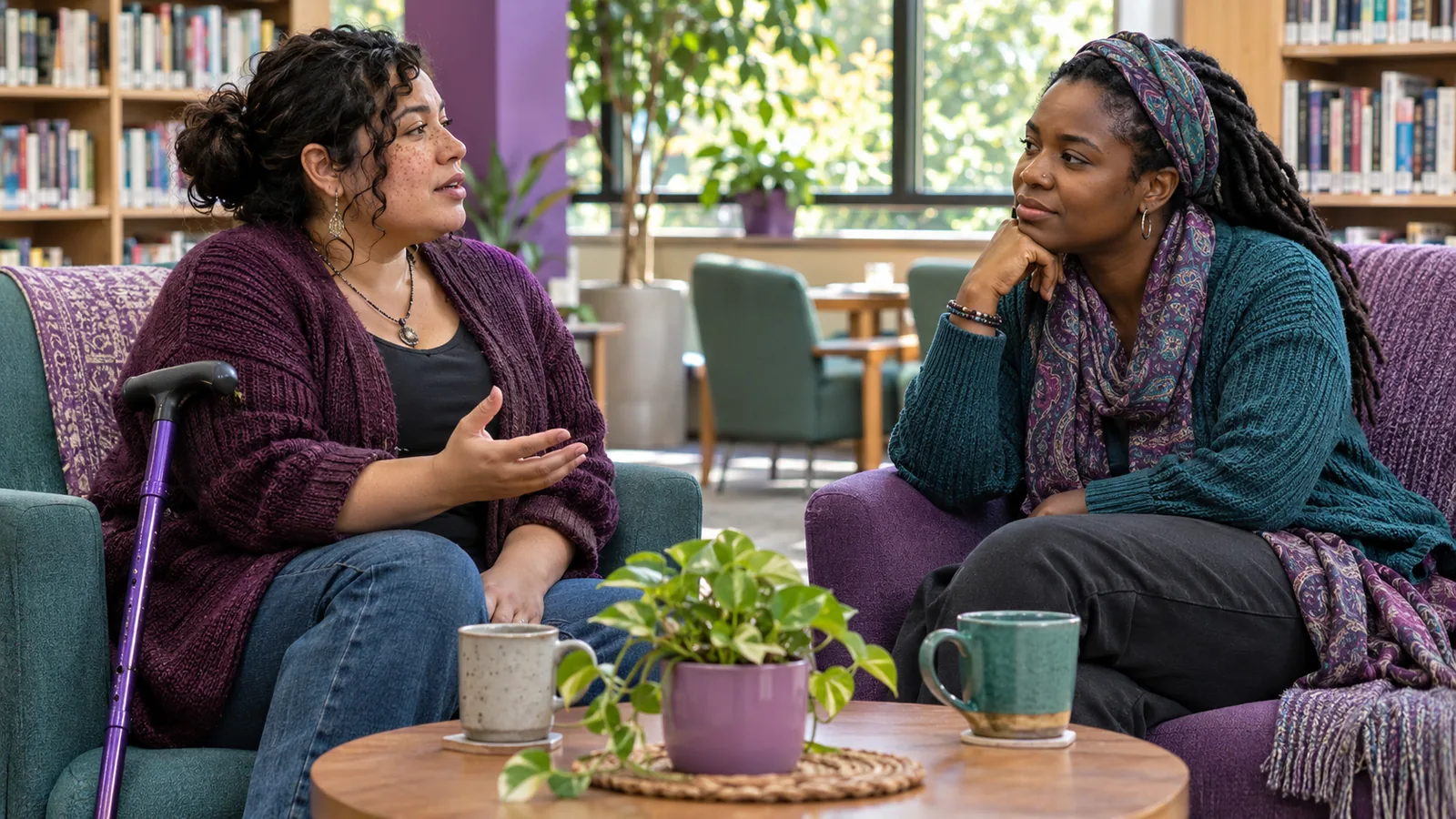
“Let’s meet soon” can turn into a task with many steps. You may need to book a ride, save energy, check access, arrange care, and hope your symptoms allow it.
A backup plan can reduce some of that pressure.
 |
 |
Try: “I’d like to see you. My pain changes, so could we plan a short visit and switch to a call if I can’t travel?”
Or: “I need to book transport ahead. Can we agree on the time and check that there is somewhere to sit?”
A friend can offer: “Would a visit, a call, or a message be easiest this week? It’s okay if you need to change plans.”
Keep the offer honest. Do not promise unlimited availability. A small plan you can keep is more useful than a large promise that fades.
For more on these experiences, listen to Episode 14: Understanding Chronic Pain and Episode 48: Invisible Illness.
Can online connection help?
Derek makes an important point in the recording. A heartfelt online conversation can be meaningful. It may be how relatives across the world remain part of each other’s lives.
For someone who cannot leave home easily, an online group may be a main route to friendship. Text can also give a person more time to think.
The useful question is what happens during the contact. Do you feel heard? Is there a chance to respond? Can you build trust over time?
Passive browsing may feel different from a call with a friend or a regular group where people remember you. Notice how you feel afterward, without judging yourself for using a screen.
Greg also mentions difficult memories appearing on Facebook. If a feature leaves you distressed, explore its settings, take a break, or ask someone you trust to help you adjust it.
Online contact can offer real connection, especially when leaving home is difficult.
Five small ways to begin
1. Name the need in plain words
You might say, “I’ve been feeling cut off,” or “I miss having someone to talk with.” You can share a little without telling your whole story.
If a person responds poorly, that hurts. It does not prove that your need is wrong. Consider who else might be a safer person to approach.
2. Choose a step that fits today’s energy
A ten-minute call may fit better than an afternoon out. A voice message may fit better than a live call. Sitting near others at a library may be enough for today.
Being around people can be a starting point, even when you are not ready for a long conversation.
3. Practice the opening
Liam describes rehearsing conversations with a counselor and later with other people he trusted. He found it helpful preparation.
You could practice: “How did you get interested in this group?” Or: “I’ve enjoyed talking. Would you like to chat again next week?”
Rehearsal can help you prepare. You still get to be yourself, pause, and change the subject.
4. Look for a repeat meeting
A regular group gives you another chance to recognize a face and continue a conversation. You do not have to build a friendship in one visit.
Check the cost, access, expectations, and group rules first. It is reasonable to try a group and decide that it does not suit you.
5. Make the next contact specific
Instead of leaving with “We should do this again,” try: “Would Thursday at three work for a short call?”
If someone cannot make it, leave room for another time. A missed message or declined invitation has many possible explanations. You do not have to turn it into a verdict on your worth.
Keep boundaries while building connection
Loneliness can make attention feel especially powerful. You still have the right to move slowly.
You do not owe someone money, private details, physical contact, or constant replies because they have been kind. You can leave a group that shames people, ignores consent, or pressures members to share more than they want.
A useful sentence is: “I’m happy to talk, but I’m not ready to share that.”
You can also care about someone and say, “I can’t talk tonight. Could we check in tomorrow?” Healthy connection has room for both people’s needs.
If you support someone who feels lonely, ask what kind of contact they want. Advice is not always the first need. Sometimes a person wants company while making dinner, a shared game, or someone willing to listen.
Places to explore for support
In the recording, Greg mentions peer spaces that have helped him feel less alone.
The P.E.E.R. Center provides free peer support in Columbus, Ohio. Check its current services and contact details before visiting.
Pathway Clubhouse in Columbus offers a community for adults living with mental illness. Its official FAQ lists membership requirements: age 18 or older, residence in Franklin County, and a mental health diagnosis. Its membership page explains how to make contact. Ask about access, services, and any costs relevant to your situation.
If you live elsewhere, use the Clubhouse International directory to look for a nearby program. Each location can explain its own membership process.
You can also explore our free online peer support groups, including chronic pain and mental health. Check the current details on the website before joining.
Peer support can offer understanding and community. It does not replace medical care or crisis support.
Two gentle choices for this week’s challenge
Choice one: ask for one small connection. Send a message to someone you trust: “I’d enjoy a short catch-up. Would you have ten minutes sometime this week?”
Choice two: make room for someone else. Check in with a person you care about. Offer a clear, manageable choice: “Would you prefer a call, a message, or some quiet company?”
You only need to choose one. If this week is too hard, you can write the message without sending it yet. The aim is a possible next step, not another test to pass.
Questions people often ask
Can I feel lonely in a relationship?
Yes. Sharing a home or having a partner does not always mean feeling understood. Try naming the kind of closeness you miss. If talking is difficult or unsafe, seek appropriate support.
Does enjoying time alone mean something is wrong?
No. Chosen solitude can feel good. Notice whether you feel restored, or whether you want contact but feel unable to reach it. Both needs can exist in the same week.
What if I have nobody to call?
Start with a supported setting, such as a peer group, community program, library activity, or counselor. You can also read Episode 5: Nobody to Talk To? for more ideas.
When should I ask for professional help?
Ask when loneliness feels persistent, distressing, or linked with worsening mood or daily difficulties. You do not need to wait for a crisis. Episode 9: Asking for Help explores that step.
In the United States, call or text 988 for mental health or suicide crisis support. Visit 988 Lifeline for details. Call 911 for immediate danger.
Further reading and watching
These are additional resources for this article, not links named in the episode.
- WHO: Social connection, questions and answers.
- CDC: Loneliness and social support, 2022 survey findings.
- US Surgeon General: Social connection advisory.
- KindnessRX: The Science of Kindness.
- KindnessRX: Kindness Toolkit.
Three TED and TEDx talks offer more ways to think about connection:
- Jonny Sun: You are not alone in your loneliness. A personal reflection on feeling alone and finding connection online.
- Olivia Remes: How to cope with loneliness. Ideas to consider alongside the practical steps in this article.
- Robert Waldinger: What makes a good life? Lessons from the longest study on happiness. A talk about relationships and well-being.
You deserve relationships where there is room for your needs and your whole self. That can take time to find. Today, one honest message, one accessible invitation, or one person willing to wait while you speak can be a place to begin.