How Kindness and Simple Habits Can Change Your Life
The Quiet Power Behind Small Choices
There’s a quiet revolution happening in the lives of ordinary people. Not the kind that makes headlines or trends on social media — but the kind that happens at 7 a.m. when someone chooses to smile at a stranger, write one grateful thought in a notebook, or send a heartfelt message to a friend they’ve been meaning to check on. These moments seem insignificant. But stack them together, day after day, and they become the architecture of a life that feels genuinely good to live.
This is the truth about how kindness and simple habits can change your life: the transformation is not loud. It’s consistent.
If you’ve ever felt like a better version of your life was just out of reach — not because of big failures, but because something small was missing — you’re not alone. The truth is that how kindness and simple habits can change your life is one of the most overlooked conversations in personal growth. Real, lasting change rarely arrives through dramatic turning points. It builds quietly, through deliberate daily kindness and small habits repeated so consistently that one day you look back and barely recognize how far you’ve come.
Why Kindness and Simple Habits Can Change Your Life
Most transformation strategies focus on what you need to add — a new morning routine, a gym membership, a better diet. But the most sustainable change starts somewhere far simpler: in how you treat people, including yourself, and in the tiny rituals you choose to repeat each day.
Kindness and simple habits are connected at their core. Both require you to show up intentionally in small, unglamorous moments. Both reward you not immediately, but through compounding. And both are available to you right now, regardless of your circumstances, schedule, or energy level.
How to Build Daily Kindness Habits That Actually Stick
Learning how to build daily kindness habits is less about willpower and more about design. You don’t rise to the level of your intentions — you fall to the level of your systems.
Start With a Kindness Anchor
An anchor habit is an existing behavior to which you attach a new action. This is one of the most effective strategies in behavioral science, and it works because your brain already has that routine wired in.
Try these anchors:
- After you pour your morning coffee → send one genuine, unprompted message to someone you appreciate.
- After you sit down at your desk → write one kind sentence about what you’re looking forward to today.
- After you get into bed → recall one kind thing that happened in the last 24 hours.
These take under a minute. But over 90 days, they rewire how you see people — and how you see yourself.
Make Kindness Visible in Your Environment
Your surroundings shape your behavior more than your motivation does. A few simple changes:
- Place a sticky note on your mirror with a reminder: “One kind thing today.”
- Keep a small notebook by your bed — not for productivity, but for one nightly reflection.
- Add a recurring phone reminder at 2 p.m. that simply says: “Say something kind.”
These cues remove the need to remember to be kind. They build it into your day structurally.
Simple Daily Habits for a Better Life: Where to Begin
If you search for simple daily habits for a better life, you’ll find thousands of elaborate routines. Most people try them, feel overwhelmed, and quit. Here’s a different approach: begin with just three habits — one for your morning, one for your midday, and one for your evening.
Morning Habits That Improve Your Mood
How you start your day shapes your emotional baseline for the next 16 hours. These habits take five minutes or less:
- Gratitude before your phone: Before checking any screen, name three specific things you’re grateful for. Not general things — specific ones. Not “my health” but “I slept well and woke up without an alarm.”
- One intentional breath: Take a single long, slow breath before getting out of bed. It activates your parasympathetic nervous system and drops your cortisol slightly before the day begins.
- A kind start: Send one warm, unsolicited message — a voice note, a text, a comment. It takes 30 seconds and creates a ripple that reaches back to you throughout the day.
Midday Habits for Focus and Connection
The middle of your day is when kindness tends to collapse under stress. These habits protect your energy and your relationships:
- Pause before replying to difficult messages — one full breath first.
- Ask a colleague or family member one real question and wait for the full answer.
- Step outside for five minutes, even briefly — natural light and movement reset your nervous system
Evening Habits for Reflection and Reset
Evenings are where growth consolidates. What you do in the hour before sleep tells your brain what to process overnight:
- Write three things that went well — not big wins, just honest ones.
- Acknowledge one moment where you were kind, patient, or present.
- Put your phone face down 15 minutes before you intend to sleep — replace it with stillness, reading, or quiet conversation.
Benefits of Being Kind Every Day
The benefits of being kind every day go far beyond being liked by others. Consistent kindness reshapes your internal world in measurable ways.
Kindness and Mental Health
Research in positive psychology consistently shows that people who regularly practice acts of kindness — even small, informal ones — report higher life satisfaction, lower rates of depression, and a stronger sense of meaning.
When you act kindly, your brain simultaneously releases dopamine (the reward chemical), serotonin (the mood stabilizer), and oxytocin (the bonding hormone). This is often called the helper’s high — and unlike most highs, it has no negative side effects.
Kindness also interrupts negative thought loops. When your attention is directed outward — toward contributing something to someone else’s day — the internal noise of worry, self-criticism, and anxiety naturally softens.
Kindness and Your Relationships
Every relationship you value is built, brick by brick, out of small moments. Not grand gestures — small ones. Remembering a detail someone shared. Listening without preparing your response. Saying “well done” without being asked to.
These micro-moments of kindness accumulate into a sense of emotional safety. And emotional safety is the foundation of every relationship that actually lasts — in friendships, in families, and at work.
Does Kindness Make You Happier?
This is one of the clearest answers to how kindness and simple habits can change your life — yes, and the research is consistent on this. People who intentionally practice kindness report feeling happier than those who don’t, and the effect strengthens when kindness is varied (different acts, different people) rather than repeated identically. The brain responds to novelty, so mixing up your kind acts keeps the reward fresh.
How Small Habits Improve Mental Health
Understanding how small habits improve mental health is the key to making this practical rather than abstract. Mental health isn’t only shaped by therapy, medication, or major life events. It is shaped, day by day, by the tiny inputs you feed your nervous system.
The Habit Loop and Emotional Well-being
Every habit follows a loop: cue → routine → reward. When you design kind, intentional habits, you’re engineering positive cue-routine-reward cycles into your day. Over weeks, these cycles strengthen. The behavior becomes automatic. And what was once an effort becomes a default.
For mental health specifically, the most impactful micro-habits are:
- Gratitude practice — trains the brain to scan for positive input.
- Social connection rituals — even brief, genuine contact- reduce loneliness.
- Movement anchors — even a five-minute walk lowers stress hormones measurably
- Reflection habits—journaling or quiet thinking —build self-awareness, which is the root of emotional regulation.
Habit Stacking for Positive Lifestyle Change
Habit stacking for positive lifestyle change means layering new behaviors onto existing ones so they require no additional willpower. The formula is:
“After I [current habit], I will [new habit].”
Examples that combine kindness with simple habits:
- After I make my bed → I write one thing I’m proud of from yesterday.
- After I lock my front door → I set one intention for how I want to show up today.
- After I finish my last meeting → I send one encouraging message to someone on my team.
Each stack takes less than two minutes. But across a full year, these stacks represent hundreds of intentional kind actions and thousands of small, positive inputs into your mental and emotional health.
How to Practice Self-Kindness Daily
No article about kindness is complete without addressing the relationship you have with yourself. Learning how to practice self-kindness daily is not about self-indulgence — it’s about sustainability.
The Inner Voice Problem
Most people are significantly harsher with themselves than they would ever be with someone they love. The inner critic runs constantly, cataloguing failures and dismissing progress. This chronic self-criticism is not motivation — it is corrosion.
Self-kindness doesn’t mean ignoring your mistakes. It means responding to them the way a good coach would: with honesty, care, and forward focus.
Simple Self-Kindness Habits to Start Today
- When you make a mistake, ask yourself: “What would I say to a close friend in this situation?” Then say that to yourself.
- Rest without qualifying it — you don’t need to earn a break. Rest is part of performing well.
- Celebrate small wins out loud, even if only to yourself. Progress deserves acknowledgment.
- Say no when you need to. Every authentic “no” is an act of self-respect — and respect is kindness directed inward.
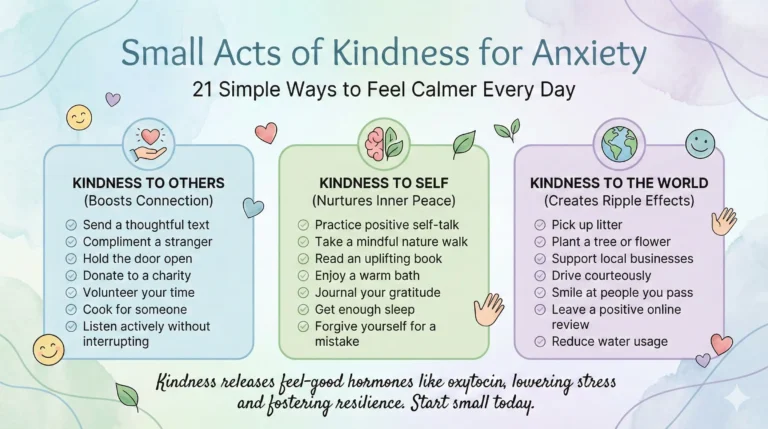
Related: 21 Small Acts of Kindness for Anxiety | Why You Should Email Your Future Self | 11 Global Kindness Traditions
How to Be Kinder to Yourself and Others: A Practical Framework
If you want a simple framework for how to be kinder to yourself and others, think of it in three directions:
| Direction | What It Looks Like | Example Habit |
| Outward kindness | Acts directed toward others | One daily kind message or gesture |
| Inward kindness | Compassion toward yourself | Replacing self-criticism with self-coaching |
| Environmental kindness | Creating spaces that support goodness | Decluttering, calm surroundings, removing friction |
All three directions reinforce each other. When you’re kind to your environment, you’re less stressed. When you’re less stressed, you’re kinder to yourself. When you’re kinder to yourself, you have more genuine warmth to offer others.
Overcoming the Obstacles Most People Don’t Talk About
“I don’t have time for new habits.”
The habits above require between 30 seconds and five minutes. Time is almost never the real barrier — friction is. Remove friction by making the habit smaller, not by finding more time.
“I try, but I forget.”
Design your environment to remember for you. Phone reminders, sticky notes, objects placed in your path — these aren’t cheating. They’re smart engineering.
“It feels awkward or forced.”
Every new behavior feels unnatural at first. Awkwardness is not evidence that something is wrong — it’s evidence that something is new. Stay with it. Authenticity comes with repetition.
“I’m kind to others, but I neglect myself.”
This is one of the most common patterns, especially among caregivers, parents, and high performers. Sustainable outward kindness requires inward kindness as its foundation. You cannot draw indefinitely from an empty well.
FAQs
How long does it take for simple habits to change your life?
Most people notice a mood and energy shift within 7–14 days of consistent small habits. Behavioral science suggests that a habit takes 18–66 days to become automatic, depending on its complexity.
Can kindness really improve my mental health?
Yes. Consistent acts of kindness increase serotonin and dopamine levels, reduce stress responses, and build a sense of purpose — all of which are directly linked to mental wellbeing.
What is the easiest kindness habit to start with?
Send one genuine, unprompted message per day to someone you appreciate. It takes under a minute and creates immediate positive ripple effects for both parties.
Is self-kindness selfish?
No. Self-kindness is the foundation of sustainable generosity. People who practice regular self-compassion are consistently more patient, more empathetic, and more resilient than those who don’t.
How do I stay consistent with habits when life gets overwhelming?
Shrink the habit to its smallest possible version. If your full habit is a five-minute gratitude journal, your emergency version is one sentence. Consistency matters far more than completeness.
Your Next Step Starts Right Now
You now have a complete roadmap — the keyword research, the framework, the habits, and the science. But none of it matters until you take one step.
Choose one habit from this guide. The smallest one that genuinely appeals to you. Do it today. Not perfectly — just sincerely.
How kindness and simple habits can change your life is not a theory. It is a daily practice available to anyone willing to begin with something small and stay with it long enough to feel the difference. The life you’re looking for is not waiting for a perfect moment. It is being built, right now, in the ordinary choices you make between one moment and the next.
If you want to explore more about how kindness and simple habits can change your life, visit our guides on small acts of kindness and mental health support.
Start there.