The Support and Kindness Podcast – Episode 1
When Your Mind Goes Blank
Finding Calm and Context in the Moment
Content advisory
The Support and Kindness Podcast – Episode 1 discusses anxiety, memory lapses, and lived experience with brain injury, seizures, and depression.
This episode shares personal reflections and is not a substitute for professional advice.
Episode Overview
In Episode 1 of The Support and Kindness Podcast, hosts Greg and Rich explore a deeply human experience: the moment your mind suddenly goes blank.
Drawing from their lived experience with brain injury, anxiety, seizures, and depression, they share gentle, practical ideas for regaining orientation, easing anxiety, and treating yourself with kindness when your thoughts temporarily disappear.
In This Episode, You’ll Explore
- Why minds go blank — and why this is more common than we think
- Simple ways to reorient when confusion hits
- How breath and sensory grounding can calm anxiety
- Why self‑compassion matters more than self‑criticism in these moments
A Shared Human Experience
Greg and Rich begin by normalizing something many people fear: sudden mental pauses where their thoughts seem to stop.
For people living with brain injury, anxiety, or depression, these moments can feel alarming — like a sign something is wrong. But as Rich reminds us:
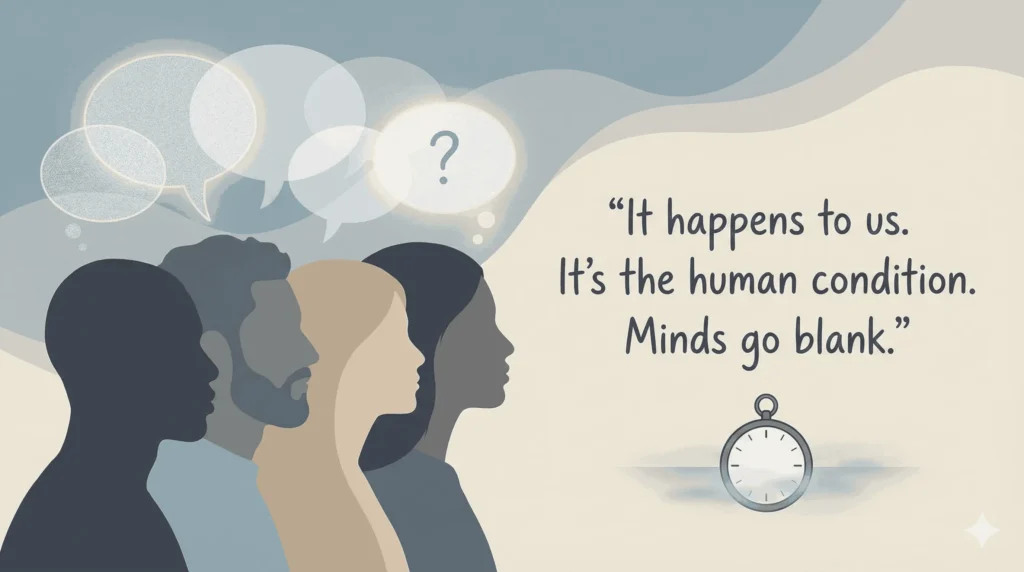
“It happens to us. It’s the human condition. Minds go blank.”
Research supports this. Short‑term memory lapses can come from stress, fatigue, overload, or distraction, and are not automatically signs of cognitive decline. These pauses often reflect the brain trying to reset under pressure.
- American Psychological Association — Self‑Compassion
https://www.psychiatry.org/news-room/apa-blogs/practicing-self-compassion
Simple Questions to Find Your Way Back
When panic hits, it often makes the blank feeling worse. Greg and Rich suggest starting small.
Ask gentle orienting questions:
- What’s going on?
- Where am I?
- What was I doing?
These questions help your brain reconnect with context — a common approach used in mindfulness and cognitive behavioral strategies.
Greg shares a practical tip:
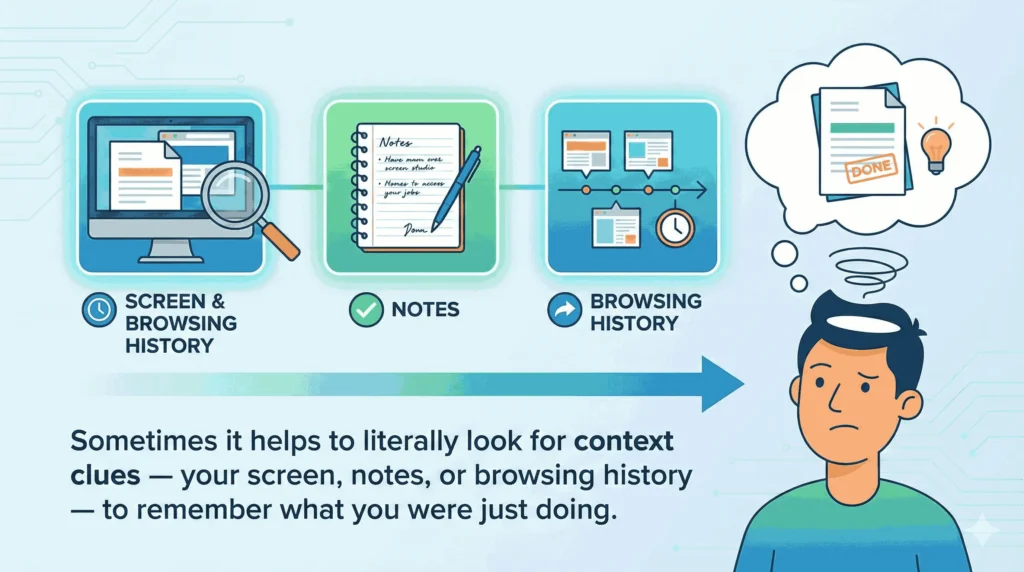
Sometimes it helps to literally look for context clues — your screen, notes, or browsing history — to remember what you were just doing.
This isn’t about forcing recall. It’s about rebuilding orientation without judgment.
Reorient Using “Context Clues”
Try this gentle reset (30–60 seconds, if it feels safe):
- Pause and look around.
- Name what you’re doing right now.
- Check one clue: your notes, screen, or last paragraph.
- Ask one question: “What was I doing just before this?”
- Resume slowly — or take a short break.
No shame. Just information.
Why Anxiety Makes Blank Moments Feel Worse
Greg explains that anxiety often causes the body to tighten:
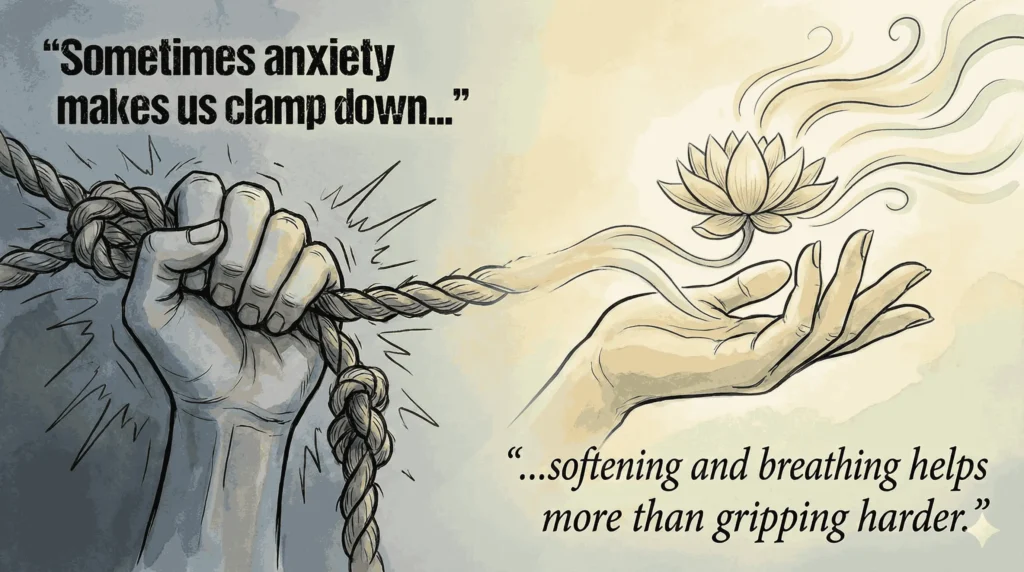
“Sometimes anxiety makes us clamp down… softening and breathing helps more than gripping harder.”
Stress activates fight‑or‑flight responses — faster heart rate, shallow breathing, muscle tension — which can interfere with working memory and focus.
Helpful overviews:
- NIH MedlinePlus — Anxiety and the fight‑or‑flight response
https://magazine.medlineplus.gov/article/anxiety-what-you-need-to-know - NCCIH (NIH) — Stress response and the relaxation response
https://www.nccih.nih.gov/health/stress
Research has shown acute stress can temporarily impair working memory:
- Luethi, Meier & Sandi (2009) — Stress and working memory (open access)
https://pmc.ncbi.nlm.nih.gov/articles/PMC2628592/
Grounding + Breath: A Gentle Reset
Greg shares a calming practice he uses: slow breathing combined with imagining a safe place, then engaging the senses.
Steps:
- Breathe in slowly through your nose
- Hold briefly
- Exhale longer and softer
Then gently imagine:
- What do you feel (warmth, breeze)?
- What do you hear (waves, leaves)?
- What do you smell (salt air, pine)?
- What do you taste (even imagined)?
- What do you see (sky, light, water)?
This is not about perfect focus — just bringing awareness back into your body.
Evidence and simple guides:
- Stanford Medicine — How controlled breathing reduces anxiety
https://med.stanford.edu/news/insights/2023/02/cyclic-sighing-can-help-breathe-away-anxiety.html - Balban et al. (2023) — Breathing practices and mood/anxiety (open access RCT)
https://pmc.ncbi.nlm.nih.gov/articles/PMC9873947/ - NHS 5‑4‑3‑2‑1 Grounding Activity
https://www.lpft.nhs.uk/young-people/lincolnshire/about-us/whats-new/grounding-activity
“Don’t Judge Yourself Harshly”
One of the episode’s most important messages is about shame.
Rich reminds us:
“To judge oneself harshly for it… we should be careful.”
Self‑compassion isn’t weakness — it’s a stabilizing skill.
Blank moment → reorient → breathe → speak kindly to yourself.
Avoid adding a second injury through self‑criticism.
Helpful perspective:
- American Psychiatric Association — Practicing self‑compassion
https://www.psychiatry.org/news-room/apa-blogs/practicing-self-compassion
Permission Helps
Rich offers two powerful permissions:
- It’s okay to say:
“My mind went blank — can you catch me up?” - It’s also okay to briefly step away — get water, take a breath, reset.
This isn’t avoidance. It can be self‑respect.
Key Takeaways
- Blank moments are common — especially with anxiety or brain injury — and don’t mean you’re broken.
- Start with orientation: where am I, what was I doing?
- Use context clues without judgment.
- Anxiety tightens the body; softening and slowing down can help more.
- Breath and sensory grounding support nervous system regulation.
- Self‑compassion reduces shame and helps recovery.
- Asking for refreshers or taking short breaks is allowed.
Weekly Kindness Challenge
Pick one or two — keep it simple.
- Micro‑kindness (under 2 min): Text someone: “Thinking of you today.”
- Micro‑kindness: Say “thank you” with intention to someone you interact with.
- Self‑kindness: Unclench your jaw, drop your shoulders, take one slow exhale.
- Self‑kindness: Take a 5‑minute pause without explaining.
- Community: Ask someone, “Do you want advice — or just listening?”
- Connection: Say one honest sentence if you blank: “Can you repeat the last part?”
- Preparation: Create one small context cue (sticky note, single open tab).
- Reflection: Journal for 5 minutes:
“When my mind goes blank, what story do I tell myself — and what kinder story could I practice?” - Future‑you kindness: Place one helpful item where you’ll need it later.
Even if your mind goes blank today, you’re still you — and you still deserve kindness.
If something here helped, consider sharing it. Someone else might need that reminder.
Episode & Resources
- Listen to Episode 1 — What Do You Do When Your Mind Goes Blank?
https://podopshost.com/68bb1f4767d04/48431 - KindnessRX — Community & resources
https://kindnessrx.org/ - CDC — Effects of Traumatic Brain Injury
https://www.cdc.gov/traumatic-brain-injury/about/potential-effects.html - Mind Blanking Research (Kawagoe et al., 2019)
https://pmc.ncbi.nlm.nih.gov/articles/PMC6865483/
Join Our Weekly Virtual Support Groups (KindnessRX)
We host free online support groups every week. Each group provides a safe, confidential space to connect with people who understand similar challenges and to share practical, emotional, and peer support.
Mondays — 2:00 PM EST
Brain Injury Support Group — Understanding Life After Brain Injury
Living with a brain injury can affect memory, mood, physical ability, and relationships. Whether you are newly diagnosed or have been managing for years, recovery is often long and complex. This group offers a supportive online community where members share experiences, offer practical tips, and support one another through life after brain injury.
Tuesdays — 12:00 PM EST
Chronic Pain Support Group — The Silent Struggle of Living with Chronic Pain
Chronic pain is ongoing and often invisible, affecting both physical and emotional well-being. This group focuses on connection, understanding, and shared coping strategies to help reduce isolation and support daily life.
Wednesdays — 7:30 PM EST
Mental Health Support Group — Understanding the Need for Mental Health Support
This group provides a welcoming and respectful space to discuss depression, anxiety, and overall emotional wellness. Through open conversation and peer support, participants work toward reducing stigma and finding practical ways to cope and connect.
Sign Up Here (Luma Calendar):
https://luma.com/calendar/cal-oyT0VPlVTKCPxBw
Listen to The Podcast
https://podopshost.com/68bb1f4767d04/48431